


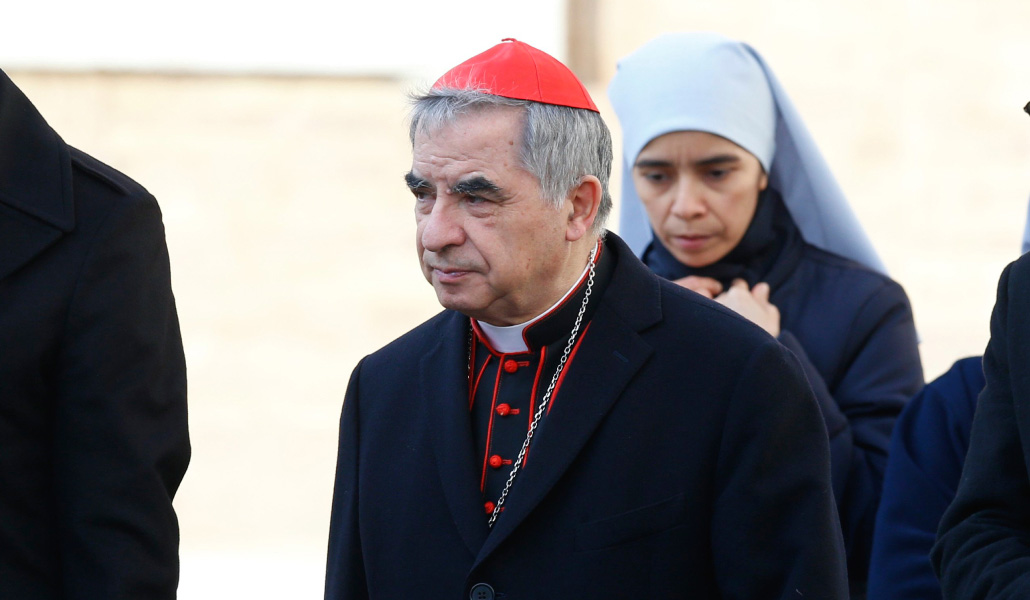
The lawyers of Cardinal Giovanni Angelo Becciu have denounced a “serious breach” by the Promoter of Justice of the Vatican for not fully delivering the documentation of the London property case, despite the express order of the Court of Appeal on March 17, in a statement sent directly to the French media Tribune Chrétienne.
Read also. The Becciu case collapses: the Vatican annuls the trial and forces to start from scratch
The defense argues that the prosecution has omitted documents alleging their supposed irrelevance, which would constitute a direct violation of the right to defense and the principle of equality between the parties. According to lawyers Fabio Viglione and Maria Concetta Marzo, “nothing can be examined by the judge that has not been previously made available to the parties,” so any filtering of evidence compromises the validity of the process.
The complaint comes after the Court of Appeal of the State of the Vatican City decreed the total nullity of the trial and ordered its repetition from the beginning. The decision, adopted on March 17, annulled all proceedings, including the convictions handed down in December 2023 —among them that of Becciu himself for embezzlement—, after detecting structural flaws in the procedure, especially in access to evidence and the formation of the file.
A process questioned from its origin
The London building case, centered on the acquisition of the property at 60 Sloane Avenue by the Secretariat of State, is one of the biggest financial scandals of the Vatican in recent years. The operation, which generated million-dollar losses, highlighted opaque financial circuits and serious deficiencies in the management of funds.
From the beginning of the process in 2021, the defenses denounced irregularities, including the use of exceptional norms during the investigation and the application of pontifical rescripts —unpublished decrees— that modified procedural rules in the midst of the trial’s development.
Risk of a new nullity
Becciu’s lawyers now warn that the situation could have serious legal consequences. In their view, the incomplete delivery of the documentation not only fails to comply with the Court of Appeal’s order but also reproduces the same defects that already led to the annulment of the process.
In this context, they do not rule out a new nullity, even of the indictment, if it is confirmed that the prosecution has unilaterally decided which evidence to make available to the defense.
Although Leo XIV has not intervened in the process, the repetition of the trial places him before a case inherited from Francis that tests the solidity of the Vatican judicial system. Beyond the facts investigated, what is at stake is the institution’s capacity to guarantee a truly fair process and in accordance with the basic guarantees of law.