


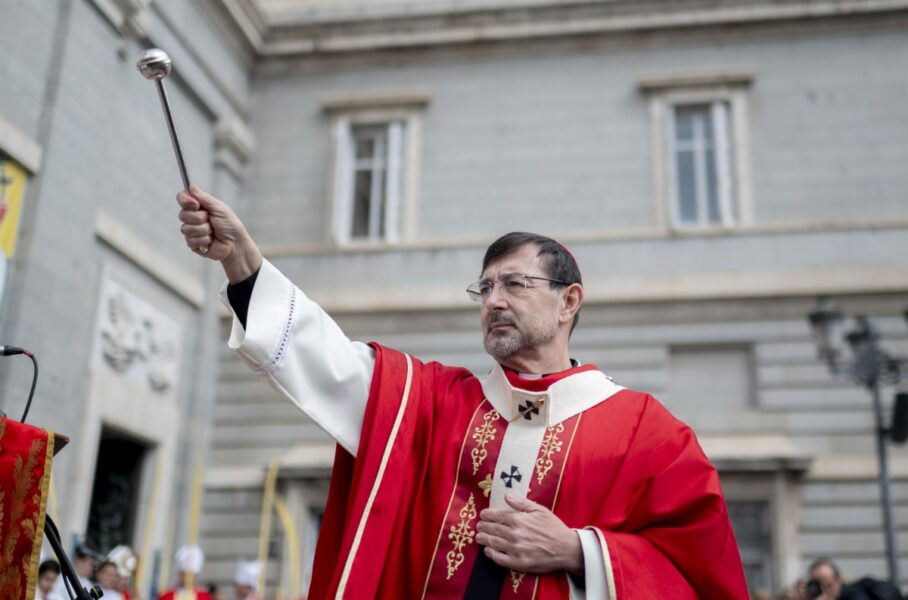
With the statements of Mons. Francisco César García Magán —general secretary of the Spanish Episcopal Conference— from last Thursday, it was already clear that the agreement for the «re-signification» of the Valley was signed only by the cardinal archbishop of Madrid, José Cobo. We already knew the content of the agreement. But the full dissemination of the correspondence between both parties adds a decisive element: it not only confirms the existence of the pact, but also details its gestation and evidences the exact sequence of events.
The documents, dated March 4 and 5, 2025, published by El Debate, not only confirm the existence of the agreement, but also detail its terms and evidence the exact sequence of events.
The Government Defines the Framework for Intervention
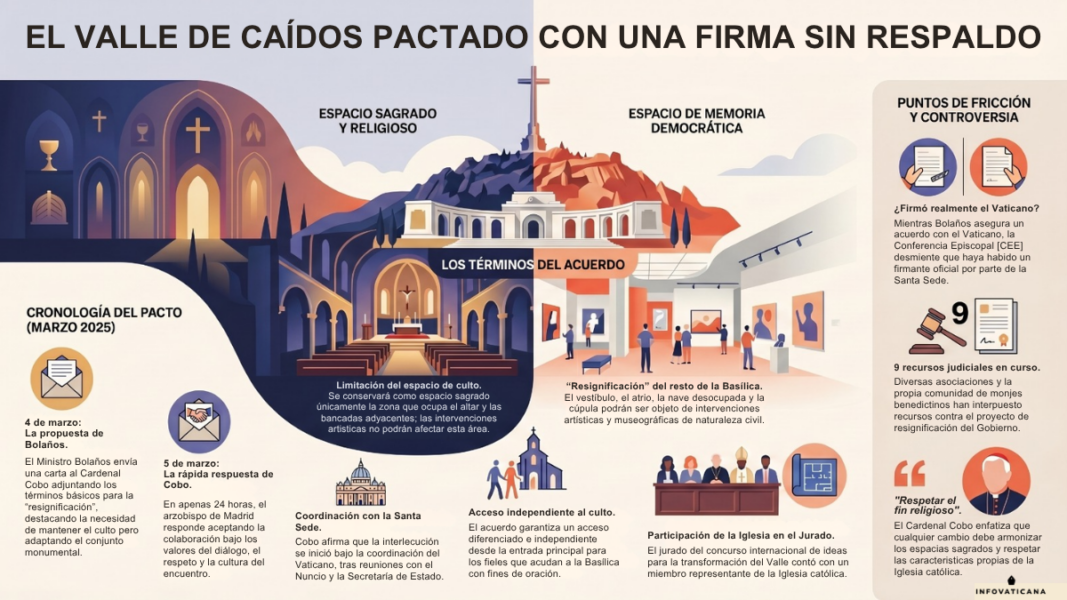
The process begins with the letter that Félix Bolaños sends to Cardinal Cobo on March 4. In it, the minister presents the re-signification of the Valley as a shared objective with the Church and already sets the fundamental lines of the agreement.
Bolaños states that both parties have agreed on “the need […] to maintain worship in the Basilica Altar and a differentiated access,” thus introducing the idea of physically delimiting the liturgical space within the complex.
The attached document, also revealed by El Debate, further specifies that approach by stating that “inside the Basilica, the area occupied by the Altar and the adjacent pews will be preserved as a space dedicated to worship.” It then establishes that “the rest of the spaces inside the Basilica […] are not intended for worship and may be subject to artistic and museographic interventions.”
Cobo Accepts the Government’s Approach
Cardinal José Cobo’s response arrives just twenty-four hours later. According to the published documentation, the archbishop of Madrid does not introduce any substantive reservations, but rather assumes the proposed framework and shows willingness to collaborate.
In his letter, Cobo assures: “Count on our collaboration and our desire to contribute to this process with the values of dialogue, respect, the culture of encounter, coexistence, and peace.” This is not an ambiguous response, but an explicit acceptance of the ongoing process.
Furthermore, the cardinal acknowledges that the religious elements of the Valley will be integrated within that same framework by stating that “we have understood that the presence of religious elements in the Valley can be incorporated into this process.” The interlocution is thus fully assumed.
The Reference to the Holy See: A Backing That Does Not Appear
In the same text, Cobo introduces a statement that is key to understanding the subsequent controversy. The archbishop maintains that the entire process has been developed “under the coordination of the Holy See.”
However, this point clashes with what has been known afterward. The Spanish Episcopal Conference has been clear in stating that the Vatican has not been a signatory to the agreement. That is, the reference to Rome does not translate into any legal or institutional endorsement.
The distance between both statements generates a contradiction that is difficult to sustain: a coordination is invoked that has no reflection in the signature or in formal backing.
A Responsibility That Is No Longer Diffuse
With the evidence on the table, the focus shifts to the concrete action of the one who assumed the interlocution.
The letters show that Cardinal José Cobo accepted the framework for re-signification and did so without explicit backing from the Holy See. Reviewing the facts, the conclusion imposes itself: the signature is there, the agreement too, but the invoked endorsement does not appear. And in the absence of that backing, the position of the one who signed is inevitably exposed.