


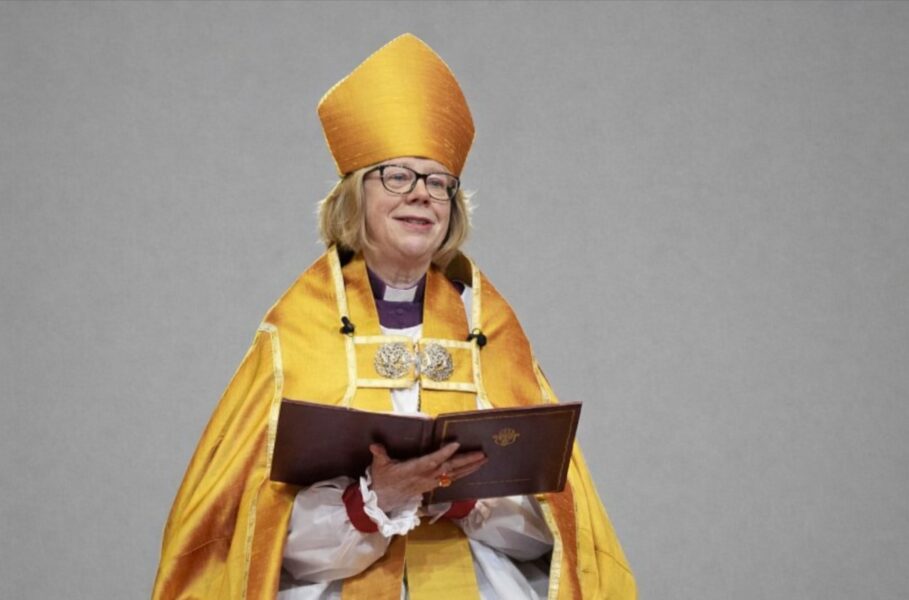
The images arriving from Rome this week do not seem normal. They are a visual shock. A woman whom the Catholic Church does not recognize as a priest or as a bishop—because doctrinally it cannot recognize her as such—appears in St. Peter’s dressed in a violet cassock, pectoral cross, episcopal ring, and all the outward signs of apostolic sacred authority. She is received with honors. She blesses Catholic bishops in the Clementine Chapel. She is accorded the treatment due to a primate. She poses in Renaissance courtyards that for centuries saw legitimate successors of the Apostles pass by. And tomorrow Monday, in an audience with Pope Leo XIV, the scene will reach its iconographic climax: two figures dressed in similar fashion, seated at the same level, conversing as equals.
It is worth pausing on that visual anomaly before proceeding, because it is the real issue.
We are not faced with a mere protocol anecdote. We are faced with a scene of the banalization of the sacred. And the damage this scene causes is not political, nor media-related, nor even strictly ecumenical: it is sacramental and catechetical. When sacred signs are used as if they were equivalent even though they are not, the capacity of the faithful people to distinguish is gradually destroyed. The cassock, the pectoral cross, the blessing imparted to the assembly, the episcopal treatment, the solemn reception, the photographs that tomorrow will open the news around half the world: everything communicates one thing simultaneously, even though canonical documents say otherwise. And what it communicates is devastating. It communicates that it makes no difference to be a valid bishop or not to be one. That it makes no difference to uphold Catholic doctrine or to deny it in its essentials. That it makes no difference to bless in accordance with the faith that the Church has professed since the Apostles or to turn the blessing into an empty gesture devoid of theological content, equivalent to a cordial greeting between civil dignitaries.
This article proposes, in its first part, to present who the bishop is who is being received with such honors—her biography, her positions, her own words. And in its second part, to examine what this week’s photograph means for the custody of the sacred in the Church.
Who is Sarah Mullally
Sarah Elizabeth Bowser was born in Woking, Surrey, in March 1962. The youngest of four siblings. She studied at Winston Churchill Comprehensive School and at Woking Sixth Form College. She chose nursing over medicine, considering, as she herself has recounted, that the former allowed for a more holistic care of the patient. She trained as a nurse at South Bank Polytechnic, completed theological studies at Heythrop College, specialized as an oncology nurse at the Royal Marsden Hospital, and rose to become Director of Nursing at Chelsea and Westminster Hospital. In 1999, at 37 years old, she was appointed Chief Nursing Officer of England, the highest position in British public nursing: a six-figure salary, an office in Whitehall, regular meetings with Prime Minister Tony Blair, and the effective rank of a senior state official.
At the peak of her administrative career, in 2001, she was «ordained» to the Anglican diaconate and presbyterate as a self-supporting minister—that is, without initially abandoning her government post. In 2004 she left the NHS to dedicate herself full-time to the «priestly ministry,» a decision she herself described at the time as «the biggest I have ever made in my life.» In 2012 she was installed as Canon Treasurer of Salisbury Cathedral. In 2015, consecrated Suffragan Bishop of Crediton, in the Diocese of Exeter, becoming the fourth woman made bishop in the Church of England since the episcopate was opened to women in 2014. In 2018, installed as the 133rd Bishop of London, the first woman in the see that is third in hierarchy within English Anglicanism. In 2019, Dean of the Chapels Royal. In 2026, elected 106th Archbishop of Canterbury and enthroned on March 25 in her cathedral, with the responsibility of presiding, as primus inter pares, over an Anglican Communion of approximately 85 million faithful spread across 42 autonomous provinces.
The Financial Times has characterized her as «theologically liberal.» She herself defines herself, in so many words, as a feminist. Both facts are descriptively accurate and it is worth taking them seriously: they summarize better than any gloss the theological substance of her ministry.
The priesthood that the Catholic Church does not recognize
The Catholic doctrine on the impossibility of ordaining women to the priesthood was definitively formulated by St. John Paul II in the Apostolic Letter Ordinatio Sacerdotalis of May 22, 1994:
«I declare that the Church has no authority whatsoever to confer priestly ordination on women, and that this judgment is to be definitively held by all the faithful of the Church.»
The Congregation for the Doctrine of the Faith, in its Responsum ad Dubium of October 28, 1995, signed by then-Cardinal Joseph Ratzinger, specified that this doctrine requires the definitive assent of the faithful because it belongs to the deposit of faith taught infallibly by the ordinary and universal magisterium. The reasons, according to the text of John Paul II, are three: the example of Christ in choosing twelve men as apostles—a decision that cannot be explained by cultural conditioning, given that Jesus distanced himself from so many customs of his time regarding women—the constant practice of the Church that has faithfully imitated this choice, and the living magisterium that has always maintained such a reservation as belonging to the divine plan. The Church, the document emphasizes, does not affirm that it does not want to ordain women: it affirms that it cannot.
Mullally was ordained to the diaconate and presbyterate in 2001, consecrated bishop in 2015 in Canterbury Cathedral itself, and enthroned as Archbishop of Canterbury in March 2026. Each of those acts, read from Catholic doctrine, did not produce the sacramental effect it purports to produce: the outward signs were performed, but the required ministerial matter was not present. This is not a controversial theological opinion nor a conservative position within Catholicism: it is the definitive teaching of the Church, and it has been so long before Mullally’s appointment.
The blessings of homosexual unions
Mullally did not limit herself to supporting the liturgical opening of Anglicanism to same-sex unions: she directed it. From 2020 to 2023 she chaired the so-called Next Steps Group, the episcopal committee of the Living in Love and Faith (LLF) process that culminated in the approval, on February 9, 2023, of the Prayers of Love and Faith. These are liturgical prayers that Anglican parishes may use, at the discretion of the parish priest, to bless same-sex couples who have entered into civil marriage or registered partnership. They include prayers of thanksgiving, dedication, and God’s blessing on the couple as such.
Her speech before the General Synod on February 6, 2023, presenting the motion, contains the clearest articulation of her theological hermeneutic. It is worth transcribing it:
«This has sometimes been characterized as a disagreement between those who take Scripture seriously and those who are swept along by the whims of culture. The resources of Living in Love and Faith illustrate that this is not the case at all. People have read Scripture seriously and find a difference of meaning.»
This is the key hermeneutic thesis. Scripture, read with the same seriousness by all, would admit opposing readings on the morality of homosexual relationships, and therefore ecclesial unity can be built on that interpretive difference without the need to resolve it doctrinally. The pastoral letter with which Mullally presented the new prayers formulates it with even greater clarity:
«We express our joyful affirmation and celebration of LGBTQI people in our church communities. (…) For the first time, churches within the Church of England will be able to do this: it is really a first time.»
And along with the rest of the Anglican episcopate, in the same process, she signed a public letter of apology whose tone deserves to be fixed with exactness:
«We apologize together for the rejection, exclusion, and hostility that LGBTQI+ people have experienced within the Church. Our eyes have been opened to the harm we have done, especially to LGBTI+ people. We realize that this behavior has not reflected God’s universal love for all people.»
The Catholic doctrine on marriage and homosexual acts is formulated in the Catechism with crystal-clear clarity:
«Basing itself on Sacred Scripture, which presents them as grave depravations, Tradition has always declared that ‘homosexual acts are intrinsically disordered.’ They are contrary to the natural law. (…) Under no circumstances can they be approved.» (CCC 2357)
It is true that the infamous Declaration Fiducia Supplicans of the Dicastery for the Doctrine of the Faith (December 2023) admitted the possibility of non-ritual, spontaneous, brief pastoral blessings, not equivalent to a liturgical rite, in which the minister may invoke the good of the persons who approach, without that blessing sanctioning the moral situation of their union and without any risk of confusion with matrimonial blessing. But it must be qualified at least that the Catholic Church resisted and that Cardinal Víctor Manuel Fernández, in the Press Note of January 4, 2024, insisted: «they are not blessings of the bond, they are not blessings of the union.» The Anglican Prayers of Love and Faith are exactly what that Note excludes: liturgically formalized prayers, approved by ecclesial authority, offered over the couple as such and celebratory of the bond. Mullally’s letter says it in so many words: «joyful affirmation and celebration» of the couple.
Abortion: «more pro-choice than pro-life»
On March 18, 2026, a week before her enthronement, the House of Lords debated an amendment to the British government’s Crime and Policing Bill that sought to completely decriminalize abortion in England and Wales at any stage of pregnancy—that is, to eliminate even the current restrictions that allow interrupting the pregnancy up to week 24, thereby de facto authorizing abortion up to the moment of birth. Mullally had announced a six-day walking pilgrimage from St. Paul’s Cathedral in London to Canterbury Cathedral, following the so-called Becket Way, as spiritual preparation for her ministry. The dates coincided exactly with the vote. Public pressure forced her to interrupt the pilgrimage to attend the chamber, where she did not support the infanticidal amendment. But what is decisive is not that technical vote, but her attempt at evasion and two prior elements that are worth fixing with her own words.
In previous interviews, Mullally had defined herself as «more pro-choice than pro-life.»
And in her intervention on March 19, 2026, in the House of Lords, she declared:
«I do not believe that women who act in relation to their own pregnancies should be criminally prosecuted. (…) I support the Church of England’s principled opposition to abortion, which comes accompanied by the recognition that there may exist strictly limited conditions under which abortion may be preferable to any other available alternative.»
The Catholic doctrine on procured abortion admits no gradation. The Catechism formulates it with extreme precision:
«From its earliest days, the Church has affirmed the moral evil of every procured abortion. This teaching has not changed; it remains unchangeable. Direct abortion, that is to say, abortion willed either as an end or a means, is gravely contrary to the moral law.» (CCC 2271)
«Formal cooperation in an abortion constitutes a grave offense. The Church attaches the canonical penalty of excommunication to this crime against human life.» (CCC 2272)
St. John Paul II, in Evangelium Vitae (1995), declared with magisterial authority: «direct abortion (…) always constitutes a grave moral disorder.» The distance between admitting abortion as «preferable» in limited conditions and rejecting its criminal prosecution, on the one hand, and declaring it «always a grave moral disorder» that the Church sanctions with excommunication, on the other, is not a distance of nuance. It is the distance between two incompatible anthropologies.
Gender pastoral care
In February 2022, from the Diocese of London, Mullally promoted the creation of an Advisory Group on «pastoral care and inclusion of LGBT+ people in the life of our church communities» and institutionally backed the observance of LGBT+ History Month. The Living in Love and Faith process included from its origin, along with sexuality, gender identity as an explicit object of discernment. The resulting pastoral care adopts the language of identity affirmation: people are who they themselves say they are, and the Church must accompany that self-definition with care and recognition.
The Declaration Dignitas Infinita of the Dicastery for the Doctrine of the Faith (April 2024), approved by Pope Francis, articulated with force the Catholic doctrine on this issue:
«Gender theory is dangerous because it aims to eliminate differences in its claim to make everyone equal. These differences, in fact, are the most beautiful visible signs of the ineffable creativity of the Father.» (DI 56)
«All attempts to obscure the reference to the ineliminable sexual difference between man and woman must be denounced as contrary to human dignity.» (DI 58)
The testimony of the global South
The most serious opposition to Mullally’s appointment does not come from Catholicism nor from English conservative circles, but from within the Anglican Communion itself, and specifically from its global South. The Global South Fellowship of Anglican Churches—which brings together more than ten provinces with approximately 35 million faithful, mostly African—qualified her election as a «missed opportunity to unite and reform» the Church. Archbishop Justin Badi Arama, primate of South Sudan and current president of the GSFA, expressly declared that he does not recognize her as a spiritual leader.
These global South churches do not speak from Western cultural conservatism. They speak from a reading of Scripture and Tradition that coincides in the essentials with Catholic doctrine on marriage, priesthood, sexuality, and life. Their bishops uphold marriage as the union of man and woman, reject the blessing of homosexual unions, defend the inviolability of life from conception, and maintain an anthropology founded on created sexual difference. For all these reasons they have not come to Rome this week. And for all these reasons it would be with them—not with the one who today poses in St. Peter’s—that Christian ecumenism would have any real theological sense.
The photograph and the banalization of the sacred
So far the profile of the person and her positions. Now the real issue.
What the image communicates
Turn your eyes to the photographs that these days millions of faithful without the formation and discernment that our Infovaticana readers have will see. A woman crosses the courtyard of St. Damasus in the Vatican dressed in the violet cassock, sash, Roman collar, pectoral cross, and episcopal ring. Cardinals greet her, open doors for her, lead her to the pope’s office. She will pose next to Leo XIV. She will receive the honors due to a primate. She will bless some and others, according to the custom of bishops. The image will cover front pages, open TV news broadcasts, be printed in ecumenical history manuals. And the image will say, without words but with extreme eloquence, the following: before this person and before the successor of Peter, the sacramental signs are interchangeable.
That visual equivalence is false. And it is so in a way that matters, because sacred signs are not protocol ornaments. They are what St. Augustine called verba visibilia, visible words: they communicate a theological reality. The cope, the mitre, the pectoral cross, the episcopal ring, the crozier, the liturgical vestments, the gesture of blessing, the treatment as successor of the Apostles: all these signs mean something in the Christian sacramental language. They mean that the one who bears them has received by the laying on of hands in uninterrupted apostolic succession the power of orders, the sacramental character that configures him ontologically with Christ the Head to act in persona Christi in the sacraments. That power is, in Catholic faith, the only reason why the bishop dresses as he does and blesses as he does. When the sign is separated from its content, it does not remain neutral: it becomes active in the opposite sense. It communicates that the content never really mattered.
How the Church is destroyed without open persecution
The damage is not only that Sarah Mullally is in St. Peter’s this week. The damage is that she seems to occupy a sacramental place that she does not doctrinally have, and that it is allowed—even favored—for the sign to function against the truth that the sign should custody. In that the aesthetics of communion covers the doctrinal fracture until it becomes invisible to the untrained eye, which is the vast majority of the faithful people. In that the sacred ceases to be custodied and passes to being administered as diplomatic scenery.
It is a subtle, highly effective, and almost undetectable form of erosion of the faith. The Church has resisted throughout history open persecutions, heresies formulated frankly, declared schisms, brutal attempts at physical annihilation. Those threats, as terrible as they were, were recognizable. The faithful knew what to resist, knew whom not to obey, knew what to believe and what to reject. The threat represented this week in the Vatican is of another nature: it does not deny the doctrine frontally, but wraps its contradiction in courtesy, smiles, protocol, ecumenical language, and edifying photographs. And it does so in the place that amplifies it the most, the visible heart of the Catholic Church, before lenses that will broadcast the images to the whole world.
The catechetical result is devastating. The average faithful who this week sees the photographs will draw three simultaneous conclusions: that Catholic bishops and the Anglican primate are substantially the same; that the doctrinal differences between both churches must therefore be matters of secondary nuances or mere cultural forms; and that the positions of the Anglican primate—female priesthood, the blessing of homosexual unions, the pro-choice position on abortion, the affirmative pastoral care of gender ideology—must be doctrinally compatible with Catholic faith, since the pope receives her with honors and shares sacred signs with her. None of these three conclusions is true. The three will be adopted massively as if they were. And they will be incorporated into the religious common sense of millions of people who will no longer need any dissenting theologian to believe what the visual liturgy of the Vatican itself will have taught them.
The sign confronted with the truth
It is worth formulating it with the greatest possible clarity. Catholic doctrine holds that Sarah Mullally is not a bishop, not a priest, cannot consecrate the Eucharist, cannot validly confirm, cannot sacramentally absolve, does not bear apostolic succession, does not represent a church that is in sacramental communion with Rome. All this, simultaneously, is what Catholic doctrine affirms. And all this, simultaneously, is what the photograph of tomorrow’s encounter visually denies to the spectator.
The question that a Catholic may legitimately ask is not whether it is wrong for the pope to receive her. Diplomatic reasons to do so exist, are ancient, and are part of a legitimate way of managing inter-ecclesial relations inherited from the Second Vatican Council. The question is another: whether the outward signs with which that reception is clothed—the cassock, the pectoral cross, the reciprocal blessings, the episcopal treatment, the location in sacramentally dense places like the papal basilicas—are at the service of the truth of the faith or are functioning, in practice, against it. Whether they custody the sacred or exhibit it as mere interchangeable clothing. Whether they preach what the Church believes or contradict it before the eyes of the faithful people.
To that question, this week, one must respond with honesty. And the honest response is that the scene in St. Peter’s, for a few hours, is visually suspending the difference between the Catholic priesthood and its Anglican imitation. When that difference is suspended before the eyes of all, the doctrine is not left intact: it is contradicted in practice. And a practical contradiction, repeated in images for years, ends up weighing more than any document from the Dicastery for the Doctrine of the Faith drafted and published on a web page that almost no one reads.
The true ecumenism
There exists an authentic Christian ecumenism, desired by Christ in his priestly prayer—»That they may all be one»—and mandated by the Second Vatican Council in Unitatis Redintegratio. But that ecumenism does not consist in visual equivalence nor in protocol courtesy that dissolves the differences under institutional smiles. It consists in the patient, demanding, doctrinally honest path toward the shared truth about God, about Christ, about the Church, about the sacraments, about man created male and female, about human life, about marriage, about the sacramental ministry that Christ instituted.
That path is not traveled by dressing equally those who believe opposite things. It is traveled by naming the differences with clarity, bearing the painful weight that such clarity entails, and working together—in truth, not in choreography—to reduce them. The other path, that of edifying photographs and interchangeable signs, does not bring closer: it distances, because it accustoms the Christian eye to not distinguish, and a Christianity that does not distinguish is no longer Christianity, it is a decorative religious vagueness.
Magisterium cited: Catechism of the Catholic Church (CCC 2271, 2272, 2357); John Paul II, Apostolic Letter Ordinatio Sacerdotalis (1994); John Paul II, Encyclical Evangelium Vitae (1995); Congregation for the Doctrine of the Faith, Responsum ad Dubium (1995); Dicastery for the Doctrine of the Faith, Declaration Fiducia Supplicans (2023) and Press Note of January 4, 2024; Dicastery for the Doctrine of the Faith, Declaration Dignitas Infinita (2024); Second Vatican Council, Decree Unitatis Redintegratio (1964).