


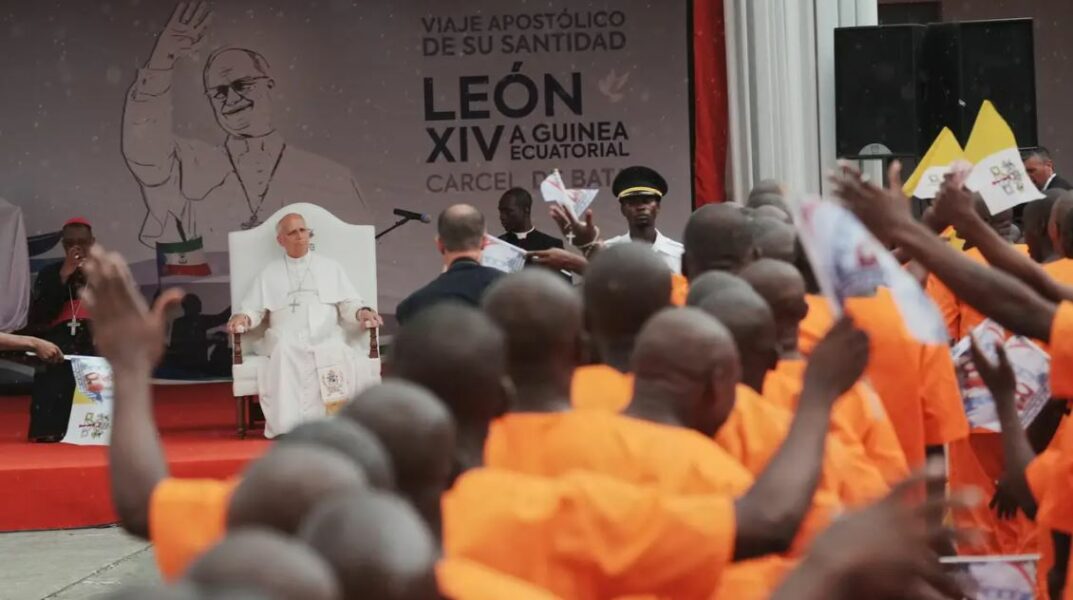
While the city where I live is international news for a local festival—the April Fair—, as artificial and ephemeral as it is devoid of theological and cardinal virtues, the Vicar of Christ has gone to Africa to proclaim the Good News of Jesus. And he has concluded his trip in the only Spanish-speaking country on the continent, a former Spanish colony, Equatorial Guinea, ruled for decades by a dictator with an iron fist; more specifically, his last visit has been to a prison in that nation. But what has been striking is that many of its inmates—my brothers in the Catholic faith (and, of course, more brothers than so many neopagans with whom I live and cross paths day by day in my Marian city)—have celebrated his arrival with a song and a dance that has touched the heart of Leo XIV. But also—and how—mine.
In the courtyard of that prison, the prisoners performed a performance whose lyrics went like this:
«Our Holy Father, we thank you, pray for our sins and our freedom; we repent for everything that has happened in our lives; many of us have been deceived by the devil and others by bad influences. But we have the hope of regaining our freedom. We are believers, we will never be forgotten according to the law, according to the will of God. Our Holy Father, we thank you, pray for our sins and our freedom».
They spoke of sin, of repentance, of the devil and his deceptions, of freedom, of hope, of prayer, of thanksgiving, of God’s will over their lives… in short, of what is the very essence of Christianity, words that have ceased to be heard today in Europe and in our Western world. At the end of the dance-song, I was deeply moved, because I immediately associated that moment with one of the most sublime passages of the Gospel, narrated only by Luke (Lk. 4, 16-30): the Christian proclamation of freedom to the captives.
Let us remember that the Lord had just defeated the devil in his first assault, when this one tempted him in the desert. The father of lies expressly told him that everything in the world belonged to him. Sometimes I imagine that what was shown to the Lord on that very high mountain was a landscape similar to the Fairground of the Fair—whose boundary is significantly the so-called Hell Street—; Fairground where every excess and vice sets up its tents. If He was—as he said—the Son of God, his actions—thought the devil—should be as spectacular as those of a Jupiter; for that reason, his temptation focused on pleasure, fame, and above all, power. But, surprisingly, the divine Jesus was the antithesis of everything that the Greek poets recounted about their gods. The Beatitudes present the world upside down; in his life, He had nowhere to lay his head (Mt. 8, 20); He did not want the news of his healings to be spread (Mk. 8, 41-42), and even less that they proclaim him king (Jn. 6, 15); He spent his existence serving others (Mk. 10, 45), without pause until death, and a death on the cross, in which he canceled the certificate of debt consisting of our sins (Col. 2, 14). He left absolutely nothing for himself: everything of his he gave us forever (his Body, his Soul, his Blood, and his Divinity); he even washed, like a servant, the feet of those who would later abandon him shamefully (Jn. 13, 1-20). He preferred prostitutes, the poor, and the most despised of his society (because they believed in him), and he put them before the rich, the wise, priests, scribes, and lawyers (who rejected him) (Mt. 21, 31); He came to us, in short, to free the captives and the needy (that is, all men, without exception), and he achieved it in an amazing way: by ransoming us from the two worst slaveries that anyone can suffer (even more than a prison in Guinea): one, that of sin, and another—much worse, and much more common—the pride of supposing that we are free from it. Jesus bears and destroys our sins, but above all, he does not cease to warn us of the fatal error of believing ourselves righteous. Hence the parable of the Pharisee and the tax collector in the temple (Lk. 18, 9-14). It was the sinful tax collector—and not the righteous Pharisee—the only one justified.
After the experience of the desert, Jesus expounded in the synagogue of Nazareth—with words taken from Isaiah—his program of saving action:
«The Spirit of the Lord is upon Me;
because he has anointed me to bring good news to the poor,
he has sent me to heal the brokenhearted;
to proclaim freedom to the captives,
and sight to the blind.
To set at liberty those who are oppressed
and to proclaim the year of the Lord’s favor».
Those prisoners in Guinea truly had internalized those words, perhaps heard during childhood, in school or in church, or in some Christian movie they saw on television with their families. Time passed, their lives went astray, and very much so, but the light of Christ—his unconditional love for sinners—never went out in their hearts. For that reason, it could be reactivated again and with great intensity after the visit of the successor of Peter, of the one to whom the Lord entrusted precisely «to strengthen the brothers in the faith» (Lk. 22, 32).
Thank you, in short, dear Holy Father Leo, for doing it, for going where no one in their right mind wants to be, for fulfilling the work of charity of visiting prisoners, for strengthening faith in Jesus and bringing him to those men the true freedom that Our Lord has brought us. Just like Jesus with the good thief (Lk. 23, 43), you have given hope to those whose bad actions had led them to lose their freedom. Or as they themselves acknowledge in their song, they repent of their bad acts, instigated directly by the devil (with his temptations), or by bad company (that is, also by the devil, though indirectly). But, even so, the Lord already assured us that we can only lose freedom through sin (Jn. 8, 34), and I believe that those prisoners have assimilated that profound Christian lesson very well. In this way, the prison—with being very harsh, and more so because of the country that houses it—becomes a secondary problem for whoever has received interior peace and freedom, something that only living faith in Jesus Christ can give us. And it has been the Pope who has made it possible in this apostolic journey, which began in the homeland of a great sinner—Saint Augustine of Hippo—and concludes in this Guinean prison, a symbol—who would have thought—of irrepressible Christian hope.
May the Lord bless and protect you, dear Holy Father Leo!