


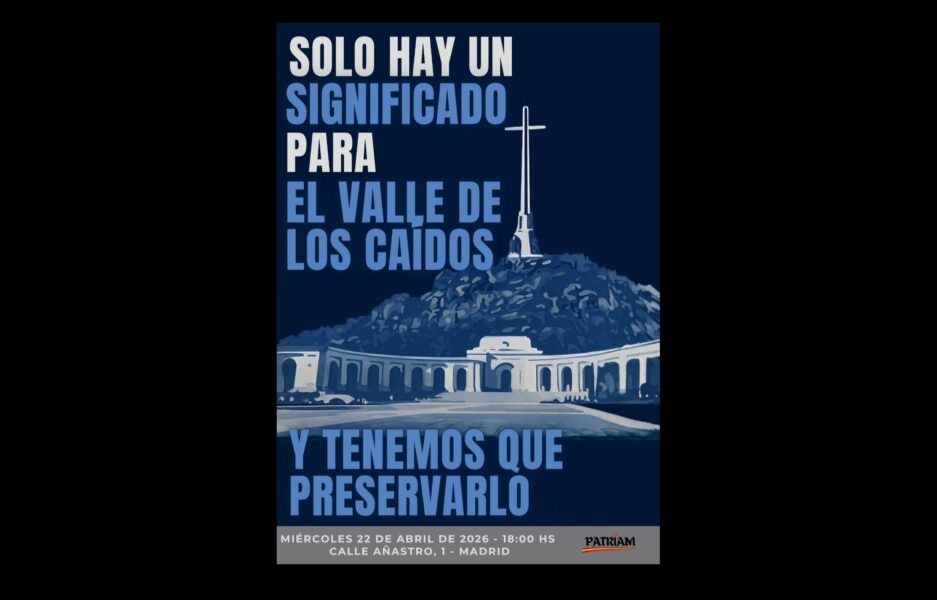
Raúl Murcia, member of the Terra Ignota team who participated in the making of the documentary about the Valle de los Caídos, shares this letter on the occasion of the demonstration called for this afternoon, at 18:00, in front of the headquarters of the Spanish Episcopal Conference, in defense of the inviolability of the Basilica and in support of the Benedictine community of the Valley
I’m not an atheist, but neither am I a believer in the usual sense. I don’t go to Mass on Sundays nor confess once a year, as tradition dictates. My relationship with religion is rather distant.
But there are things that one recognizes even if one doesn’t practice them. Because you don’t need to believe to realize that there are places that have a special meaning.
That was my first sensation upon arriving.
The Valle de los Caídos had never particularly caught my attention. A great Cross, yes, that I would see in the distance on every trip back home along the A-6. Look at it, greet it with respect, and until next time.
That day, when we finally got to grab the cameras and start filming our documentary about the Valley, the entrance didn’t impress me. I went up the path more worried about not veering off, with the fog we had woken up to. And once up there, it seemed to me like just another parade ground. Very large, yes, but just another one.
It was only when I looked up and saw the Cross, imposing, that I realized I was in one of those different places. And only after getting to know the monks did I understand its meaning.
There’s something about those places that commands respect. It’s not a matter of ideas or ideology. It’s a basic sensation: one enters and knows that it’s not just any place.
That’s why the idea that a temple could become a space where political readings or revanchist adjustments about the past are introduced clashes so much. Not because the past shouldn’t be discussed, but because there are places where it’s not appropriate to do so.
That’s why I’m so disconcerted by the agreement signed by Cardinal Cobo with Minister Bolaños.
Beyond technical explanations or who has or doesn’t have competence, what is perceived from the outside is something simpler: a decision has been made about a place that doesn’t seem entirely theirs. And it has been made without consulting those who live there, those who perfectly understand what it is, and moreover, without giving too many explanations.
If it were a museum or a public building, it would already be debatable. But a basilica is not the same. It’s not the same even for someone who hasn’t set foot in a church for years.
Not everything goes everywhere. And certainly, not everything goes inside a basilica.
This week, the president of the Episcopal Conference has invited the Government and the monks of the Valley to reach “a reasonable and satisfactory agreement for both parties” that will be “a testimony that it is possible to overcome polarization and find ways of encounter”.
Three things should be said about this. All three in the positive. And all three with forcefulness and without beating around the bush.
The first. I welcome that request, precisely because it means, de facto, that what was signed by Cardinal Cobo has no value whatsoever.
Thank you, bishops, for listening to those you should: your faithful.
Faithful who have been worried for so many months seeing how a sacred temple was going to be profaned and no one seemed to be doing anything to prevent it.
If the Episcopal Conference now asks for a new agreement, it’s because the previous one was not the way.
No need to add more. The gesture speaks for itself and it must be appreciated.
The second. That new “satisfactory” agreement between the monks and the Government will not be possible without a prior and non-negotiable condition: the inviolability of the basilica.
An agreement can negotiate many things. But there’s something that’s not on the table.
A consecrated temple is not resignified. A basilica is not subjected to political readings.
The sacred, by definition, is outside of what a negotiation between parties can touch.
If that is not guaranteed, no matter how much someone signs it and no matter how many solemn acts are organized to bless it, there will be no agreement.
And we will be there again to defend it if necessary.
The third. We ask the Episcopal Conference to speak clearly and to support the monks without reservation in their defense of the sanctity of the basilica.
We ask it with respect, but without beating around the bush. Because love for the shepherds is not shown by remaining silent; it is shown by telling them what needs to be said.
The monks cannot be left alone in this, against what they face. A Benedictine community, no matter how sturdy it is, cannot fight alone against the apparatus of the State.
And we—those who go to twelve o’clock Mass and those who don’t go as much—need to see their Church behind them, speaking clearly.
The Church is not there to get into political discussions, and I agree. But neither can it fall into excessive caution, to the point of resembling fear, silence, and then complacency too much.
It doesn’t seem that complicated.
It’s about defending their rites, their sacred places, and their faithful. With as much forcefulness as the prudence it has always had. Even more so when it has in front of it who it has.
Because let’s not fool ourselves: what’s at stake is not just the Valley.
If the sacred nature of a temple can be negotiated, a door will have been opened through which tomorrow even the very Belzebub himself could enter.
Today it’s the Valley. Tomorrow it could be the Basilica of Pilar, which precisely because she is their patroness Captain General will not lack interest in managing and resignifying it “for the sake of a supposed democratic value”, stripping it of its true reason for being: to give consolation to anyone who wants it, when passing through Zaragoza. It could be Covadonga. El Escorial. It could be Montserrat. Any temple with symbolic weight that bothers someone in some office. Or it could be legislating the centuries-old rules of any brotherhood.
What is silenced today is signed tomorrow. And what is signed tomorrow is taken as good the day after.
That’s why it matters so much, and now, that this be done right. Because what is resolved here will mark what comes after. And because time plays in favor of those who want to touch what should not be touched.
The Valle de los Caídos is one of those places where many things intersect.
There’s history. There’s religion. There’s a sacred cemetery where the fallen in a civil war that all our elders suffered rest. There’s a hundred blessed who died for love of Jesus, forgiving their executioners.
But there’s also something more that is not so easily explained: the realm of the sacred.
Reducing everything to a management or usage problem is falling very short. And, to be honest, trying to reduce it that way is not an oversight: it’s a strategy.
In a few weeks, the Pope will visit Spain.
Before that, the next meeting of the bishops is an unmissable opportunity to speak clearly and put things in their place.
The very faithful need consolation and refuge from their shepherds in times of unease. And those of us who are not so much need to see that what we also fight for, even from a more distant plane, remains alive.
It’s enough to speak clearly. And that’s what we ask. That the Spanish Episcopal Conference draw the red line of defending the sacred and defend it not on a competence or judicial level, for that lawyers are already there, but where it has to defend it.
That’s why, this Wednesday at six in the afternoon, many of us will be in front of the Episcopal Conference in a rally called by a Valladolid association, PATRIAM, since, as we said, it’s not just a matter of the faithful or Madrileños. This is a cause that affects us all.
Not to confront anyone. And much less to point fingers at our shepherds.
We will be there to accompany. To support. To advise. To ask them, with respect but without mincing words, to do what they have to do: support the monks, defend the inviolability of the basilica, and say loud and clear that a temple is not to be touched.
And we will also be there because silence, at this point, is no longer neutral. Silence already plays. And it plays in favor of who it shouldn’t.
There we will be, those who go to Mass and those who don’t go as much. The very believers and those who, like me, recognize from outside that there are things worth defending.
Because this is not just about believers.
It’s about something simpler and more serious: it’s about respecting what has a special meaning for so many people. And not allowing it to become, little by little and agreement by agreement, something else entirely.
Because even if one is not very religious, there’s something that is understood without needing explanations: that there are things that should not be touched.
Raúl Murcia, “Pirata”