


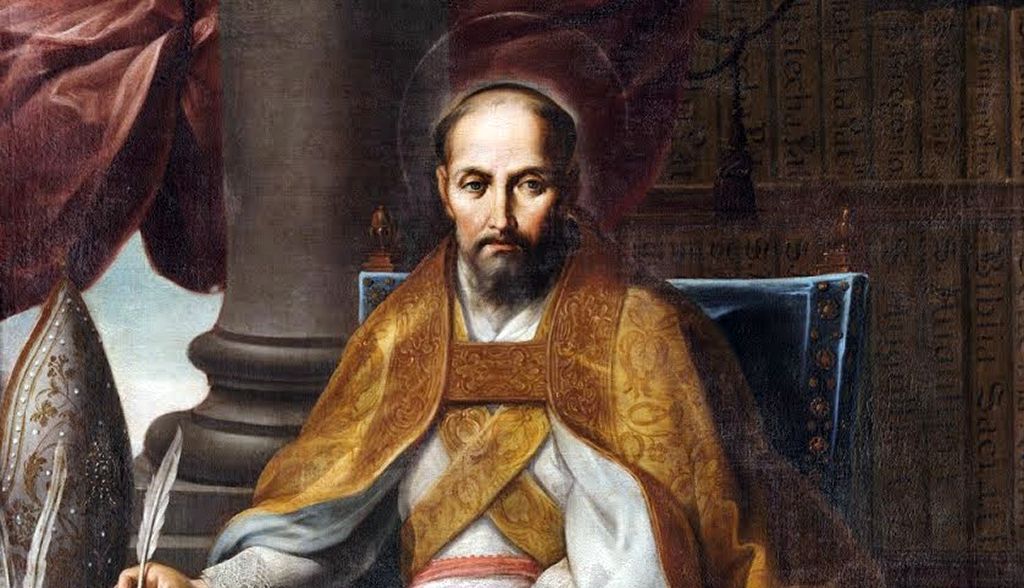
On April 21, the liturgical calendar recalls Anselmo de Aosta, Benedictine monk, abbot of Bec, archbishop of Canterbury, and doctor of the Church. The memorial is obligatory, the texts of the office are the customary ones, and in some parishes a homily will be read on the Proslogion and the ontological argument, that logical pirouette with which Anselmo believed he demonstrated the existence of God starting from the mere concept of God. Some will recall his Cur Deus homo, his polished Latin, his monastic humility, his conciliatory temperament. What almost no one will say from the ambo is why Anselmo ended up in exile twice, why William the Red and then Henry I of England preferred to keep him far away, and what that frail old man had that made kings nervous. The answer fits in a single sentence: Anselmo refused to allow civil power to appoint bishops. For that stubbornness, he spent years away from his see, wrote from exile, and died, in 1109, without having seen the conflict that was bleeding Latin Christendom in his time resolved.
The matter is known by a technical name that sounds like archival dust, the investiture controversy, and it summarizes one of the most serious political disputes of the Middle Ages. The underlying question was simple and devastating at the same time. When a bishop or abbot took possession of his office, he received two indistinguishable things to the feudal eye: a lordship with lands, vassals, revenues, and jurisdiction, and a spiritual office with cure of souls, sacraments, and doctrinal authority. The ceremony consisted of someone handing him the staff and the ring, visible symbols of the office. The issue was who had the right to deliver those symbols. If the king or emperor did it, the bishop was in fact a crown official with a sacramental addition. If the pope or a metropolitan did it, the bishop was above all a pastor, and his feudal bond with the monarch was subordinated to a higher authority. The difference seems ceremonial. It was not. It determined whether the Church was an administrative branch of the State or an autonomous legal society with its own headship.
During the 11th century, Germanic emperors had been de facto appointing the bishops of the Empire, and Frankish and English kings did the same in their kingdoms. The practice was called lay investiture and produced a courtly episcopal class, often simoniacal, that understood the office as a political career. Buying a see was so widespread a custom that the word simony, derived from that Simon Magus in the Acts of the Apostles who wanted to buy the gift of the Spirit, had become synonymous with the normal way of making an ecclesiastical career. The monastic reform that started from Cluny and crystallized in the papacy of Gregory VII sought to cut this system at the root. The Dictatus papae of 1075, the synodal decrees against lay investiture, and the clash with Henry IV are well-known episodes. Canossa, in January 1077, with the barefoot emperor in the snow waiting for the pope’s absolution, passed into iconography as the moment when spiritual power humbled temporal power. Reality was more tangled, and the controversy remained alive for another half century, but the principle was established: the Church claimed for itself, exclusively, the right to appoint its pastors.
Anselmo was, on the British island, the face of that claim. He arrived in Canterbury in 1093, almost by force, torn from his contemplative life at Bec by the insistence of a William the Red who only wanted a domesticated primate. Soon the king discovered that that thin monk, exquisite Latinist and silent in prayer, was not manageable. Anselmo maintained that the archbishop of Canterbury should receive the pallium from the pope and recognize Urban II as the legitimate pontiff, against the schism that the king preferred to maintain to have free rein. He also maintained that vacant sees should not be sold or left empty so that the crown could collect its revenues, a habitual practice in those years. And he maintained, above all, that investiture by the king’s hand was inadmissible. For all that, he asked permission to go to Rome in 1097, and the king granted it with relief, confiscating the see’s possessions along the way. When William died and Henry I ascended the throne, Anselmo returned to England. The peace lasted little. The new king demanded that the archbishop render feudal homage to him for his lands and accept bishops invested by the crown. Anselmo refused. He left England again in 1103 and remained away until 1106. The compromise reached then, ratified at the Council of London in 1107, was one of the precedents for the one that would be signed in 1122 in Worms between the papacy and the Empire: the king renounced delivering the staff and the ring, spiritual symbols, and reserved the reception of feudal homage for the temporalities. The Church retained the election and spiritual investiture of its bishops. The distinction may seem academic. It is not. It means that for nine hundred years Catholic doctrine has held that no civil power has the right to appoint bishops.
This doctrine is not a devout opinion. It is codified. Canon 377 of the current Code of Canon Law, promulgated by John Paul II in 1983, states with the dryness of legal texts that the Roman Pontiff freely appoints bishops or confirms those legitimately elected, and adds that henceforth no right or privilege of election, nomination, presentation, or designation of bishops is granted to civil authorities. The phrase is deliberately categorical because it aims to slam the door on several centuries of concordats in which Catholic monarchies, from the Habsburgs to the Bourbons, retained remnants of royal patronage. That clause of 377 is, read in historical key, the legal monument that collects the final victory of the Anselmian line. No lay investitures. No one outside the Church decides who is a bishop of the Church. For that principle, Anselmo, Thomas Becket, and hundreds of less famous prelates suffered exiles. For that principle, Pius VII faced Napoleon, Pius IX the Kingdom of Italy, Pius XI fascism and Calles, Pius XII Stalin and the Eastern satellite regimes. The imprisoned Czechoslovak bishops, the Hungarians under house arrest, Cardinal Mindszenty refugee in the American legation in Budapest for fifteen years, Cardinal Wyszynski in Poland, are names that belong to that same line. Rome did not negotiate the faculty to choose its pastors either with the medieval Christian emperors or with the 20th-century atheist dictators.
Until 2018. On September 22 of that year, the Holy See and the People’s Republic of China signed a provisional agreement on the appointment of bishops whose full text has never been made public. What is known, from confirmations by Francis himself and from the practice of the following six years, is the mechanism. Candidacies for bishop are drawn up within the so-called Catholic Episcopal Conference of China, an organism not recognized by universal canon law and overseen by the Patriotic Association, which is in turn a transmission belt of the United Front of the Chinese Communist Party. Those names reach Rome. Rome can accept them or, in theory, not accept them. The agreement was renewed in 2020, in 2022, and, most recently, on October 22, 2024, this time for four years, until October 2028, which the Vatican’s own diplomacy has presented as a consolidation. Under the pontificate of Leo XIV, the mechanism has continued to function normally: the first bishop appointed by the new pope was Giuseppe Lin Yuntuan, auxiliary of Fuzhou, in June 2025, and throughout that year new ordinations have taken place in Shanghai and Xinxiang within the same framework.
It is advisable to dismantle the cosmetics of language. It is called an agreement, consensus, respectful and constructive dialogue. What happens, translated into plain Spanish without makeup, is that a single Marxist-Leninist party, which has in its program the Sinicization of religions and keeps more than a million Muslim Uyghurs in re-education camps, proposes the names of the Catholic bishops of its country and the pope ratifies them. The initiative for the candidacy is, in fact, in the hands of the State. The Holy See retains a right of veto whose effective exercise is unknown and, in at least two documented occasions, the Chinese authorities themselves have appointed or transferred bishops without prior Vatican consent, without such acts provoking any canonical consequences. Rome has complained and moved on to another matter. The asymmetry is structural. A regime that persecutes the underground Church, demolishes churches, prohibits minors from attending catechism, replaces crucifixes with portraits of Xi Jinping in some temples, and considers the bishop of Rome a foreign power, has achieved what Henry IV, Philip the Fair, Napoleon, and Stalin could not: to be the one who presents candidates for the Catholic episcopate.
Cardinal Joseph Zen, emeritus bishop of Hong Kong, nonagenarian, has denounced the agreement from the first day with words that the curia has preferred not to hear. He spoke of betrayal, of selling out the underground Church, of abandoning the bishops and priests who for decades paid with prison and forced labor for their fidelity to Rome. He was prosecuted in Hong Kong in 2022 for collaborating with a fund to aid pro-democracy demonstrators, and the Vatican diplomacy barely moved a muscle in his defense. The reason is transparent. Any energetic gesture would have irritated Beijing and compromised the agreement. The Holy See’s foreign policy in recent years, articulated by Cardinal Pietro Parolin with the realist logic of Casaroli’s old Ostpolitik, has decided that in China one must be inside at any price, that decades of catacombs did not produce results, and that a controlled official Church in communication with Rome is worth more than a heroic and isolated clandestinity. It is a debatable option. What is not debatable is that it clashes head-on with the doctrine on the libertas Ecclesiae that the Church itself has defended since Gregory VII.
This is where today’s date acquires relief. While in every cathedral in the world the memory of Anselmo is celebrated, the doctor par excellence of the freedom of the Church against temporal power, the successor of Peter maintains in force an agreement whose content remains secret, whose practice grants the Chinese Communist Party the initiative in appointing the bishops of the most populous country on the planet, and whose recent renewal prolongs the situation until 2028. Anselmo wrote from exile that he preferred to lose the see rather than receive the staff from the king’s hand. Today they are received from the hand of a United Front committee. The distance between what is preached in the liturgy and what is signed in the Secretariat of State is the measure of an incoherence that no joint communiqué disguises.
It will be argued that the Chinese situation is exceptional, that twelve million Catholics divided for seventy years needed a pragmatic solution, that the possible good is worth more than the ideal good, that the sacramental unity with Rome of all bishops is already a fruit of the agreement. Some of these arguments have weight, and the situation of the persecuted Church in China does not admit simple answers from a European desk. But the problem is not prudential but doctrinal. What was at stake in the investiture controversy was not the convenience of this or that concordat, but the theological question of who the Church is: a society founded by Christ with its own principle of authority or an association whose headship can be co-opted by civil power. Anselmo answered, with the monastic courtesy of Bec and the firmness that cost him two exiles, the former. The current practice with Beijing, without stating it as such, answers the latter.
Hypocrisy does not consist in having signed the agreement, a decision that belongs to the political prudence of the pastors and admits defense. It consists in continuing to celebrate with normalcy the feast of the saint who embodies the contrary doctrine without offering a single word that acknowledges the tension. It consists in reading in today’s office Anselmo’s letters from exile as an edifying episode of the past, without noticing that the situation he denounced is reproduced, in other guises, in the present. It consists in proclaiming urbi et orbi canon 377, drafted precisely to close the era of lay investitures, while de facto admitting an exception whose demographic magnitude surpasses that of any other particular Church in whose episcopal designation the ancient Christian princes might have interfered.
Anselmo died on April 21, 1109, exactly nine hundred seventeen years ago, in Canterbury, after a life that combined the finest metaphysics of his century with a long and uneven struggle against two kings. The Church canonized him, proclaimed him a doctor in 1720, and celebrates him every year. The coherence between that homage and the current diplomatic practice with Beijing is a matter that the Church itself will have to resolve. In the meantime, the reader who attends a Mass in his honor today can ask himself whether the words of the preface, which recall his courage in the face of the powers of the world, refer solely to a 12th-century figure or if they also interpellate the ecclesial body that pronounces them.