


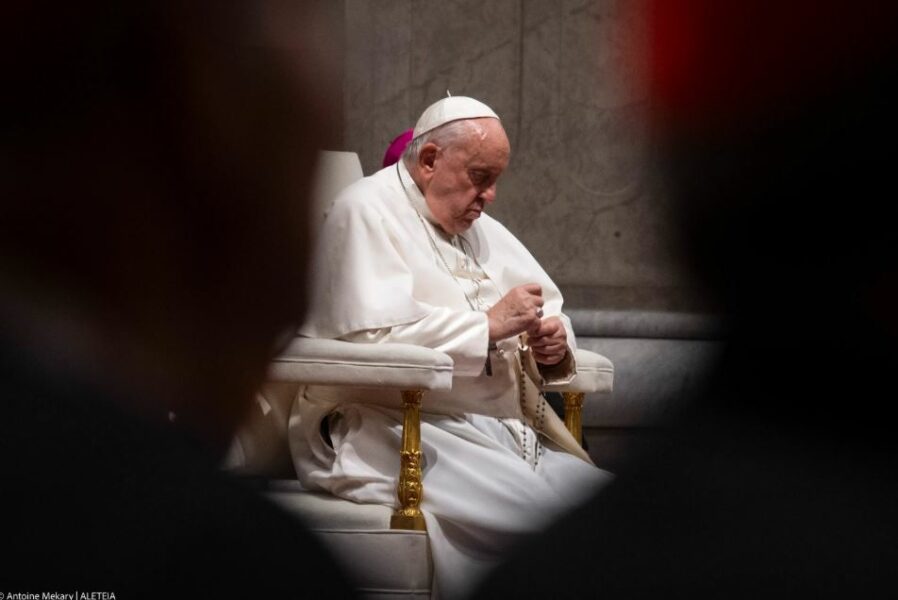
On April 21, 2025, Easter Monday, Jorge Mario Bergoglio died in Santa Marta. A year has passed and the mourning is no longer news: what remains is the balance.
I. The Man
Bergoglio arrived at the balcony on March 13, 2013, with a «buona sera» that was, at once, a greeting and a program. He came from Buenos Aires with the reputation of an austere archbishop—subway, small apartment, peripheries—carefully built by his friendly biographers. The reality of the porteño government was more complex: an iron hand with collaborators, a long memory for offenses, a marked preference for suspicion over priests of traditional sensitivity, and a network of personal loyalties that he would later replicate in Rome.
He was a Jesuit from the generation that followed the expulsion of the traditionalists from the Company, formed in the atmosphere of the theology of the people—younger sister but unmistakable of the theology of liberation—that read the Gospel in a key of sociological protagonism of the poor rather than in a key of the Kingdom. Pious in Latin American popular devotion; intellectually impatient with anything that smelled of doctrinal rigor. That combination explains almost everything: the kisses to prisoners on Holy Thursday and the devastating letters to communities that only asked to be able to pray with the 1962 Missal are not a paradox, they are a method.
He died weakened after the long stay at the Gemelli in February-March 2025. He wanted to be buried in Santa Maria Maggiore, outside the Vatican. Even in the sepulcher, the calculated gesture of distance from a Tradition that he had decided to use as a backdrop and not as a home.
II. The Communicator
Francis was an intuitive and effective communicator, and here credit must be given where it is due. He understood before almost anyone in the Curia that the image weighs more than the text, that the gesture travels faster than the encyclical, and that a Pope who walks barefoot in Lampedusa has more reach than one who signs documents in Latin. The problem is that he confused reach with evangelizing effectiveness. That millions see a photo does not mean that millions convert; it means, simply, that millions see a photo.
The preferred style—brief homily from Santa Marta, interview on the plane, loose phrase—produced during twelve years a constant drip of calculated ambiguity. The famous «Who am I to judge?» was not a slip: it was a formula that Francis allowed to circulate knowing perfectly well how it would be read outside the Church and within it. The interviews with Scalfari—an agnostic who reconstructed the conversations without a recorder and published theological barbarities signed by the Pope—were repeated up to six times. After the first, it was no longer carelessness: it was connivance with a format that allowed saying what could not be written and half-denying it when convenient.
And then there is the central contradiction of the public figure: a Pope who preached synodality, decentralization, and a «polyhedral» Church governed with an authoritarianism that John Paul II or Benedict XVI would not have signed. Lightning appointments by phone, improvised commissariats over entire congregations, rescripta ex audientia without passing through the competent dicasteries, use of the motu proprio as a hammer. The Church «outgoing» toward the outside coexisted with an inward Church where publicly dissenting from the Pope had immediate professional cost. One cannot preach parrhesia to the faithful and practice forced silence with the cardinals.
III. The Five Documents That Define the Pontificate
From Francis’s magisterial production—four encyclicals, seven apostolic exhortations, dozens of motu proprio—five texts summarize the legacy. The longest or most cited ones have not been chosen, but those that will weigh the most in the next fifty years, for better or worse.
1. Evangelii Gaudium (2013)
Programmatic apostolic exhortation. The manifesto of the pontificate.
Published eight months after the election, it is the matrix text. Here Francis sets the vocabulary, the enemy, and the method. The vocabulary: «Church in exit», «mercy», «shepherds with the smell of sheep». The enemy: the «doctor of the law», the «museum Christian», the «neopelagian»—categories that in his twelve years of pontificate he would systematically apply against anyone who defends the norm, never against anyone who dissolves it—. The method: the four principles of chapter IV, especially the famous «time is superior to space» (EG 222-225), which is much more than a pastoral aphorism. It is a magisterial license to open doctrinal processes without closing them, to launch questions without resolving them, to sow changes that will mature with bolder successors. It is the theoretical core of the Bergoglio method: not to define, to condition.
To this is added the treatment of the Jewish people in EG 247—«we can never consider that the Old Testament has lost its vigor»—which in the context of the document slips dangerously toward the thesis of two parallel covenants that Ratzinger had contained with extreme care. And a constant that would repeat until the end: the caricature of the traditional Catholic as rigid, unhappy, and fearful, presented as pastoral analysis when it is, simply, a judgment of intentions about millions of faithful whom the Pope never bothered to know.
It is literarily brilliant. It is pastorally useful in stretches. And it is, at the same time, the foundational act of everything that would come after.
2. Laudato si’ (2015)
Encyclical on the care of the common home.
The first encyclical entirely his own—Lumen Fidei was a finished text by Benedict XVI with a changed signature—and the only major document of the pontificate that holds up if the accompanying ecological propaganda is abstracted. It recovers the doctrine of man as custodian of creation, denounces the practical relativism of consumption, and, above all, explicitly links environmental ecology and human ecology: there is no coherent defense of the forest without defense of the unborn, and one cannot protect the animal while discarding the elderly (LS 117, 120). That thesis is deeply Catholic and should have been formulated before.
That said, the encyclical has two serious burdens. The first: it adopts the IPCC climate consensus as if it were revealed data, confusing what is majority scientific opinion with what would be binding doctrine. It is not for the Pope to canonize a climatological model, just as it did not correspond to Leo XIII to canonize an economic model. The second: the language about «Mother Earth», the uncritical quotes from Bartholomew, and certain cosmological passages open a door to environmental pantheism that theologians less prudent than Francis—starting with the Amazonian wing of the pontificate—would cross joyfully five years later with the Pachamama strolling through the Vatican gardens.
The best document of the pontificate. Which says as much about its value as about the general level of the other four.
3. Amoris Laetitia (2016)
Post-synodal apostolic exhortation on love in the family.
The document that broke the sacramental unity of the Catholic Church. What is at stake in chapter VIII and in the sadly famous note 351 is not a minor pastoral question: it is whether a faithful who lives objectively in adultery—second civil union with legitimate spouse alive—can be absolved and admitted to communion without purpose of amendment. Against twenty centuries of discipline, against Trent, against Familiaris Consortio, against Veritatis Splendor, Francis answered yes «in some cases». And then he systematically refused to clarify what cases, under what conditions, and with what criteria.
The five dubia presented by Brandmüller, Caffarra, Meisner, and Burke in September 2016 were technical questions, drafted in the most sober canonical language possible, that admitted a «yes» or «no» response. There never was one. Silence was the response. And the silence of the magisterium before legitimate questions about the magisterium is not neutrality: it is a deliberate taking of position for ambiguity. The private letter to the bishops of Buenos Aires endorsing their permissive interpretation—leaked later as if it were an official act—completed the mechanism: real guidance for those who wanted to read it; formal denial for those who protested.
The result is there to see. In Poland one discipline is applied; in Germany, another; in Argentina, another. The same sacrament, the same objective situation, incompatible responses according to the zip code. That is not legitimate pastoral diversity: it is the dissolution of sacramental catholicity. And the most serious thing is that the problem is irreversible without an explicit act by a successor, because the text is drafted precisely so that there is nothing to withdraw—only ambiguity to clarify—.
The document where Bergoglio stopped being a pastor with a debatable method to become a Pontiff who consciously chose to break disciplinary unity in exchange for a concrete pastoral advance. And not even the advance was pastoral: it was ideological.
4. Traditionis Custodes (2021)
Apostolic letter in the form of motu proprio on the use of the Roman liturgy prior to 1970.
The most revealing document of the pontificate, because it is the only one in which Francis acted without any ambiguity. With Traditionis Custodes he revoked Benedict XVI’s Summorum Pontificum—still alive, still resident a few meters away—and subjected the celebration of the traditional Roman Missal to a regime of authorization, surveillance, and programmed extinction. The Responsa ad dubia of the following year, signed by Roche, closed the remaining cracks: prohibition of personal parishes, prohibition of promoting the traditional Mass in bulletins, obligation to use the new lectionary in Latin—an absurd combination that no one had asked for—, restriction of ad tramitem ordinations.
The justification was a survey of the world’s bishops whose results the Vatican refused to publish. When fragments were leaked years later, they showed exactly the opposite of what was stated in the preamble of the motu proprio: the vast majority of bishops did not report serious problems with traditional communities. The Pope lied, or at least allowed Arthur Roche to lie in his name, about the documentary basis of the most severe act of government against a group of Catholic faithful in more than half a century.
What was punished with Traditionis Custodes was not schism—traditionalists in full communion are, by definition, not schismatics—but the very existence of a liturgical sensitivity that Bergoglio considered unbearable. The official argument—that these faithful rejected the Second Vatican Council—is false for the vast majority and, in any case, irrelevant: the Church has canonical mechanisms to deal with individual dissents, it does not need to extinguish an entire liturgy. Benedict XVI had written that «what was sacred for previous generations remains sacred and great for us too, and it cannot be suddenly totally forbidden». Francis decided that it could. And the distance between those two phrases measures exactly the rupture that this pontificate has introduced in the hermeneutic of continuity.
It is the most unjust act of the twelve years. Period.
5. Fiducia Supplicans (2023)
Declaration of the Dicastery for the Doctrine of the Faith on the pastoral sense of blessings.
The consummation of the method. Víctor Manuel Fernández, installed at the head of the former Holy Office with no more credentials than personal friendship with the Pope and a theological bibliography best not remembered, signed the declaration that allows blessing couples in irregular situations «including same-sex ones». The letter of the document says that the union is not blessed, only the persons; that there is no rite; that there is no equivalence with marriage. The letter says many things. The reality is that the next day the world’s headlines announced that the Church was blessing homosexual unions, and neither Fernández nor Francis did anything serious to deny it until four weeks later, when the fire in Africa had forced the rectification.
That rectification—the complementary note of January 2024 admitting that blessings must last seconds, without liturgical gestures, without vestments, without rings—is a confession of failure written with the greatest possible dignity. But the damage was done. And what will remain in memory is not the complementary note but the headline.
Even more serious was the ecclesial response. Practically the entire African episcopate, led by Ambongo, rejected the application of the document in their territories with a signed declaration that Francis himself had to endorse to avoid the ridicule of excommunicating half a continent. Episcopates of Asia, Eastern Europe, some bishops in the United States did the same. A declaration approved by the Pope and signed by the Prefect of the Doctrine of the Faith was rejected by entire episcopal conferences without any canonical consequence. That had not happened in the modern history of the Church. And it did not happen because the African bishops are rebels: it happened because the document was indefensible.
St. Thomas taught that a pastoral act whose objective meaning for the recipient contradicts what the text affirms is scandal. Fiducia Supplicans is the operational definition of scandal in moral theology: it was known how it would be read, it was drafted knowing it, and it was published anyway. It is not an error: it is a policy.
IV. What Remains
Twelve years later, the Church that Francis leaves is more known and less believed, more present in the media and less present in hearts, with the applause of politicians and media of the most stale left but with sacramental statistics that sink in almost the entire Western world. Vocations continue to fall. The German dioceses approach formal schism without Rome doing more than concerned letters. The traditional is persecuted. The modernists, rewarded. And the cardinalate, after twelve years of appointments, looks more like a network of personal loyalties than a representative college of the universal Church.
His successor faces an ungrateful task: to restore without vengeance, to clarify without humiliating, to pick up the pieces without turning the restoration into another rupture. We pray for him, and we also pray for Francis, who needs the mercy he preached so much now more than ever.
Requiescat in pace. Et lux perpetua luceat ei.