


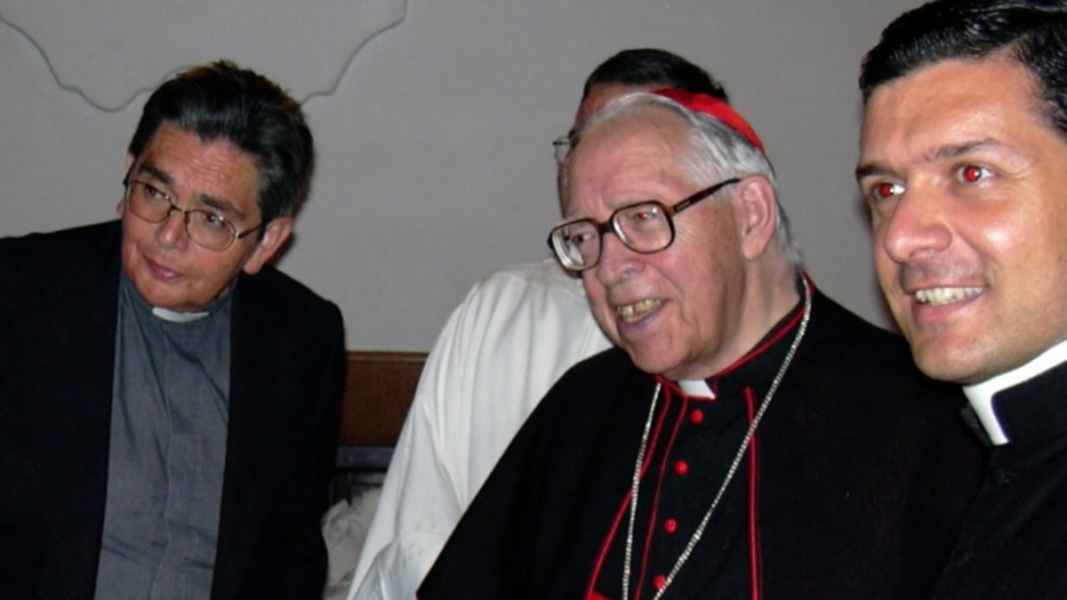
In this month of April, two priests of great stature have passed away, almost on the same day: Don Miguel Ponce Cuéllar and Monsignor Nicolás González González. If yesterday I wrote about the first, today I want to evoke Don Nicolás, in whom the diocese of Ávila has had one of its most representative priests: 91 years of life, nearly 70 of ministry. Born in Navatejares on September 10, 1934, trained in Ávila and Rome, he was ordained in March 1957. In Ávila, he was a doctoral canon of the Cathedral—by competition in 1969—, dean, judicial vicar, diocesan economist in several stages, lieutenant vicar general, and during the vacancy of 1991, pro-vicar general. Promoter Fiscal and Defender of the Bond, member of the Council of Economic Affairs, of the College of Consultors, of the Presbyteral Council… And Catholic education and care for the poor.
But when I think of Don Nicolás, all these positions fade into the background for me, because his figure is, for me and for so many, inseparably linked to the Monastery of the Incarnation in Ávila.
He arrived there shortly after being ordained, at a singular historical crossroads. That monastery, the flagship of the female Carmel, had embraced Discalced life in 1940 due to a promise from the nuns to Saint Teresa if they were spared from the outrages of the «godless» during the war. However, the community’s decline and the building’s ruin had been increasing, making a profound restoration urgently necessary.
It was then that the small great bishop of Ávila, Don Santos Moro Briz, turned to Saint Maravillas of Jesus. Only she could restore the Incarnation of Ávila, and Mother Maravillas, after resisting not a little, yielded, seeing that it was God’s will. With her intelligence and supernatural sense, she sent to Ávila the unparalleled Mother Magdalena de Jesús Gutiérrez y Gómez-Acebo, who arrived on September 24, 1966 (after having been, very young, prioress of Duruelo and El Escorial), accompanied by eight other nuns.
There they found the young chaplain Don Nicolás. He himself recounted, in his sober tone, that the first contact was a notice to pick up some vegetables from the garden at the turn that they wanted to give him for his meal. That’s how things began. From then on, the tandem between Mother Magdalena and Don Nicolás was providential. She was the visible soul of the community, ad intra and ad extra; he, a most effective, most discreet collaborator, who never drew attention to himself, who never meddled in what was not his responsibility, but who was attentive to everything and helped with everything. Between the two, they literally contributed to rebuilding the monastery.
For nearly half a century, his presence was something familiar at the Incarnation: his slow and mellow voice, his firm steps through the chapel of the Transverberation, his celebrations of Holy Mass, unhurried and careful, his attention to the faithful. Later, from 1992 onward, with the new prioress, Mother Carmen de Jesús, faithful successor to Mother Magdalena, the collaboration remained intact, faithful, in full continuity.
How many arrangements did Don Nicolás not make? How many aids did he not obtain? For how many contacts was he not an intermediary? I don’t know, because he did everything wrapped in an elegant discretion, forgetful of himself. A self-forgetfulness with which he also enveloped the hundreds and hundreds of hours of research and patient work that culminated in the «History of the Monastery of the Incarnation of Ávila,» an indispensable reference for any researcher.
He was an old Castilian, sparing, sturdy, not given to exteriorizing. I confess that when I met him, at my eighteen years—I, an Extremaduran, though with two years of childhood lived in Ávila—I did not find in him a particularly approachable person. Perhaps the immaturity of my adolescence, already in its final stages, did not allow me to see. But time would allow me to discover in him a great nobility of heart, a deep sincerity, a clean uprightness, a notable human and priestly stature.
Already as a priest myself, I dealt with him frequently. And he did not disdain to concelebrate with me many times, approaching me with an affability that, without losing his sobriety, was very real. I was able to attend at his house, like a disciple, encounters with my dear Cardinal Don Marcelo and with Don Rafael Palmero, first auxiliary bishop of Toledo and later bishop of Palencia and Orihuela-Alicante. In those gatherings, with his sister Agueda present, his faithful guardian angel, Don Nicolás conducted himself with naturalness, without protagonism, but with a solid presence of a true friend. He manifested himself in the same way each year when in August Don Marcelo came to celebrate the feast of the Transverberation: the imposing presence of the Primate Cardinal imposed itself on its own, but Don Nicolás was an incomparable introducer of ambassadors.
Don Marcelo—who loved him dearly, from the years when, as archbishop of Barcelona, he went to Ávila and was welcomed by the chaplain of the Incarnation—already as emeritus archbishop of Toledo and very elderly, during one of those August stays in Ávila asked me to take him to the Social Security hospital, because he was determined to see Don Nicolás who had suffered a very serious traffic accident and was fighting between life and death. I took the cardinal, who had to wait like everyone else until he could enter—alone—into the ICU. Upon leaving, he told me, moved, that he whispered in his ear: “Nicolás, Nicolás, it’s me, Marcelo…”, without getting a response, leaving with uncertainty about his recovery. That day I saw Don Marcelo’s eyes moist, and I respected his silence in my car, returning to the House of the Teresians, where he was staying in the City of Knights.
Don Nicolás recovered almost miraculously. His return to the Incarnation was a feast, with the patio adorned and the bells ringing. A decade later, in 2012, very elderly, his friend Mother Magdalena died. I will never forget Don Nicolás’s homily at the exequies. The bishop presided, but it was evident that no one else could preach it. It was a measured, sober, profound, true, heartfelt funeral oration… like him.
In his later years, when he saw himself already very old and without strength, he moved to the Priests’ House in Ávila. And, with ascetic lucidity, he resolved never to return to the Incarnation, not so much out of detachment, but because it would have been an indefinable tearing for him: it was more than half his life that he had left there.
His heart, however, did not move from that monastery. His thought never strayed from the Holy Mother Teresa of Jesus, for whose legacy he worked so much, about whom he spoke so much and wrote so beautifully. A person very close to the Incarnation told me—close to the point of being able to say that she is one and the same with that House—that, precisely the day before his death, she had a kind of inspiration to visit Don Nicolás, already unconscious, and saw that his room was like a small copy of the monastery: a painting of the Virgin of Mercy, another of Saint Teresa, another of Saint John of the Cross, the photos of John Paul II with his Carmelites in 1982… As if he had wanted to carry with him, until the end, that which had been the center of his life.
Don Nicolás has been a complete man, in every sense of the word: upright, responsible, hardworking, faithful. A good priest, one of those who do not seek to be remembered, but are.
In writing these lines, in this month when two such different and great priests have passed away, I give thanks to God for having placed them in my path. Because, in diverse ways, both have left in me—and in so many—a very deep mark.
Rest in peace, Don Nicolás, and carry remembrances to the Holy Mother Teresa, to the little saint Friar John, to the «dawn,» Magdalena de Jesús, to Don Marcelo. They will have received him in grand style!