


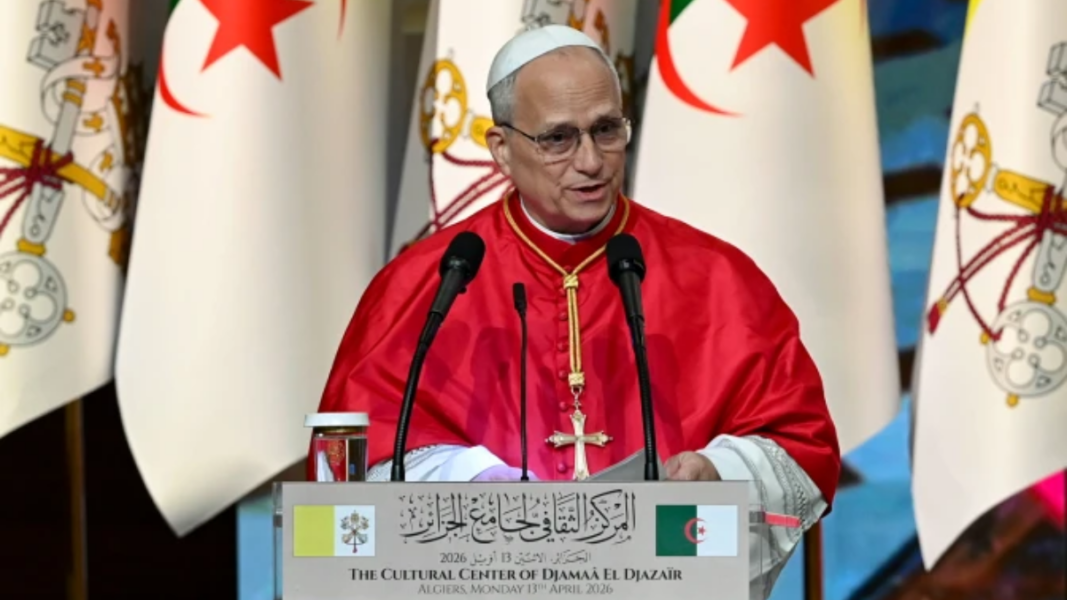
The visit of Leo XIV to Algeria these days once again places under the spotlight an issue that for too long has been treated with diplomatic euphemisms: the legal and social situation of Christians in a country that proclaims freedom of worship while organizing its effective limitation. The Pope’s trip, which began on April 13 with the first stage of his apostolic journey to Africa, arrives in a State where Christianity is not formally abolished, but is subject to a legal framework designed to contain it, administratively suffocate it, and reduce it to a tolerated, monitored, and politically irrelevant presence.
That contrast is not accidental. The Algerian Constitution maintains, on the one hand, the centrality of Islam as the religion of the State and, on the other, a formulation of religious freedom subordinated to the law and public order. The problem lies not so much in the solemn declaration of principles as in its normative development. That is where the less decorative and more brutal reality of the system emerges: when Christianity steps out of the private sphere and seeks to exist as a visible, communal, transmissible, and legally recognized faith, the state apparatus activates to remind it that in Algeria religious freedom has an owner.
The first of the two legal realities that most clearly reveal this structural discrimination is the regulation of so-called proselytism. Ordinance No. 06-03, of February 28, 2006, which sets the conditions and rules for the exercise of non-Muslim worship, presents itself as a regulatory norm. In reality, it is an instrument of control and punishment. Its Article 11 sanctions with two to five years in prison and a fine of 500,000 to 1,000,000 dinars anyone who “incites, constrains, or uses means of seduction” to convert a Muslim to another religion. The same provision also punishes the manufacturing, storage, or distribution of printed or audiovisual materials intended to “undermine the faith” of a Muslim. The formula is deliberately expansive. It does not punish only coercion, which would already be prosecutable by other means, but simple missionary activity, the dissemination of religious texts, and, at bottom, any serious form of Christian preaching directed at Muslims.
That means the Algerian State does not limit itself to protecting public order: it penalizes the very content of the Christian mission when it is directed at the Muslim majority. To put it bluntly, Christians can be allowed to exist, but not to fully proclaim their faith. They are granted a mutilated right. They can pray, under enormous conditions; they can gather, if authorized; they can subsist, as long as they do not grow. Such a regime does not safeguard religious freedom. It empties it from within.
The same Ordinance No. 06-03 tightens the siege even further with its Article 13, which punishes with one to three years in prison anyone who practices worship outside the conditions set by the norm or without the corresponding authorizations. The trap is evident: the State demands registration, authorization, supervision, and suitable premises, but at the same time blocks or delays those recognitions for years. Then, it uses the lack of regularization that it itself provokes as a basis for closing churches, persecuting pastors, and judicializing the ordinary life of Christian communities. It is not an administrative dysfunction. It is a technique of repression wrapped in bureaucratic language.
The facts confirm it. The 2023 international religious freedom report from the U.S. Department of State noted that proselytizing among Muslims by non-Muslims is a crime in Algeria, and detailed that the law provides for up to five years in prison for attempting to convert a Muslim or for distributing materials intended to “shake” their faith. The same report recorded convictions for unauthorized worship and for producing religious materials, in addition to the closure of churches affiliated with the Protestant Church of Algeria, of which only three remained open at the end of 2023. A year later, the situation did not improve but consolidated: the U.S. Commission on International Religious Freedom stated in its 2026 annual report that the Protestant churches in Algeria closed by the government between 2018 and 2024 remained shuttered during 2025 and that only one remained open in Algiers, moreover under strong restrictions.
The suffocation does not end with the normative structure. It has produced concrete victims. Hamid Soudad, a Christian convert, was arrested in 2021 and convicted for expressions related to Islam linked to a caricature shared on Facebook in 2018. His case was recorded in the USCIRF’s database of prisoners of conscience for religious freedom, which identifies him as imprisoned for his religious expression. Also, Pastor Youssef Ourahmane, vice president of the Église Protestante d’Algérie, was convicted for organizing an unauthorized religious meeting; his conviction was upheld on appeal, though with a reduced sentence. They are different cases, but they obey the same logic: turning visible Christian practice into a criminally suspicious activity.
Amnesty International has described that pattern with notable clarity. In its 2022 assessment, it stated that between 2017 and 2022, Algerian authorities used the Penal Code and the regulatory norms for the exercise of religions other than Islam to prosecute hundreds of non-Sunni believers and close several Protestant churches. The organization added a legally very revealing fact: Article 51 of the 2020 Constitution protects freedom of opinion and the “freedom to practice acts of worship,” while the 2016 Constitution expressly protected freedom of conscience. The change is not minor. Replacing conscience with the act of worship is not a technical improvement: it is a conceptual degradation. Conscience protects inner adherence, change of religion, and personal conviction. The “act of worship” is something much narrower, controllable, and administrable. It is the difference between recognizing the person as a free subject or tolerating them only when performing permitted rites.
The second legal reality that betrays the marginalization of Christianity is found in family law. The Algerian Family Code, reformed in 2005, provides in its Article 30 that “a Muslim woman cannot marry a non-Muslim.” There is no civil neutrality here that allows dodging the problem through a merely state marriage, because the Algerian civil marriage is not religiously neutral: it is structured by a confessional logic derived from Islamic law. In practical terms, a Christian man cannot validly contract marriage in Algeria with a Muslim woman except through prior conversion to Islam. The U.S. Department of State’s 2023 religious freedom report reiterated that the Family Code prohibits Muslim women from marrying non-Muslim men except through their conversion.
This rule is not anecdotal nor can it be dismissed as a simple cultural peculiarity. It has direct consequences on religious freedom and civil equality. It prevents a Christian from forming a family with a Muslim woman without going through the renunciation, at least formal, of their own religious identity. It is not just regulating marriage: it is legally penalizing the public persistence of Christianity in the family sphere. One thing is to restrict the expansion of a faith through laws against preaching; another, even deeper, is to hinder its social continuity through marital barriers. The combination of both mechanisms is devastating. On the one hand, the vertical transmission of faith to new converts is obstructed; on the other, its horizontal reproduction in family and community life is made difficult.
It is worth calling things by their name. The Algerian legal framework is not simply “sensitive” on religious matters, nor “prudent,” nor “jealous of interconfessional balance.” It is a discriminatory framework that privileges Islam not only as the majority or state religion, but as a legally dominant identity before which other confessions remain subordinated. Religious freedom exists to the extent that it does not alter the religious hierarchy that the State itself has decided to shield. That is why the law punishes Christian preaching directed at Muslims. That is why it blocks the ordinary functioning of non-Muslim churches. That is why it turns marriage between a Muslim woman and a Christian into a legal obstacle. The entire system conveys the same message: Christianity can be tolerated, but not fully free.
Some will try to relativize this diagnosis by recalling that apostasy is not formally typified as a crime. It is a weak and, at bottom, misleading defense. A State does not need to expressly punish apostasy if it has built around the convert an environment of penal threats, social marginalization, family vulnerability, marital impossibility, and institutional closure. Modern repression does not always take the crude form of a frontal prohibition. It often prefers the more effective path of normative strangulation.
That is precisely what is happening in Algeria. The problem is not only that there are prosecuted Christians, convicted pastors, or sealed churches. The greater problem is that all of it is consistent with the current legal design. We are not faced with isolated abuses that contradict a good law, but with the fairly consistent application of a bad law and a confessional conception of the State incompatible with authentic religious freedom.
The presence of Leo XIV in Algeria introduces, at least, an opportunity. May this trip serve to denounce that situation clearly, without empty diplomacies or evasive formulations, and to open a breach or begin to operate a change. Who knows if it can turn out that way.