


… But the Lord hears the cry of his faithful, and granted this converted writer, after all his suffering, to fall asleep in His peace on Easter Day.
When we saw the story of Sister Wilhelmina Lancaster, we commented that we would dedicate some of these texts to people who had suffered immensely from the liturgical reforms stemming from the Second Vatican Council and had fought for the traditional liturgy. Following this thread, today we are going to see the sad but luminous story of Evelyn Waugh.
Waugh, born in England in 1903, converted from Anglicanism to Catholicism in 1930, a time of numerous conversions of English writers and artists to the Church of Rome; following the conversion of St. John Henry Newman at the end of the 19th century. In the 1930s there were about twelve thousand annual conversions to Catholicism just in England.
Adriano Erriguel describes the way in which, “one fine day, Evelyn Waugh converted to Catholicism. It was not a mystical crisis, nor a ‘fall from the horse.’ Waugh’s conversion was, it seems, cerebral and discreet. He himself explained that ‘through a firm intellectual conviction, but with very little emotion, I was admitted to the Church.’ Martin D’Arcy, a Jesuit and Waugh’s spiritual director, wrote: ‘I have never known a convert who based his assents so firmly on the truth.’ This pragmatic and practical approach to his faith served Waugh ‘through the trials of his life.’ And this is one of the great lessons that Evelyn Waugh can teach today’s Catholics: sentimentality has never been part of our faith. Faith, in its traditional definition, is an assent of the intellect to the truth revealed by God. Therefore, once the Truth is known, the fact that one may ‘feel nothing’ in prayer for long periods of time is of the least importance.
The magnificent Joseph Pearce delves into the background of Waugh’s conversion to Catholicism and the reason he remained faithful to the Church and its Tradition: on August 21, 1930, Waugh had written to the Jesuit Martin D’Arcy that he had come to the conclusion that the Catholic Church was ‘the only genuine form of Christianity (and) that Christianity is the essential and formative component of Western culture’. Six weeks later, on September 29, Father D’Arcy received Waugh into the Church. As a result of his conversion and the controversy it aroused, Waugh wrote an article for the Daily Express in which he explained his reasons for converting to Catholicism: ‘It seems to me that, in the current phase of European history, the essential question is no longer between Catholicism, on one hand, and Protestantism, on the other, but between Christianity and chaos. Today we can see it everywhere as the active denial of everything that Western culture has represented. Civilization —and by this I mean the entire moral and artistic organization of Europe— has no power in itself to survive. It arose through Christianity and, without it, has no meaning or power to demand loyalty. The loss of faith in Christianity and the consequent lack of confidence in moral and social norms has been embodied in the ideal of a materialistic and mechanized State… It is no longer possible… to accept the benefits of civilization and at the same time deny the supernatural basis on which it rests.’ Affirming that ‘Christianity is essential to civilization and needs more combative strength than ever in centuries,’ Waugh argued that ‘Christianity exists in its fullest and most definitive form in the Roman Catholic Church.’
Waugh was a prolific and highly successful writer, before and after his conversion; his most famous work is Brideshead Revisited, a chronicle of the struggles of an aristocratic family regarding Catholic truth and faith.
After reviewing the fundamental aspects of his conversion to Catholicism, many things could be said and have been said about Waugh, but here we are going to focus only on the bitter trial and profound pain that the reforms undertaken by the Second Vatican Council, especially in the liturgy, meant for him.
Evelyn Waugh’s Catholic spirituality can be defined as deeply liturgical, based on his love for the traditional Mass. In fact, one of the facets of Catholic faith that most attracted Waugh was the Tridentine Mass. Therefore, “when the Second Vatican Council began to make adjustments to the liturgy, he began to fear that the beautiful and solemn form of prayer that had attracted him – and so many other converts – to the Church would be eliminated and replaced by the new forms of Mass with which experimentation began, which he considered banal, worldly, and unholy. While revolutionary clerics introduced more and more innovations and ‘reforms,’ Waugh wrote on behalf of the laity who remained faithful to the secular traditions of the Church: ‘We hold the beliefs, try to observe the moral law, go to Mass on holy days and often glance at the vernacular translations of the Latin… We take some trouble to educate our children in the faith… In all times we have formed the main body of ‘the faithful,’ and we believe that the Church was founded for us as much as for the saints and for public sinners.’”
Waugh expressed his concerns to his bishop, Cardinal John Carmel Heenan of Westminster, in a series of letters throughout the 1960s: he was concerned that, in an attempt to make the laity feel more relevant, the crucial role of the priest in the Mass would be diminished and that, in an effort to make the laity participate more actively in the Mass, they would gradually forget to participate spiritually. “I detect a new kind of anticlericalism,” he wrote to Heenan: “The new anticlericals seem to minimize the sacramental character of the priesthood and suggest that the laity are their equals.”
He also considered the introduction of the vernacular language unnecessary and stated that its mandatory nature was an affront to God: ‘This was the Mass for whose restoration the Elizabethan martyrs went to the scaffold’.
Adriano Erriguel highlights that, more than a reactionary, Evelyn Waugh was a rebel against the modern world. He retired to live as far away as possible from the modern world, in a remote country house in Gloucestershire. There he devoted himself to studying theology, writing his novels with an old ink pen, and quaffing the wine from his well-stocked cellar. From there he launched diatribes about the course of the Catholic Church and the liturgical reforms of the Second Vatican Council, which the author of Brideshead Revisited judged “incoherent, amorphous, and formless, insofar as they introduce chaos and uncertainty, reflections of a Eucharistic theology that departs from the priestly and sacrificial sense (…) with a loss of the clarity of the sacrifice in the Tridentine rite.”
The discrepancy between the ancient faith and modern innovation was the backdrop to Waugh’s increasingly energetic commitment against the winds of modernism that seemed to sweep through the Church in the 1960s, a storm that cast its sinister and gloomy darkness over the last years of his life.
The blogger Wanderer dedicated a series of 7 posts on his blog in 2015 to Evelyn Waugh and the liturgy, noting that “this suffering was, ultimately, one of the causes that would lead to his premature death in 1966.” Wanderer offers the translation of some of the most significant paragraphs from a note that Waugh published in The Spectator on November 22, 1962, about the reforms that were already foreseen that the conciliar gale was going to give us. Here we will mention only two excerpts, but we leave the link because we think it is absolutely recommended to read his detailed reflection on the profound dismay and pain of its destruction by the Second Vatican Council.
“Recently I heard the sermon of an enthusiastic neo-presbyter who spoke, probably alluding to Macmillan’s unhappy phrase regarding Africa, of a ‘great wind’ that is about to blow, sweeping away the irrelevant accretions of the centuries and revealing the Mass in its pristine and apostolic simplicity. Meanwhile, I looked at his congregation, made up of parishioners from a small rural town, of which I consider myself a typical member, and thought how little their aspirations matched ours (…). Even less do we aspire to usurp his place [the priest’s] at the altar. ‘The priesthood of the faithful’ is a misleading phrase of this decade, abominable to all those of us who have encountered it. We claim no equality with our priests whose personal defects and miseries (when they exist) serve only to emphasize the mystery of their unique calling. Anything regarding attire or manners or social habits that tends to camouflage that mystery is something that distances us from the sources of devotion. The failure of the ‘French worker priests’ is still fresh in our memory (…). While the Mass continued in the usual way I wondered how many of us desired to see any change.”
“In recent years we have experienced the triumph of the ‘liturgists’ in the reform of Holy Week (the reforms of Pius XII, applied from 1955). For centuries these rites have been enriched by devotions very dear to the faithful –the anticipation of the morning Office of Tenebrae, the vigil at the Altar of the Monument, the Mass of the Presanctified. It is not a matter of how Christians in the second century celebrated Easter. It is a matter of the organic growth of the people’s needs. Not all Catholics could attend all the offices, but hundreds did, going to live in or near monastic houses and making an annual retreat that began with the Office of Tenebrae in the evening of Holy Wednesday and culminated near noon on Holy Saturday with the anticipated Easter Mass. During these three days the time was conveniently distributed between the rites of the Church and the sermons of the priest in charge of the retreat, with few occasions for distractions. Now nothing happens before the evening of Holy Thursday. The entire morning of Good Friday is empty. There is about an hour in the church on Friday afternoon. The entire Saturday is blank until late at night. The Easter Mass is sung at midnight before a tired congregation that is forced to ‘renew their baptismal vows’ in the vernacular and then go to bed. The meaning of Easter as a feast of the dawn has been forgotten, as has that of Christmas as Christmas Eve. I have noticed in the monastery I frequent a marked drop in the number of retreatants since the innovations, or as the liturgists would prefer to call them, restorations. It may well be that these services are closer to the practices of the early Christianity, but the Church enjoys the development of dogma; why then is it not granted the development of the liturgy?
In another of Waugh’s letters it can be read: “The Second Vatican Council has me down. I don’t think it’s likely that these unpleasant trends within the Church will be reversed.” In a letter to his bishop, Cardinal Heenan, he notes: ‘The new liturgy seems to me a temptation against Faith, Hope, and Charity, but never—I ask God for this—will I apostatize.’
Because of this entire liturgical revolution that had been brewing in the Church for decades, but clearly from the Holy Week reforms of Pius XII and the Second Vatican Council, depression tormented Waugh’s life from the year 1960, although also linked to certain physiological problems, such as severe insomnia he suffered from. In one of his letters it can be read: “I have aged a lot in these last two years. I am not sick, but I am very weak. I have no desire to go anywhere or do anything, and I know I am a bore. The Second Vatican Council has gotten to me” (…). “Easter meant a lot to me, before Pope John and his Council: they have ended the beauty of the liturgy. I haven’t yet doused myself in gasoline and set myself on fire, but now I have to cling tenaciously to the faith without any joy.”
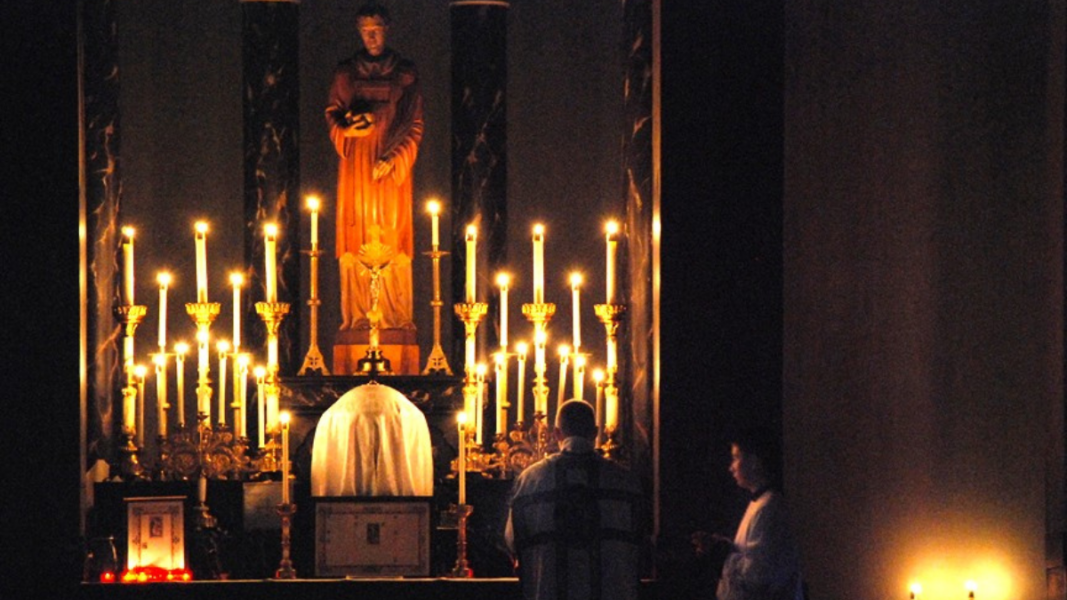
Before Holy Week of 1965, unable to face the new liturgy, Waugh asked his old friend from Downside Abbey, Dom Hubert van Zeller, to celebrate a private Mass for him in the traditional Rite on Easter Sunday. Evelyn’s family, deeply concerned about the seriousness of his depressive state, also interceded for this cause. But the abbot opposed it. Then, Waugh asked the same of Father Philip Caraman, his friend and confidant during his last and difficult years. On April 10, Easter Sunday, at ten in the morning, Father Caraman celebrated Mass in Latin according to the ancient form in the Catholic chapel of Wiveliscombe, attended only by this family and a few friends. Upon leaving the church, many of those present noticed how happy Waugh was. Father Caraman highlighted his serenity and joy, as if the depression had evaporated or as if he had just emerged from a dark night of the soul: ‘He was kind and at peace with himself, with that quiet serenity that priests usually find in those who are dying’. His friends who accompanied them to that Mass recount that the Evelyn who emerged from the ceremony was a transformed Evelyn. They return to the house and, while preparing for the Easter lunch, Evelyn Waugh died suddenly.
His daughter Margaret recounted this event in a letter with words of joy more than sorrow: “Don’t be too sad about Dad. I think it was like a miracle. You know how much he wanted to die; and to do so on Easter Sunday, when all the liturgy speaks of death and resurrection, and after hearing Mass in Latin and receiving Holy Communion, is exactly what he wanted. I am sure that at Mass he prayed for his death. I am very happy for him.”
In his panegyric during the requiem Mass celebrated in Westminster Cathedral, Father Caraman highlighted the place that the Mass occupied in the heart of Waugh’s life and faith: “The Mass was the most important thing for him in this world. For most of his life, it remained the same as it had been for centuries, identical and recognizable everywhere, while everything else was threatened by change. He was saddened when he read that in some churches the old altar had been removed and replaced by a table, or that side altars had been suppressed because private Masses were considered non-liturgical or unnecessary. Like all who know something of the course of history, he felt disturbed.”
In the epilogue to his biography of Waugh, Christopher Sykes tried to explain the reasons for his friend’s obstinate opposition to the new reforms of the Church: “His opposition to reformist trends was not the simple expression of his conservatism or aesthetic preferences. It was based on something deeper. He thought that, in its long history, the Church had developed a liturgy that allowed the ordinary and sensual man (as opposed to the saint, who is outside any generalization) to approach God and be aware of holiness and divinity. To throw all that away under the excuse of updating seemed to him not only foolish, but also dangerous… he could not bear to think of a modernized liturgy. If that string is tuned, he thought, faith will be lost… Whether his fear was justified or not, only the inescapable judgment of time will be able to demonstrate.”