


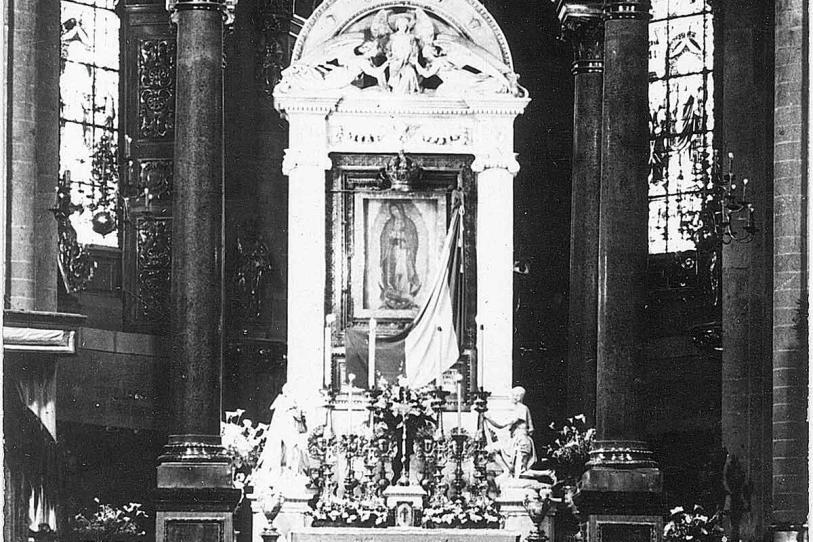
On July 30, 1926 marked the first full day that the Sacred Original of Santa María de Guadalupe remained outside the vicinity of Tepeyac, safeguarded in a double-bottomed wardrobe under the custody of engineer Luis Felipe Murguía Terroba. One hundred years later, that episode—occurring in the darkness of the night of July 29 to 30—remains one of the most discreet and transcendent moments in Guadalupan history. While Mexico plunged into the religious persecution that would ignite the Cristero War, a small group of faithful and ecclesiastical authorities decided to protect Juan Diego’s tilma from possible attacks, temporarily replacing it with a faithful oil-copy replica.
The context was one of extreme tension. Following the dynamite attack of November 14, 1921, when a staff member from the President’s Private Secretariat placed a stick of dynamite among the altar flowers without damaging the image, fear of further assaults intensified. That decade was marked by conflict and clashes, harsh confrontations and assassinations, as Catholic groups faced off against government-aligned ones. All of this culminated in the enactment of the Calles Law, which prompted the Mexican episcopate’s Collective Pastoral Letter of July 25, 1926, decreeing the suspension of public worship beginning July 31.
The safety and integrity of the tilma were in jeopardy. The Abbot of Guadalupe, Feliciano Cortés, and Archbishop José Mora y del Río authorized the creation of a replica. The painter from Puebla, Rafael Aguirre, an expert in Guadalupan representations, worked under intense pressure and, in approximately fourteen days, delivered the painting known as the “Twin”.
At midnight on July 29, 1926, under the direction of Abbot Cortés himself and in the presence of witnesses, a group of workers removed the gold-framed image from the back of the main altar. The Sacred Original, protected by its silver sheet, was wrapped in silk cloths, sealed, lacquered, and covered with coarse burlap. It was placed inside the double bottom of an old Chinese wardrobe that stood in the Basilica. Simultaneously, the Twin took the original’s place; engineer Murguía suggested smoking the glass to dull the fresh oil’s shine so the switch would go unnoticed. No one noticed during the nearly three years that followed.
The wardrobe was transported in a moving truck loaded with old beds and mattresses to the home of engineer Luis Felipe Murguía Terroba, in downtown Mexico City (first on Meave Street and, later, after the area was designated “red,” to the Murguía Bookstore, on what is now 16 de Septiembre). There the image remained, guarded with absolute discretion. A lamp burned continuously before the wardrobe; every Saturday Abbot Cortés celebrated Mass in the house. The Murguía family assumed responsibility for protecting the most precious treasure of Mexican devotion at the moment of greatest risk. During those years, the Archbishop of Mexico came every Saturday to celebrate Mass in that house, which had become the Murguías’ home.
When the conflicts ended, the return was also carried out in secret. On June 28, 1929, two days before the resumption of public worship following the so-called “arrangements,” Abbot Cortés, two canons, engineer Murguía, and three witnesses opened the wardrobe before a notary. The image was found intact. It was reinstalled in its gold-and-silver frame that same night with minimal ceremony and the utmost discretion. The Twin, which had occupied the main altar from 1926 to 1929, was given to the Murguía family as a token of gratitude. Today it is venerated in the Church of the Sacred Heart of Jesus in Pachuca, Hidalgo, built at the initiative of that same family next to the University of Soccer and Sports Sciences.
This centenary takes on special resonance when projected toward October 12, 2026, the date that will mark fifty years since the solemn transfer of the Sacred Original to the new Basilica of Guadalupe. In 1976 the image left the old sanctuary (now the Expiatory Temple of Christ the King) to occupy its current place in a building designed to welcome millions of pilgrims. The continuity is eloquent: the same image that in 1629 left Tepeyac during the Great Flood to console a flooded city; the same one that in 1926-1929 was removed not to console, but to be protected from anticlerical hatred; and the same one that, since 1976, presides over the new Basilica and continues to be the center of Mexican piety.
The 1926 event was not merely an act of prudence in the face of the enemies of the faith. It was a concrete expression of faith that prioritizes preserving the visible sign of the Mother of God when circumstances demand it. The discretion of that night, the silence of the custodians, and the fidelity of the Murguía family ensured that, when worship was restored, the Mexican people recovered Juan Diego’s tilma intact. From the perspective of the half-century of the new Basilica, that secret withdrawal reminds us that Guadalupan devotion has known how to adapt to historical storms without losing its center. The image that millions contemplate every day today is the same one that, one hundred years ago, traveled hidden in a wardrobe to continue being, in times of trial, Mother and Protector.