


On the feast of the Most Precious Blood of Our Lord, 1 July 2026, four priests of the Priestly Fraternity of Saint Pius X (FSSPX) received episcopal consecration at the seminary in Écône, Switzerland.
In the presence of the Superior General, Davide Pagliarani, and a large gathering of priests, religious and faithful from around the world, Alfonso de Galarreta, assisted by Bernard Fellay, two of the bishops consecrated by Marcel Lefebvre, laid hands on Pascal Schreiber, Michael Goldade, Michel Poinsinet de Sivry and Marc Hanappier, so that they might serve as auxiliary bishops of the Fraternity without territorial jurisdiction.
The ceremony, broadcast live and celebrated outdoors on the meadow of the historic seminary, has sharply revived old tensions between the Fraternity and the Holy See. Barely twenty-four hours later, on 2 July, the Dicastery for the Doctrine of the Faith issued a statement describing the act as “schismatic in nature”, recalling that it lacked a pontifical mandate and declaring that both the consecrators and the newly consecrated incurred the excommunication foreseen by canon 1364 § 1 of the Code of Canon Law.
The document, signed by Prefect Víctor Manuel Fernández, further warns that clerics and lay faithful who formally adhere to the Fraternity would automatically incur the same latae sententiae excommunication, and urges all not to remain in what Rome considers a state of schism. Reactions were swift. For some, the measure is necessary to safeguard the Church’s unity; for others, it is a rigid and unrealistic application of canonical norms that fails to take into account the pastoral and generational reality of thousands of Catholics who, in various countries, have been born, baptized, confirmed and educated entirely within FSSPX communities.
Amid this new chapter of controversy, the concrete history of how the Fraternity reached Mexico and how it has taken root and expanded in the country offers a contrast worth recounting in detail—especially to clarify the situation of the FSSPX and its growth in Mexico.
The Fraternity’s beginnings in Mexico are linked to Catholic Jalisco. Zapotiltic is inseparably tied to the origin of the Priestly Fraternity of Saint Pius X in Mexico. There, in the early 1970s, amid the post-conciliar upheaval, two women, the sisters Ana María and María Isabel Contreras Villalbazo, began to notice subtle yet profound changes in the parish life of their town. The liturgy, catechesis and certain pastoral attitudes reflected the tensions running through the universal Church after the Second Vatican Council. Daughters of a deeply Catholic marriage—that of Tomás Contreras Contreras and María Villalbazo de Contreras—the sisters had received a solid formation thanks to their father’s passion for reading. María Isabel also stood out for her cultural work, editing a magazine of general interest and organizing events that promoted literature and music in the community.
Providentially, they received at their door a leaflet entitled Alerta Católica, sent by the Minim Franciscan Sisters of Mexico City, which denounced the modernist errors that were approaching. The document prompted them to seek deeper answers. They contacted the Reverend Father Adonai Correa, a priest who had remained faithful to tradition and who spoke clearly about what was happening in the Church. Little by little they came to the name of Marcel Lefebvre, the missionary bishop who, since founding the Fraternity in Écône in 1970, defended the integrity of the Catholic faith, the traditional Mass and the sacraments in their received form.
The path was far from easy. The sisters faced accusations and personal pressure. Their own uncle, Alfredo Galindo Mendoza, Bishop of Tijuana, repeatedly urged them to abandon “that path.” “Return to the loving bosom of Mother Church, giving greater joy to the angels of heaven by your conversion than by the perseverance of 99 just ones,” he would repeat, according to testimonies published by the FSSPX. They, however, remained steadfast. They knew that a movement of Catholics faithful to tradition already existed in Mexico before the Fraternity’s formal arrival, sustained by priests such as Father Adonai Correa, who celebrated Mass for them in their own home.
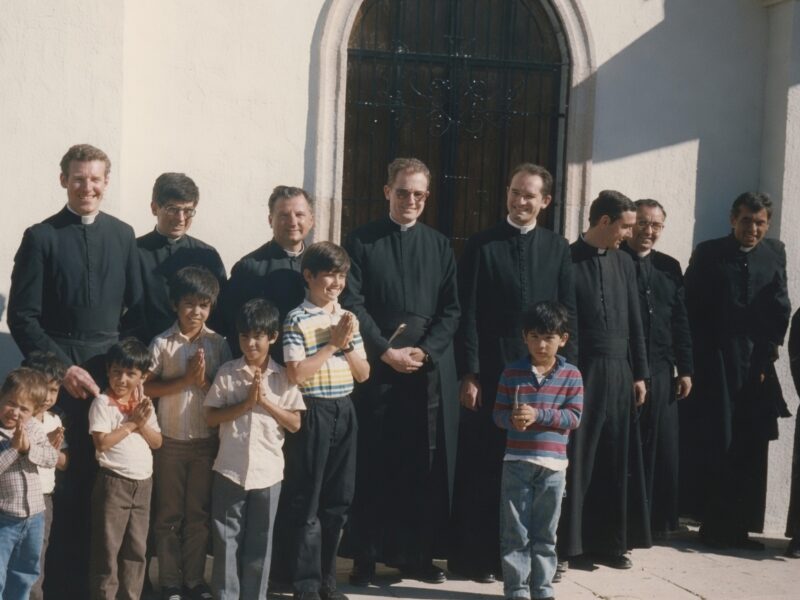
The turning point came at the end of December 1979. A group of about twelve young men gathered in a house near the Colima volcano for a spiritual retreat. Two priests and a seminarian of the Priestly Fraternity of Saint Pius X arrived, wearing cassocks. A certain Father Ford gave the first talk, which remained etched in the memory of those present: “We are of the Priestly Fraternity of Saint Pius X, founded by His Excellency Archbishop Marcel Lefebvre, a traditionalist bishop who has preserved the Catholic faith.” They preached two retreats attended by twenty-two young men, several of whom felt a call to the priesthood. The priests were enthusiastic: “The blood of the Cristeros is beginning to bear fruit.” During the retreat they were also visited by Father Regis Babinet, who, from El Paso, Texas, would begin the systematic apostolate in Mexico. From that encounter several vocations emerged that left for the seminary in Argentina in March 1980. Between 1981 and 1984, Fathers Lafitte and Babinet, based in El Paso, regularly visited the area to ensure the celebration of the traditional Mass, while Father Ford continued to preach retreats each summer.
In 1981 Marcel Lefebvre visited Mexico. He was in Guadalajara, where the Contreras sisters were able to meet him personally and offer every possible collaboration so that the Fraternity could be established in the country. They proposed a plot of land in Zapotiltic for a retreat house, a priory and its chapel. Although another site in Guadalajara was also mentioned, the history of the FSSPX recounts that it was “by divine providence” that Zapotiltic was chosen as the cradle of the Fraternity in Mexico.
The two sisters were the persons Providence had reserved for this work; however, María Isabel was going through a personal crisis after losing her two young daughters and her husband, and was also suffering from an illness that worsened over time. With an iron will she encouraged her sister Ana María to continue working for the social reign of Christ and to maintain contact with the Fraternity. On her deathbed she exhorted her to persevere without faltering and left a clear message for her uncle, the Bishop of Tijuana, who urged them not to accept traditionalism: should he come to attend her in her final moments, she asked him to thank him for his prayers and petitions for the good of her soul, but to tell him that “under no circumstances have I changed my way of thinking regarding my faith.”
In June 1984 the Superior General of the Fraternity, Franz Schmidberger, arrived in Zapotiltic to take possession of the house of spiritual exercises that the Contreras sisters had built. His words remained engraved in the historical memory of the FSSPX: “We are in the time of ploughing and sowing; with our sweat, our tears and, if God wills, with our blood, we cast the seed so that a future generation may reap a rich harvest in the divine granaries. Two more words: he who is willing to fight for a long time—perhaps his whole life—and perseveres with Mary beside the Cross of Christ, only he will not succumb to the thousand seductions of false attempts at restoration.”
On 6 September 1984 the first priests were installed: Julio Tam, Italian, as superior of the autonomous house, and a few days later Ramón Anglés, Spanish, as vicar. The regular life of the priory then began—daily exposition of the Blessed Sacrament, daily Mass, catechism for children and adults. The atmosphere was cordial and fervent, although the townspeople referred to the newcomers as “Lefebvrists” or “Hallelujahs.” In the schools, children were harassed by some nuns and by their own classmates; yet the priests instructed them solidly so that they might “resist the liberal environment” outside. Many of those young people are today fathers of families who persevere in the tradition alongside their children.
Over time other priests strengthened the work: Álvaro Calderón, Argentine, who succeeded Father Anglés and distinguished himself by his doctrinal depth in catechesis, retreats and sermons; Jesús Mestre Rojo, Spanish, remembered for his tireless zeal with children and adults; and others such as Fathers Martel, Miguel Ángel Jiménez and Mariano.
On 20 January 1988 the new chapel dedicated to Saint Raphael the Archangel—an advocation to which the Contreras family had a special devotion—was solemnly blessed. The preparation of the construction and the ceremony was entrusted to Fathers Julio Tam and Álvaro Calderón, always with the decisive help of Ana María Contreras. Lefebvre sent a letter of thanks, signed in his own hand, as he was unable to attend. The blessing filled the faithful with hope. Among the priests present were Bishops Bernard Fellay and Alfonso de Galarreta, together with Fathers Miguel Ford, Babinet, Alejandro Jiménez, Calderón and Tam. Shortly afterwards the first confirmations were administered by Bishop Galarreta. The chapel became a centre for retreats and regular sacramental life. Ana María Contreras continued the work with the same heroism that had characterised her sister until the end of her days.
Almost four decades after those first steps, the seed planted in Zapotiltic has borne abundant and widespread fruit. What in 1984 was an autonomous house in a small town in Jalisco became, already in 1985, the District of Mexico and Central America of the Priestly Fraternity of Saint Pius X. The district headquarters was later moved to Mexico City, while the priory in Jalisco was established in Guadalajara. Today, under the direction of the District Superior, Pierre Mouroux, the structure comprises six priories, nearly forty chapels and missions, three retreat centres and one school. The presence extends across numerous states of the Republic and maintains an oratory in Havana, Cuba. Among the principal priories are that of Our Lady of Guadalupe in Mexico City, with its chapel at Miguel Schultz 91, Colonia San Rafael, where Sunday Masses are celebrated along with daily catechism and rosary; that of Saint Athanasius in Guadalajara; that of Our Lady of the Rosary in León, Guanajuato; that of Saint Benedict in Gómez Palacio, Durango; and the Priory of Blessed Rafael Guízar y Valencia in Orizaba, Veracruz, as well as other houses that complete the network.
The historic chapel of Saint Raphael the Archangel in Zapotiltic, located at 287 Nicolás Bravo Street, is a place of worship and formation. Masses are celebrated there on the second and fourth Sundays of the month at 12:30 p.m., and on the preceding Fridays at 7:00 p.m. The site also houses an active Cultural Centre that organises catechesis, children’s processions and formation sessions for catechists.
Zapotiltic is a mission that continues to bear fruit. The geographical expansion of the District of Mexico is notable and sustained. There are regular chapels and missions in Mexico City and the states of México, Puebla, Veracruz, Oaxaca, Guanajuato, Jalisco, Durango, Coahuila, Nuevo León, Chihuahua, Quintana Roo—where in April 2026 the first stone of the future chapel in Cancún was blessed—Yucatán, Chiapas, Aguascalientes, Michoacán, Morelos, San Luis Potosí, Zacatecas, Hidalgo, Tamaulipas and Guerrero. This network enables dozens of faithful to have regular access to the traditional Mass, to the sacraments administered in their integrity, and to a Catholic formation rooted in tradition.
Another sign of vitality was the arrival, in September 2025, of the first Sisters of the Fraternity of Saint Pius X to the District of Mexico—the first foundation of this female congregation in the country. The sisters Marie Édouard, from France, as superior, María Cándida, originally from Mexico, and María Eulalia, from Argentina, came to support the priests’ apostolate and to promote female vocations to the consecrated life. Their presence adds to that of the Mothers Minim Franciscan of the Perpetual Help of Mary, a traditional congregation that already in the 1970s alerted the Contreras sisters and which maintains its convent in Mexico City with daily Masses.
The progressive opening of chapels and Mass centres, from southern Jalisco to the Yucatán Peninsula and the northern border, demonstrates that the work is multiplying. In a Mexico marked by pastoral and cultural challenges, this network of priories, chapels and communities represents a striking sign: Catholic generations have opted for the traditionalism that affirms itself in the perennial Catholic faith, in the Latin liturgy celebrated with reverence as it began in Zapotiltic.
According to the official FSSPX Statistics 2025 report, published by the General House on 22 December 2025, as of 1 November of that year the Fraternity counted a total of 1,482 members: two bishops (not counting the four newly consecrated on 1 July), 733 priests, 264 seminarians, 145 brothers, 88 oblates and 250 sisters, of 50 nationalities, with an average age of 47 and a presence in 77 countries.
Yet the recent declaration of the Dicastery for the Doctrine of the Faith, which describes the consecration of the four new bishops as schismatic and extends the warning of excommunication to those who formally adhere to the Fraternity, poses a paradox that cannot be overlooked. While Vatican authorities reiterate the canonical measures of 1988 and update them to the present situation, in Mexico and other countries entire generations have been born, baptized, confirmed, married and have raised their children within the communities of the Priestly Fraternity of Saint Pius X.
These faithful, especially the younger ones, have no personal memory of a “rupture” with Rome or of the circumstances surrounding the 1988 consecrations, and their legitimate bishops are those consecrated on 1 July 2026. For them, the traditional Mass, the sacraments in their received form and the doctrinal formation they receive in the priories and chapels constitute their normal, everyday Catholic life.
Applying to them the same canonical categories of “schismatics” and “excommunicated” that were used almost four decades ago is, in practice, increasingly problematic and lacking in elementary justice. Proof of this is that the FSSPX in Mexico, with its six priories, nearly forty active chapels, new foundations and generations of faithful who have grown up entirely within it, stands in stark paradoxical contrast to the accusations that continue to describe it as a marginal or irregular reality.
The history in Mexico and its present continuation show that what began as an act of discreet fidelity in a small town in Jalisco has, over time, produced a growing community whose roots can no longer be explained solely by the juridical controversy, but by the ordinary transmission of the faith from parents to children over more than four decades. And in that dilemma stands the Catholic Church of Pope Leo XIV.