


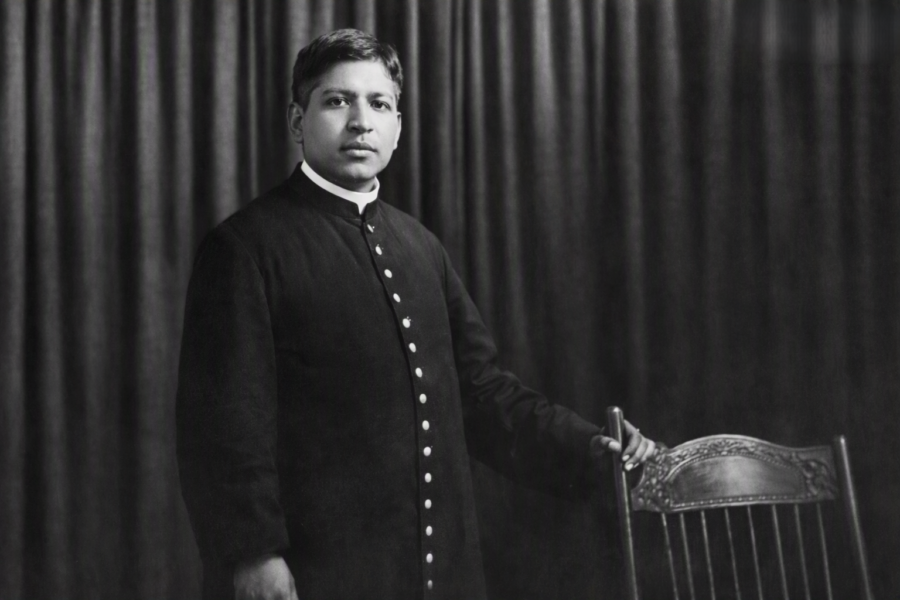
On October 8, the Church celebrates the liturgical memorial of Saint Tranquilino Ubiarco Robles, a priest and martyr of the Cristero War, whose figure, for decades relegated to an almost intimate and silent devotional context, is beginning to emerge with renewed strength among the faithful.
Ninety-eight years after his martyrdom, his story once again draws gazes, prayers, and pilgrimages, especially in Tepatitlán de Morelos, the place where he gave his life for Christ and where his remains rest. There, in the City’s Alameda, a temple that has gradually been rising celebrates the testimony of his martyrdom beside the dry, dry tree that held his body hanging on that early morning of October 5, 1928, a silent witness that has survived time, modernity, and is now transformed into an intimate space that invites moments of prayer and meditation, with devout and religious music playing 24 hours a day, where passersby become aware that the ground they tread is not ordinary.
The life of Saint Tranquilino Ubiarco, born in Zapotlán el Grande in 1899, is distinguished by a priestly journey marked by pastoral zeal, integrity, and a deep love for the Eucharist. He entered the seminary as a child and was ordained a priest in 1923. His ministry took him through various communities in Zacatecas and Jalisco, until he arrived in Tepatitlán as economical vicar of the parish of San Francisco de Asís, whose towers are the symbol that distinguishes the so-called “Pearl of the Highlands.”
The early morning of his death is recounted with precision in local tradition and historical sources. After being detained by federal soldiers, Tranquilino was taken to the holding cells of the Municipal Palace. Even there, according to testimonies, he organized the prisoners to pray the rosary. His executioner, Colonel José Lacarra, led him to the present-day Alameda; of course, in 1928, Tepatitlán was little more than a hamlet; the priest was taken to the outskirts of the town, and in that solitary place, a soldier named Vargas was given the order by Lacarra to carry out the “execution” of the vicar; however, he refused to obey, stating that the priest was “a just man.”
Vargas would meet the same fate as Ubiarco; his refusal cost him being shot. But the priest remained. It is not known who carried out the sentence, but the circumstances of the martyrdom became known. Tranquilino, before surrendering his life, blessed the rope and offered brief prayers. His body remained suspended from the eucalyptus that today stands dry, while all the other trees in the area remain green and alive.
That tree, now a symbol of spiritual resistance, still receives visits from devotees who leave flowers, votive candles, and small retablos. For years, some removed pieces of bark, convinced that it possessed healing properties. To protect it, a railing and a stone base with reliefs narrating the martyrdom were installed. The devotion, though modest, never entirely disappeared.
The parish of San Francisco de Asís safeguarded the first-class relics of the saint—his skeletal remains—preserved in an urn that attracts those seeking consolation, intercession, or simply a moment of silence before the memory of the martyr. But on August 4, 2023, a procession was organized through the streets of Tepatitlán to transfer those bone relics and place them, definitively, in the urn that can now be seen for veneration.
On October 5, 2023, coinciding with the anniversary of the martyrdom of Saint Tranquilino Ubiarco, the temple that took more than two decades to build was dedicated, its cornerstone laid on December 18, 2000, thanks to the impetus of Father Salvador Zúñiga, of happy memory, whose statue has been erected as a token of gratitude for the countless works carried out by that zealous pastor.
Also preserved are his priestly garments, those in which he was hanged, and the branch of the tree that held his body. These objects, laden with history and spirituality, constitute a small hagiographic treasure that has begun to awaken greater interest among pilgrims and scholars.
For years, devotion to Saint Tranquilino Ubiarco remained in a discreet second place, overshadowed by figures of deep regional roots such as the Lord of Mercy, Blessed Anacleto González Flores, and other martyrs like Saint Toribio Romo, who achieved explosive popularity that led to an unprecedented religious and economic phenomenon. In contrast, Tranquilino’s figure seemed destined for a minority cult; however, that perception is changing. The community has begun to become more actively involved, convinced that the temple is a spiritual and cultural meeting point that could hold importance similar to that of the martyr Toribio Romo, patron of migrants, whose magnificent cult complex is located in Jalostotitlán.
Devotion to Saint Tranquilino Ubiarco is leaving anonymity behind. His story, profoundly human and profoundly Christian, resonates today in a country marked by violence and the search for ethical references. His martyrdom, accepted with serenity and faith, offers a different light—the light of one who did not flee, did not negotiate, did not hide, and did not renounce his priesthood to save his life, but remained faithful to the end. In times when memory seems to fragment, his figure emerges as a reminder that holiness can also be born in ordinary life, in everyday ministry, and in silent self-giving.
Ninety-eight years after his death, Saint Tranquilino Ubiarco speaks again. He speaks from the dry tree, from the urn that holds his remains, from the garments he wore in his final act of love. He speaks from Tepatitlán, which is gradually rediscovering that it has a martyr at home. And above all, he speaks from the faith of those who are beginning to invoke him with renewed confidence, certain that his testimony does not belong to the past, but to the present that seeks hope on the way toward the 100th anniversary of his martyrdom, which placed him among the Cristero saints.
Saint Tranquilino Ubiarco, pray for us.