


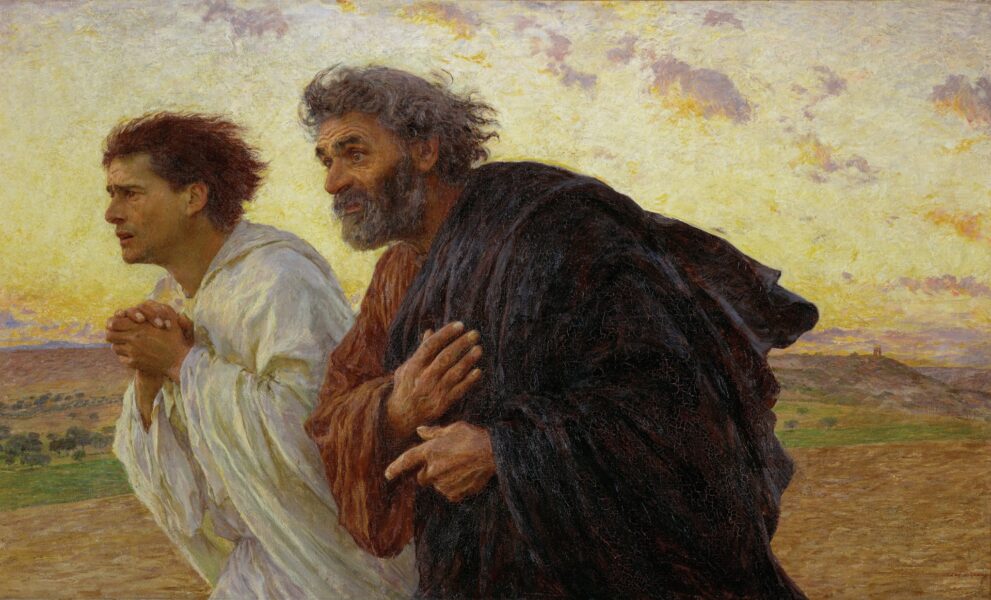
Fr. José Juan Sánchez Jácome / ACN.- During this Easter time, upon seeing the risen Christ, we experience joy, peace, and strength. But also, upon reflecting on the disciples’ experience when they encountered the risen Christ, we reconsider the situation we live in and God’s style for fostering our spiritual growth.
Looking at the disciples, we recognize that we too fall into complaining, impatience, and a lack of understanding of the pedagogy that God employs with us. There comes a moment when we tend to complain that God has left us, that He no longer listens to us, and that He has forgotten us.
This is a complaint because one feels the pain and emptiness of this experience. But it can also be a matter of impatience and a lack of understanding of divine pedagogy. We do not know how to trust in God nor do we manage to comprehend the way God is leading our life. The things of this world have their own rhythm, but spiritual life has a different dynamic.
In this Easter time, God has come to respond, through His word, to this complaint, to the impatience we feel, and to the lack of understanding of divine pedagogy. We can consider three responses that God’s word has been pointing out.
First, many times we do not feel God not because He has left, but because we focus on the pain. The suffering can be so great that we see nothing else, for pain eclipses our gaze. This happened to Mary Magdalene, who, overwhelmed by her pain, confuses Jesus with the gardener and with an angel. There was Jesus, but her pain did not allow her to see Him.
It is not a matter of denying the pain, but of not allowing it to have the last word and to eclipse our gaze. Jesus said to her: “Woman, why are you weeping?” There are pains that blind you, that prevent you from even recognizing the things you have always loved. In this way, Mary Magdalene does not realize that it is Jesus Himself who is speaking to her, and she begins her litany of pleas: “Sir, if you have carried him away, tell me where you have put him, and I will take him away.”
Referring to the Magdalene, Fr. Luigi Maria Epicoco reflected: “There are questions we raise to heaven, solutions we propose to God that, to the eyes of an external observer, seem like mere delirious words. But to all this, God responds not with an ‘explanation,’ but with a ‘vocation’: ‘Jesus said to her, “Mary!” She turned and said to him in Hebrew, “Rabboni!” (which means Teacher).’ He calls us by our name, He responds by addressing us personally.”
It is not a matter of closing our eyes to the pain of the world, but rather of changing orientation, stopping living with our gaze fixed on the tombs—even the inner tombs—and learning to live as risen ones. With Christ, we learn that our life is not defined by our sins, fears, and defeats.
Second, the sin committed leads the apostles to discard themselves. They have been cowards, they have denied Him, they have left Him alone, and in such situations, one thinks that God will no longer approach our life. When we have sinned and when we have behaved miserably, one does not always expect God to be kind. We do not expect God to be merciful when we have committed injustices. Perhaps in those moments, one expects rejection, and our own sin leads us to discard ourselves. But the risen Lord surprises us by showing us that when we least deserve it, God loves us more than anyone.
Third, many times our complaints and impatience reflect the need to strengthen a life of faith. It is not enough to maintain a religious attitude and seek God when we feel like being with Him. Does my faith depend on everything going well for me and everything making sense, or am I capable of trusting even when I do not understand? That is the most important question: seeking God, even when we do not feel like it; following God, even when we do not understand everything; being faithful to God, even though there are many adversities around us.
Faith gifts us a deep gaze and allows us to recognize God’s presence in unexpected places and moments, like the apostle John who, on the lake, comes to shout: “It is the Lord!”, upon recognizing that the man who was waiting for them on the shore was Jesus, after having obtained the miraculous catch. Faith is developing that sensitivity of John to point excitedly to the Lord who is with us.
Pope Francis says: “In that exclamation: ‘It is the Lord!’, there is all the enthusiasm of Easter faith, full of joy and wonder, which strongly contrasts with the bewilderment, discouragement, and feeling of impotence that had accumulated in the minds of the disciples.”
No sensory experience or miracle is needed, but the deep gaze that faith gives, which leads John to infect the apostles with joy once he recognizes Jesus.
Faith will make it possible for us to recognize God in our life, despite the mistakes we make and the falls we may have. Faith is not a deposit of doctrines; it is something alive that always wants to grow and develop. The Lord will always be stimulating you so that your Christian life grows and becomes more beautiful.
Therefore, if a desire to grow awakens in your heart, if you feel like loving more, if you desire to have a more joyful or more committed faith, it is the Lord knocking at your door. Do not stifle those divine impulses, do not hide them, do not extinguish them. They come from God who loves you and wants to give you something better.
God is always acting in our life. When we feel like praying, when one feels the desire to forgive, to help others, to start a new life, to overcome the slaveries that we have freely accepted. When we do not remain indolent or indifferent before the pain and evil in the world. When we ask ourselves what we have to do to bring light before so much darkness, to put love where hatred prevails, to announce the truth where lies reign.
Every time we experience these desires to grow, to commit ourselves, and to do good, it is a matter of saying, like John: “It is the Lord!”. It is not that we are good, but that the Spirit of God impels us. If I have good thoughts and want to do good, if I feel like praying, if there is a force that lifts me up in my discouragements and falls, if I want to forgive and start anew: “It is the Lord!” who is acting in my life.
It is good to shout like John to recognize that God continues to act. When we want to return to the Lord and forgive and do things well, let us not repress this impulse of the Spirit so that we may say like John: “It is the Lord!”.
The same thing that we experience, we need to recognize it when we see the commitment of other brothers and the dedication of so many people to announce God and build the kingdom, despite so much violence and darkness in the world.
John’s shout: “It is the Lord!” resembles the thrill that we can feel when, in the hard struggle of life, we intuit that the Lord is in the giving of the brothers, even though we had not realized it. The Lord is in the people who are attentive to us and whose love only becomes evident to us when they have passed away. In the Christian community that, with all the weight of its limitations, offers us the bread of the Word and the Eucharist. In those who, without boastful advertising, have understood that it is time to lend a hand so that justice may make its way. In those who are faithful to their matrimonial or consecrated vocation without anyone ever knowing. In those who, being able to earn more by lying, remain in the truth.
It is the Lord acting in us and impelling others. Love makes John more perceptive than the others and Peter faster, who immediately throws himself into the water to reach the Lord as soon as possible. St. Josemaría Escrivá points out: “Peter is faith. And he throws himself into the sea, full of a boldness of wonder. With John’s love and Peter’s faith, how far will we go?”