


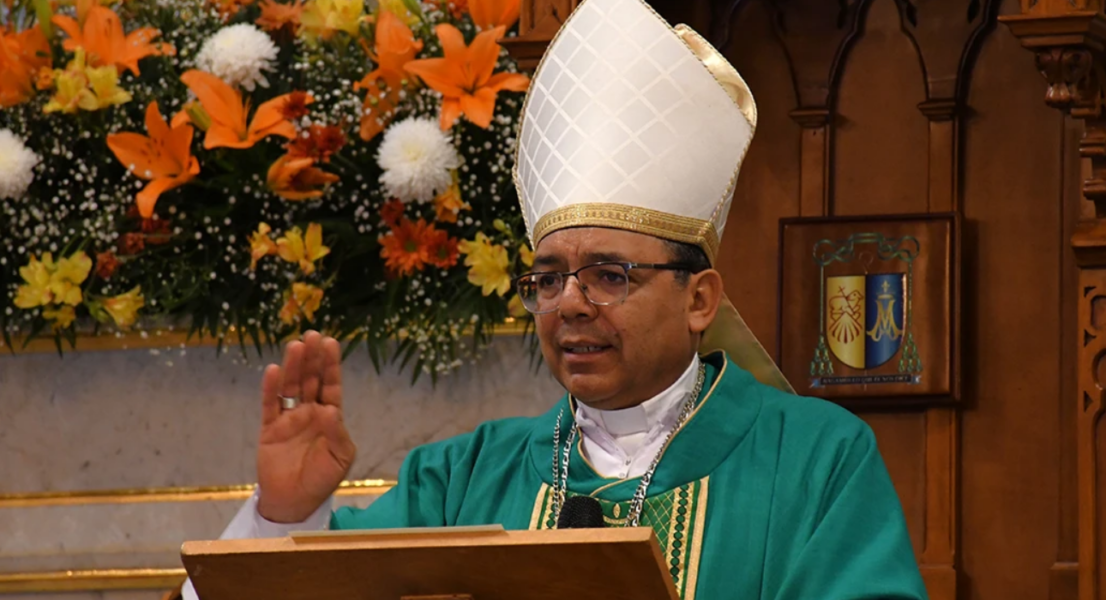
This Sunday, October 11, 2026, the bishop of Aguascalientes, Juan Espinoza Jiménez, addressed the faithful of his diocese with a statement confirming what had already spread with alarm days earlier: virtual threats against him, widely circulated on social media following his recent remarks on delicate situations unfolding in the country.
The prelate speaks with serenity and trust in God and reiterates what the Church has always preached: its duty to proclaim the Gospel, defend the dignity of every person, and raise its voice against anything that harms life, justice, peace, and the common good. His words, he clarifies, are not intended to favor or attack any individual, party, or political group, much less to polarize; they stem from the pastoral responsibility of viewing reality through the eyes of faith and always promoting truth, justice, and human dignity.
This pastoral duty, expressed through recent homilies, particularly the one on September 27 at the Cathedral of Aguascalientes, triggered a response that revealed how a sector of public debate is adrift, clinging to a medium as illegal as it is despicable. Around October 1, content began circulating from a vulgar supporter of the regime in which 40,000 pesos were initially offered, later raised to 60,000, to anyone who would “ambush” the bishop, accompanied by insults such as calling him a “rat in a cassock.”
The Attorney General’s Office of the State of Aguascalientes opened an investigation ex officio for possible crimes of threats and incitement to crime, identified the account and the IP of origin, issued a protection order for the prelate, and continues its inquiries to identify the perpetrator. However, the alleged perpetrator, now hiding the hand that threw the stone, has denied authorship and conveniently attributed the material to manipulation with artificial intelligence.
The case unfolds in a climate where other pastors have denounced harassment and an attempt to silence the voice of the Church when it points out uncomfortable realities. Yet, what stands out is how extreme hatred is unleashed in the uncontrollable realm of social media, where anonymity, virality, and the reward of likes, followers, and, in many cases, “chayote” lead some to abandon any principle of ethics and truth. They incite, dehumanize, and maintain followers willing to carry out what is shouted, shielded by distance and the relative impunity that the internet offers.
The statement from Bishop Espinoza Jiménez directly confronts this logic. Threats must not lead to fear, confrontation, hatred, or, much less, to silencing the truth. Maintain calm, avoid any provocation, and not respond to evil with evil.
This phenomenon is concerning precisely because the hatred spread in the digital sphere does not know where it lands or how far it reaches. It can take root in pro-regime fanatics, enemies of religion, or ambitious individuals willing to turn into reality for money what is offered online; an inflammatory phrase on those networks can “transform” into a real threat against any minister of the Church or any citizen who points out the inconsistencies of power.
Putting a price on a person’s life is very serious because it opens a dangerous door, normalizing the dehumanization of the other as an enemy. Social media, far from being a simple “game,” amplify and accelerate this logic, and the incentive of fame, advancement, or favors leads some to abandon any ethical filter.
The pastoral response reminds us that the Church does not fear preaching the truth when it touches on human dignity and the common good. The real risk is that virtual hatred finds concrete executors. While authorities investigate and society demands protection, the call to serenity, dialogue, and prayer is not naive or merely a cliché; it is the affirmation that Mexico cannot allow polarization, fueled on social media by those who prioritize their treacherous loyalties over truth, to lead to atrocities that no one should provoke. We are still in time to prevent a new tragedy.