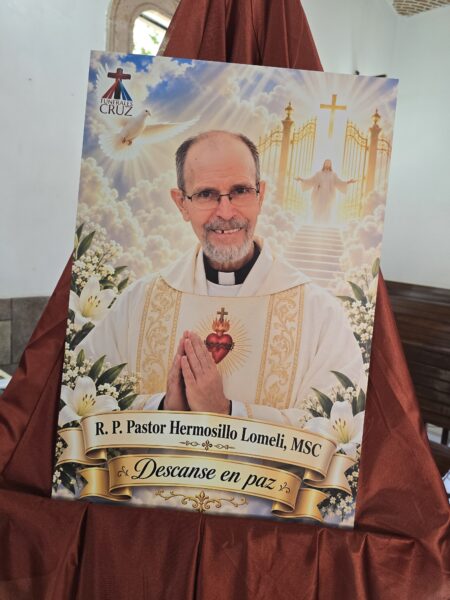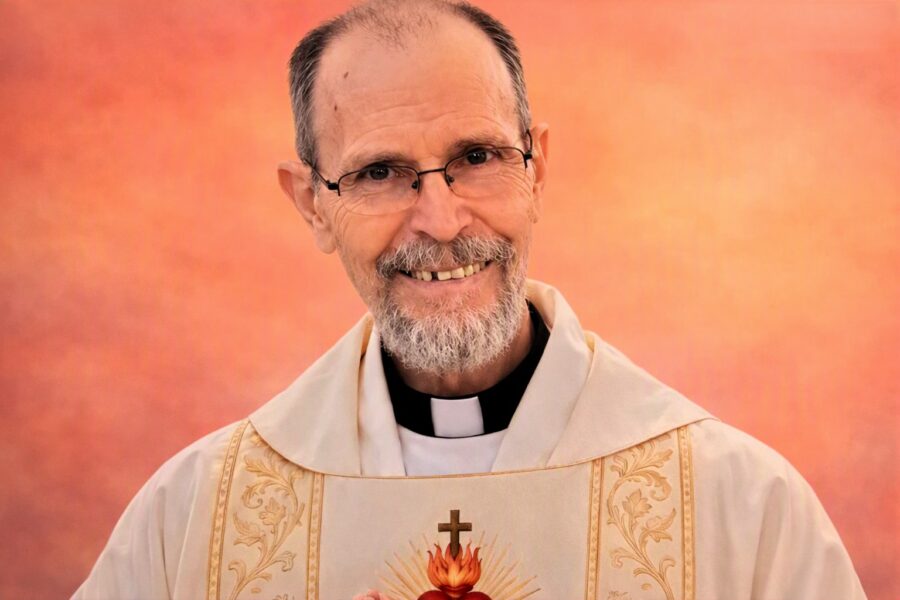
Tepatitlán de Morelos, Jalisco.- On the afternoon of September 21, 2026, the breath of the Reverend Father Pastor Hermosillo Lomelí, missionary of the Sacred Heart of Jesus and of Saint Mary of Guadalupe, was extinguished in the formation house that had welcomed him in the final stage of his life.
After the reception of his mortal remains prepared for the funeral rites, on September 22, the chapel and hallways of the Minor Seminary of the Missionaries of the Sacred Heart of Jesus and Saint Mary of Guadalupe, in Tepatitlán de Morelos, bore witness to the heartfelt homage and affection from his brothers in the Congregation, priests of the Diocese of San Juan de los Lagos, family members, friends, and faithful who had walked with him in health and in his decline, and who now came to ask for eternal rest for his soul.
At one o’clock in the afternoon, the chapel gathered two celebratory and present circles. The first was that of the Congregation. The rector of the Minor Seminary himself presided over the funeral rites and the final commendations for eternal rest. Five missionaries concelebrated with him, representing the pastoral spectrum as a whole: Father Javier Alberto Guerrero Enríquez, director of the Juan Pablo II Renacimiento Institute in Tepatitlán and now also second counselor of the general government of the Congregation; Father Moisés Cabrera Márquez, vocational counselor at the same Minor Seminary and one of those who accompanied the sick man in the hospital; Father Vicente Noceda Peña, administrative director of the Zaragoza Institute in Atizapán, State of Mexico, and a close friend of the deceased; Father Adrián López González, master of novices of the Congregation; and Father José de Jesús Valle Álvarez, from the parish of San Pedro Apóstol in Jantetelco, Morelos, who had shared with Father Pastor the missionary horizon of that land.
The second circle was that of the diocesan clergy of San Juan de los Lagos, the diocese in whose territory Father Pastor was born, ordained, and died. Present were Father Luis Manuel González Medina, pastor of San Francisco de Asís, and Father Miguel Ángel Dávalos Díaz, pastor of the Holy Family.
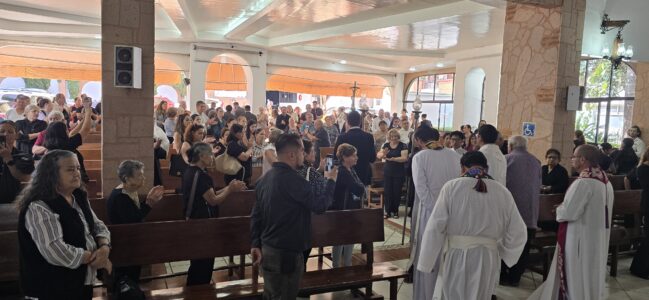
Completing the assembly were faithful, family members, and friends, the students of the Minor Seminary, and the religious women who also belong to the Congregation, a Mexican work born on June 3, 1938 in Azcapotzalco, when the priest Teodosio Martínez Ramos, from Chiapas, Pueblo Nuevo, Sitalá, gathered the first young men in response to the invitation of the Servant of God María Amada Sánchez Muñoz, foundress of the Missionaries of the Sacred Heart of Jesus and of Saint Mary of Guadalupe.
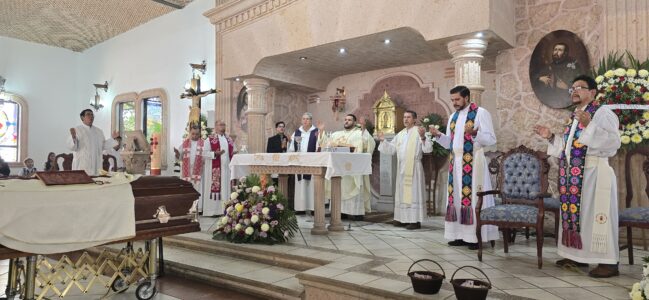
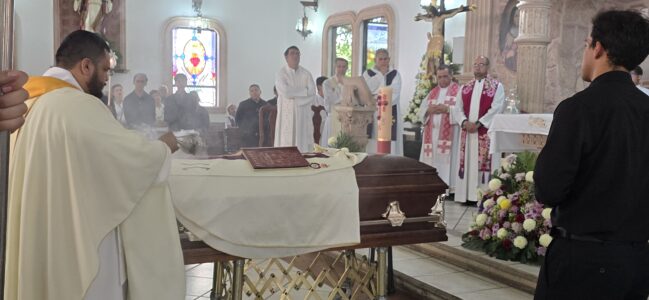
The coffin occupied the place that the funeral liturgy assigns to the baptized Christian—not hidden, not theatricalized, but placed before the altar as one who still participates, in silence, in the assembly. Around it were arranged the concelebrants, the seminarians, and the family. The scent of incense had not yet risen; first would come the rite of clothing the body with the signs of ministry. That gesture, a mystery of the priesthood and of profound theological meaning, opened the celebration and set the tone for all that would follow: the emblems and signs of the priesthood, the chasuble, the stole, and the Book of the Gospels, which declare who the deceased was before the Church and who he continues to be before God. The stole recalls the yoke of Christ assumed on the day of ordination; the chasuble, the charity that must cover the minister as his proper vesture; the Book of the Gospels, the Word that the priest was sent to proclaim and that now rests upon the coffin of one who can no longer preach.
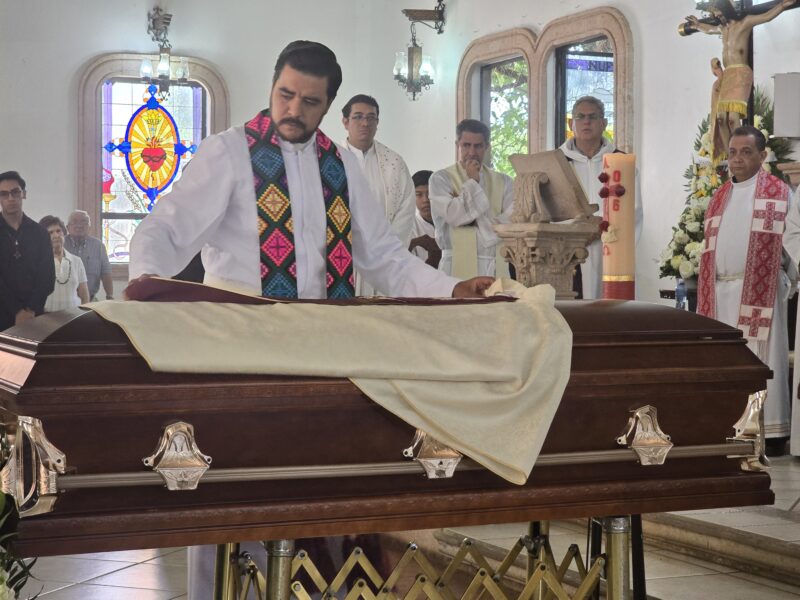
The gesture also holds a pedagogy for the living. The seminarians serving at the altar saw, perhaps for the first time with such clarity, the visible destiny of the vocation they are discerning—not only the full altar, but also the empty altar and the body vested for the final passage. The family members saw, upon their uncle and brother, not the civilian attire of youthful photographs, but the identity he chose and that the Church recognized until the end. The faithful saw confirmed what the rite never tires of repeating: the priest does not bid farewell as an official surrendering credentials, but as a baptized person whose configuration with Christ the priest extends even to death.
In the imposition of these signs, there was an echo of the words the homily would later gather. Father Pastor had ceased to preside at the Eucharist in the usual way some years earlier, overcome by illness, yet the community had not forgotten seeing him concelebrate on his priestly anniversary of December 20, at Christmas 2025, and on Holy Thursday. Those late concelebrations—the sick man still standing beside the altar—were now crowned by the chasuble he would no longer put on himself. Ministry, grace and not possession, returned to the Church in the very act by which the Church entrusted him to the Father.
Father Ricardo Casillas Ríos took the floor. He did not construct a panegyric of administrative merits nor an inventory of offices. From the first paragraph, he spoke of what the assembly had seen with its own eyes: “the great and profound faith with which Father Pastor carried his illness.”
The rector recalled that Father Pastor no longer presided at the Eucharist as before, but that it was “very gratifying” to see him celebrate on his priestly anniversary, December 20, and on his birthday, the 28th of the same month. The final stretch of his visible ministry was thus marked by Christmas and the Triduum; he concelebrated last Christmas and Holy Thursday. Between the manger and the washing of the feet was summed up, without his having planned it, the compendium of his end.
Then came the anecdote that gives this chronicle its title, which the homilist placed “about five or six years ago.” The rector saw Father Pastor crossing the hallway, as diligent as ever, and said to him, with the frankness permitted by life in common: “Father, since nothing presses you anymore, why don’t you just watch television there in your room?” The reply, which Casillas Ríos reproduced before the coffin, admitted no gloss: “No. If I am to die, I want to die on the line.”
“To die on the line” is an expression of trade and field, the refusal to withdraw before time, to turn illness into a pretext for abandoning one’s post. The rector interpreted that phrase as the attitude with which Father Pastor faced “this last part of his life and his illness.” And he added what most impressed the conscience of those who accompanied him: “However painful it was, he never complained. I never heard him say: what am I still doing here, this illness has finished me. He never complained nor railed against his illness.”
There was, indeed, a moment of physical truth that the homilist did not wish to sweeten. A few days earlier, in the hospital, Father Moisés was with him. They saw him tired. The doctor asked if he was already tired. For the first time, the sick man said yes. “But he was only tired,” the rector clarified. In that minimal phrase was summed up the honesty of a man who loved to live until living cost him and who did not feign strengths he no longer possessed.
From this Casillas Ríos drew the lesson he wished to leave the assembly: Father Pastor had a profound and great love for life and “bet on life until the very last moment, even though in his final moments living cost him so much.” It was not an apology for suffering for suffering’s sake. It was about reading, in a concrete biography, the Gospel of the day, drawing near to Jesus to take his yoke and discover that his burden is light. The yoke is felt. It hurts. It weighs. And yet, “it becomes possible to carry it. It becomes possible to move forward.” The evangelical paradox—that what does not seem gentle and light is so—is not demonstrated in the abstract; it is verified, the homilist said, when one takes the Lord’s burden and “curiously, when we take up the Lord’s burden, our own becomes light. Our own becomes bearable.”
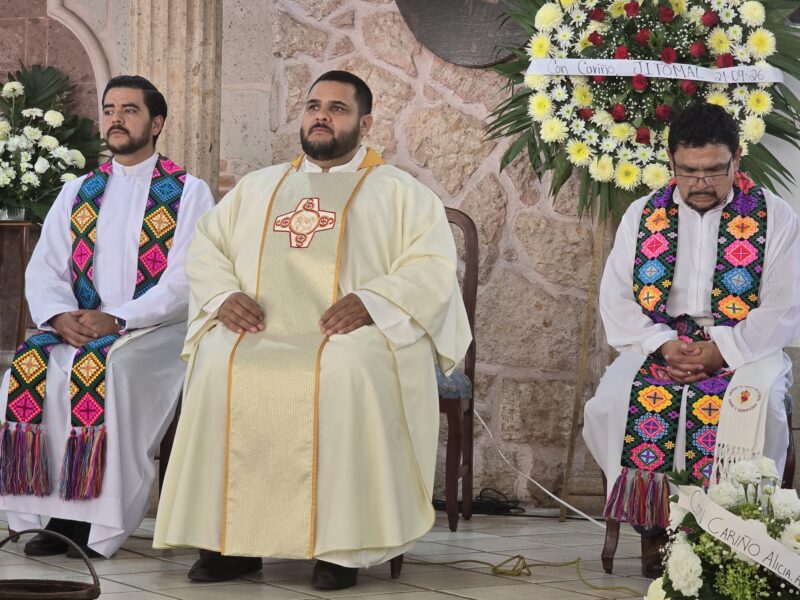
The final stretch of the homily grew more intimate. Father Pastor, Casillas Ríos said, finally heard the call to return to the Father’s house. So many times they had seen him ill, so many times frail, “but only when he finally heard that loving call did he attend to the return.” Among his brothers in the Congregation he had a very deep friendship with Father Vicente Noceda Peña. “Chente” was one of the last to be with him; he accompanied him from the weekend until the day before, in the final moments. “We believed,” the rector confessed, “that he needed to meet with Father Vicente,” in order to undertake the journey to which we are all called.
Before the end of the Mass, the celebrant gave thanks to the entire community and to the faithful who showed support and affection during Father Pastor’s life, especially to those who saw him, supported him, and cared for him to help him bear Parkinson’s disease and the subsequent convalescence after cranial surgery. The public recognition of those caregivers, often invisible in priestly chronicles, restored to the illness its communal dimension.
It fell to the deceased’s niece, Isabel, to deliver the family funeral eulogy. Not every phrase of hers was transcribed in the record, but the meaning was fixed by those who heard her: she described her priest-uncle as very joyful. That word would return in later testimonies like a refrain. It was not the joy of one who has not suffered. It was the joy of one who, even when angered, did not become aggressive; of one who made faces; of one who turned his own excess into a joke.
Before departing for the burial site, the celebrant performed the commendations for the eternal rest of the soul. He sprinkled holy water upon the coffin as a remembrance of his baptism and incensed it as a sign of the holiness of the body that was a temple of the Holy Spirit while the priest lived. The holy water refers to the font in which Pastor Hermosillo Lomelí was immersed, a child of Jalostotitlán, and from which he was born to new life; the incense honors the flesh sanctified by the sacraments and, in the case of a priest, by the anointing of the hands and by the thousand altars at which those hands consecrated the Body of Christ. Aspersion and incensation are not, therefore, a “final farewell.” They are a profession of faith in the resurrection of the flesh.
When the liturgy ended, the word ceased to be merely ritual and became shared memory. Priests who had lived with Father Pastor at different stages of his journey spoke. Their interventions coincided in three traits: joy, missionary vocation, and land of origin.
Father Luis Manuel González Medina, pastor of San Francisco de Asís, first situated priestly vocation as a sign of predilection: “The vocation of a priest is always a blessing.”
The pastor added that Father Pastor, “with all his legacy, with all he has sown, can harvest, together with Christ, that kingdom”: here, “a land of justice, love, and peace”; in eternity, “to contemplate the face of God.” He thanked the community of Tepatitlán and “these living testimonies of Christ, who walks among us as a priest, who sanctifies us with the sacraments, preaches the Gospel to us, and motivates us to live charity.” He closed with the exhortation of Saint John Paul II that has marked a generation of Mexican vocations: “Do not be afraid to give your life to Christ. Christ takes nothing from us; He fulfills us.”
Father José de Jesús Valle Álvarez highlighted the missionary qualities of Father Pastor, who served in communities in Chiapas, Morelos, and in the United States, in difficult areas of Los Angeles. He descended to the terrain of family anecdote, the same one niece Isabel had evoked. Father Pastor had never gone to the sea. When his father took him and he saw that immensity, the phrase that sprang from him, and that later became a family refrain, was: “So much water!” The expression survived the journey. When someone did something the others did not like, or when they wanted to anger him, they would repeat to him “so much water, so much water!” He would get angry, chase the provocateur, but he was not aggressive, he was never aggressive. “He was a calm person, he made faces, he did many things, and he was a very joyful person.”
In the same atmosphere of testimonies, the priest valued remaining in vocation. “Being with God, serving Him, is something very beautiful.” Immediately he introduced the reserve of realism that avoids pietism: “although we are human, although sometimes we fail, although sometimes we sin like any human being.” God, nonetheless, “helps us greatly, blesses us, accompanies us always.”
Pastor Hermosillo Lomelí was born on December 28, 1947, in Jalostotitlán, in the Los Altos region of Jalisco. He was ordained on December 20, 1979, just short of turning thirty-two, in Jalostotitlán, by the imposition of hands of Francisco Javier Nuño Guerrero, first bishop of San Juan de los Lagos. Father Javier Alberto Guerrero Enríquez, director of the Juan Pablo II Renacimiento Institute, recalled a fact that the Church of San Juan de los Lagos has coined as a sign of identity. The ordination class of Father Pastor numbered nine priests. They were ordained on different dates and in different places; that was the generation of “the nine of ’79.”
The nine, according to Father Guerrero’s count, were Father Raúl Silva Arredondo, Father Javier Ochoa Salcedo, Father Javier Salazar, Father Andrés Ramos Poblano, Father Rosario Nuño, Father Salvador Villarreal, Father Antonio Garnica, Father José Luis Aceves, and Father Pastor Hermosillo Lomelí.
Of those nine, Guerrero noted, four already rest in peace: Father Javier Ochoa, Father Javier Salazar, Father Andrés Ramos Poblano, and now Father Pastor Hermosillo Lomelí.
Nevertheless, it was a priestly life of nearly forty-seven years, marked by missionary service in Chiapas, Morelos, and difficult areas of Los Angeles, until the final stage of his life when he suffered Parkinson’s disease, which he bore heroically, offering his sufferings for the good of the community.
After a fall, he suffered a severe blow to the skull that required surgery on his head to drain a clot. After nearly fifteen days of hard struggle, his life gradually faded, and he died on the afternoon of September 21, 2026, at the Minor Seminary, the day on which the Church celebrates Saint Matthew, apostle and evangelist.
His mortal remains were interred in the Congregation’s mausoleum in the New Cemetery of Tepatitlán, awaiting the resurrection. May he rest in peace.