


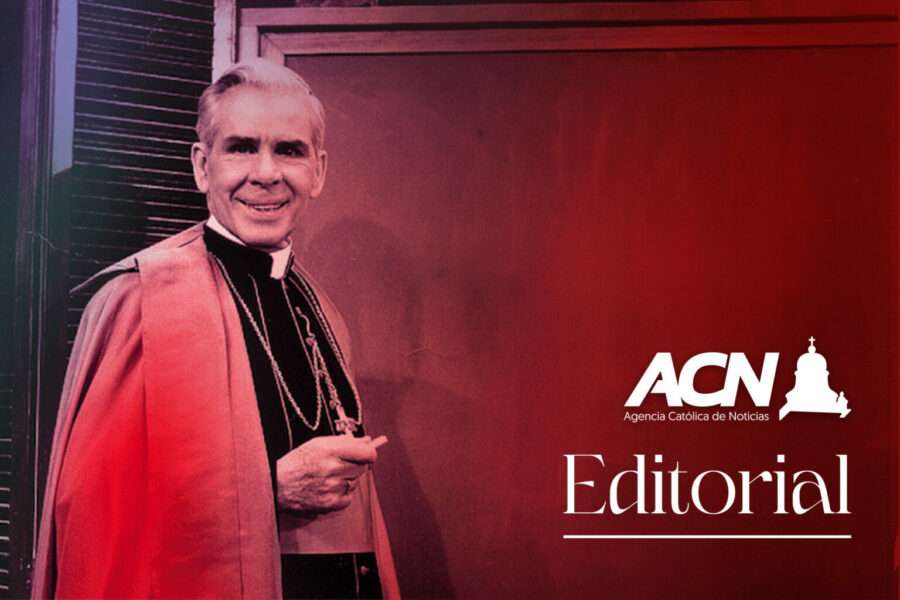
Fulton Sheen, the Blessed of Television
The beatification of Fulton Sheen, celebrated on September 24 in Missouri, reopens the debate on the role of bishops as communicators: his figure, marked by television and daily prayer, offers lights and shadows that today challenge a Church tempted by digital spectacle in times of hypercommunication.
Born in Illinois in 1895, he was a bishop who knew how to use radio and television to bring the Gospel to millions of American homes. His program Life is Worth Living made him a media reference, capable of competing in audience with entertainment figures.
Sheen’s biography reveals a man of contrasts. He served as auxiliary bishop in New York and later as bishop of Rochester, where he faced tensions with his clergy over his style of governance, a style that also led to disagreements with the powerful Cardinal Spellman, known as the American Pope. Admired for his eloquence and his defense of Catholicism against communism, he was criticized by traditionalist sectors that accused him of being an ecumenist and of accepting the reforms of the Second Vatican Council with too much docility.
His support for the liturgy in the vernacular and his admiration for thinkers like the Jesuit Pierre Teilhard de Chardin placed him at the center of controversies that still divide the Church. The core of his spirituality was the daily holy hour before the Eucharist, a commitment he assumed from his ordination and maintained even amid exhausting schedules. That discipline of silent prayer before the Blessed Sacrament was the driving force of his ministry and the source of his ability to communicate with authenticity. In the words of Cardinal Tagle, papal delegate for the beatification, Archbishop Sheen was “an earthen vessel that drew strength from Christ,” aware that his media success was not his own merit, but shared grace.
The beatification of Sheen does not celebrate a “Catholic influencer,” but a pastor who knew how to use the media without losing his center in prayer and in communion with the poor. The miracle that led him to the altars is a sign that his intercession remains alive: the inexplicable recovery of James Fulton Engstrom, born without a pulse for 61 minutes, who survived without sequelae and was approved by the Vatican in 2019 as a sign of his intercession.
But his life is also a warning: fame can be a risk if it becomes empty spectacle. Today, when many bishops and priests seek notoriety on social media, the figure of Sheen presents an uncomfortable contrast. It is not enough to accumulate followers or produce viral content; true evangelization requires spiritual coherence, a discipline of prayer, and the ability to touch the wounds of the people and use a mental agility that surprises strangers by fidelity to the Gospel amid contemporary challenges,
In an era where stupidity is applauded and truth is diluted according to convenience, the beatification of Fulton Sheen is a reminder that the model of holiness for Catholic communicators is not that of the influencer, but that of the evangelizer. The Church needs bishops who, like Sheen, use the media to open the door of faith, not to feed egos. His life shows that communication can be a path of holiness, provided it is anchored in the Eucharist and in fidelity to the Gospel. Sheen was not beatified for being famous, but for being faithful, an apostle who used television with a criterion that should guide all Catholic communicators in the age of social media: that only Christ should shine.