


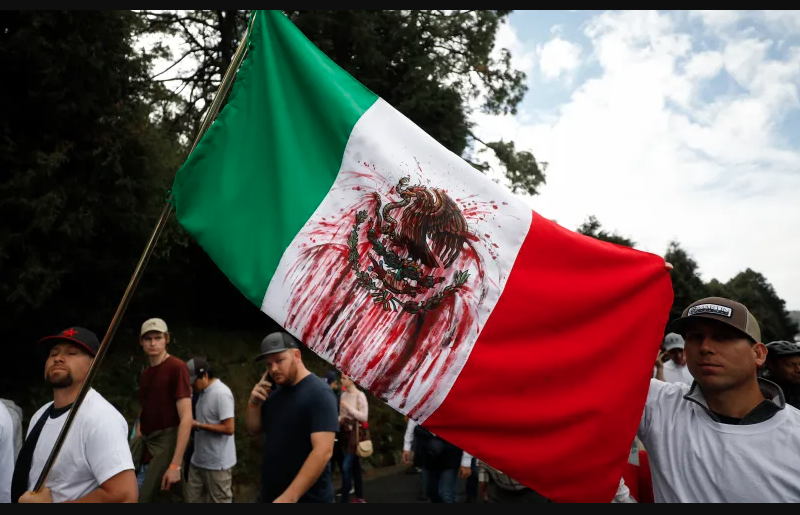
While the capital’s Zócalo exhibits with futile glory, the lights and tricolor flags that echo that Grito de Dolores of 1810, on the eve of September 16, we must face an uncomfortable question: What are we really celebrating on the 215th anniversary of the beginning of Independence?
Marked by profound wounds and polarizations, the calls for unity in the present seem to fall on sterile ground. Just 25 years ago, the Bicentennial commemorations opened the wonderful perspective of a united, strengthened, and peaceful Mexico, but that does not seem to be the case.
In 2010, the Mexican bishops published a Pastoral Letter for the Bicentennial that invited «to commemorate our history from faith, to commit ourselves today to our homeland.» Fifteen years later, that call to gratitude for the past, responsibility in the present, and hope for the future clashes head-on with a reality of bullets, violence, entrenched corruption, and broken promises. The violence that claimed thousands of lives in 2024 does not relent, and scandals like the «huachicol fiscal,» where millions of pesos were laundered involving military elements, exhibit a corruption that devours the Mexican State from within.
That Pastoral Letter was not a mere historical panegyric. The prelates, in a tone of «solidarity attitude and critical lucidity,» joined the commemoration of the Bicentennial of Independence and the Centenary of the Revolution not to romanticize the past, but to challenge the present. «As believers, we discover in the events of history the design of God, even amid the weaknesses and sins of men,» they wrote, quoting Saint John Paul II: we must see yesterday with gratitude, today with responsibility, and tomorrow with hope. In those pages, driven by five Academic Days in cities like Mexico City, Morelia, and Guadalajara, the Church positioned itself as an ally in the search for justice and reconciliation, recalling its role in feats like the uprising of Hidalgo and Morelos.
That theological reflection—where history is read through the «memory, vision, and expectation» of Saint Augustine—urged Mexicans to recognize values and limits in their foundational heritage. The Independence, with its ideals of sovereignty and freedom under the patronage of the Virgin of Guadalupe as «Patroness of our freedom,» and the Revolution, with its clamor for land and social justice, were not museum relics. They were «new faces» in complex challenges: «The ideals proposed by Independence and by the Revolution present themselves to us today with new faces, in much more complex situations.» The bishops bet on a «dialogue and reconciliation necessary for the progress of our Nation», offering from faith, charity, and truth as antidotes to division.
But, where did that commitment go? In September 2025, Mexico accumulates more than 30,000 intentional homicides in just the last year, according to preliminary data from the Executive Secretariat of the National Public Security System. States like Sinaloa, Guanajuato, Guerrero, Michoacán, Jalisco, and Mexico are the epicenter of massacres and disappearances. The 2025 World Report of Human Rights Watch denounces 6,226 complaints of torture in 2022, a number that, though outdated, reflects an impunity that persists: 95% of violent crimes go unpunished. And on the corruption front, the «huachicol fiscal» case exploded as a brutal reminder of the wound that annihilates us, but we disguise the pain with the placebo of demagoguery. Criminal networks, entrenched in the very institutions that swore loyalty to the flag and the homeland, unravel Mexico to enrich a few and impoverish many.
Faced with this panorama, the 2010 Pastoral Letter resonates like a distant and prophetic echo. The bishops warned that the Church, «in the world but not of the world,» must illuminate events with the Word, promoting solidarity from the encounter with Jesus Christ. «We want to serve the Nation, collaborating to build a cultural project from faith,» they said, in dialogue with plural academics. Today, that call challenges not only the faithful, but all of society: what sense does it make to shout «Long live Independence!» if the ideals of Hidalgo that aspired to overthrow bad government now drown in blood, corruption, disappearances, and bribes?
Are we celebrating the memory of forebears who dreamed of a free Mexico, or are we only perpetuating an empty ritual while the present betrays us? Parades that demonstrate outward an overwhelming military power are not enough, while from within, they corrode the institutions; an «effort to promote justice» is needed, as Pope Saint Pius X called for in 1910; otherwise, the Bicentennial of yesterday and this anniversary today will be nothing more than hollow echoes in a country that, despite everything, continues to beat with the faith of its people.
The «first shout» of the «first woman» president will praise everything demagoguery acclaims, but will drown out the cry of millions of Mexicans subjected by the yoke of violence, impunity, and corruption. Despite everything, what should we celebrate? Perhaps not the past history, but the homeland that we can still save.