


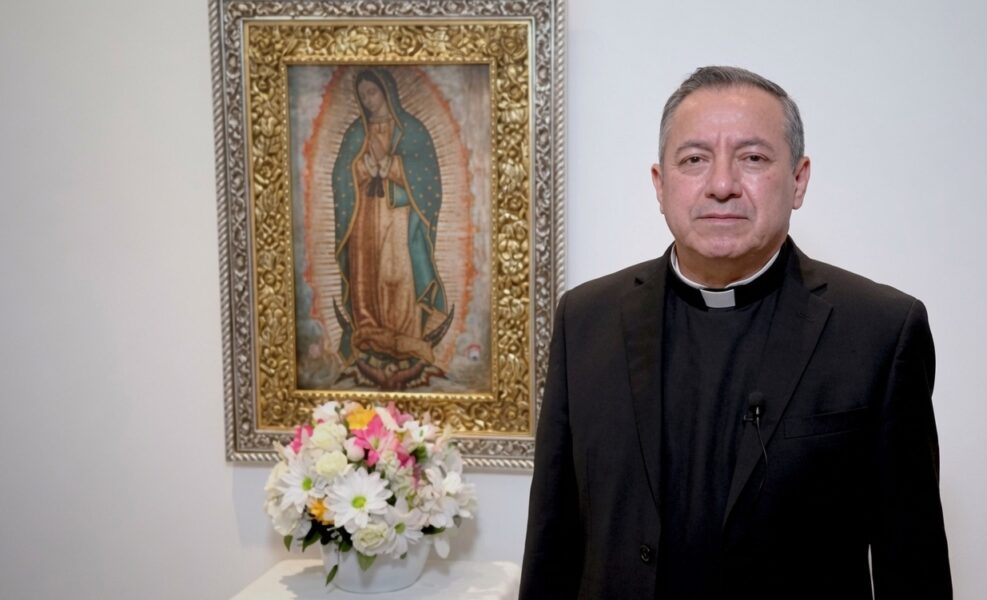
After discussions and deliberations and the return of Archbishop Aguiar from Rome, the designation of the new rector of the Basilica of Guadalupe is announced: the exorcist canon Daniel Villalobos Ortiz as the new rector of the Insigne and National Basilica of Our Lady of Guadalupe, which acquires particular significance when the procedure followed is observed. According to the applicable canonical framework and the usual practices at this shrine, Carlos Aguiar Retes made the appointment from a shortlist of candidates presented by the Chapter itself. This circumstance leaves out, at least on this occasion, possible external candidates who had the support or preference of the primate archbishop.
The choice of a canon who already belongs to the chapter and who knows firsthand both the structural problems and the recent internal tensions constitutes, therefore, a decision loaded with political and institutional implications.
The departure of canon Efraín Hernández Díaz, after the serious accusations of embezzlement, financial opacity, and irregular handling of resources made by the chapter itself, left the Basilica in a situation of institutional fragility and erosion of public credibility. The controversial reinstatement of the previous rector in May 2026, carried out unilaterally and without the explicit approval of the nunciature and the Mexican Episcopal Conference at that time, deepened internal fractures and generated a climate of distrust that the new rector must now face from day one.
Villalobos Ortiz, born in 1968 and ordained in 1998, assumes the position with an extensive pastoral trajectory. His service in various parishes of the archdiocese, his role as Episcopal Vicar, and especially his recent incorporation into the Chapter as a canon (2024) and as an exorcist canon give him direct knowledge of the sanctuary’s governance mechanisms and the wounds opened in recent months. This condition may facilitate a real renewal of administrative structures, resource control, and access to the tilma’s chapel; however, it also places him under particularly demanding public and internal scrutiny, especially regarding how his predecessor should respond, given that a prior canonical investigation took place.
The chapter that proposed him on the shortlist reasonably expects the new rector to drive concrete changes in the sanctuary’s governance, greater transparency in the handling of the substantial offerings, review of contracts and hiring processes, restoration of collegial decision-making mechanisms, and a pastoral approach more in keeping with the dignity of the continent’s principal Marian pilgrimage center. Any perception of continuity with previous management vices, or of excessive deference toward the archbishop who ultimately appointed him, will be immediately interpreted as a failure of the internal renewal effort.
Villalobos Ortiz assumes, therefore, a dual responsibility: on the one hand, to heal the deteriorated relations between the chapter and the archdiocesan authority; on the other, to demonstrate with verifiable measures that the appointment of a canon from the chapter itself was not a closing-of-ranks maneuver, but the beginning of a different stage. Public scrutiny and that of the canons who denounced the irregularities will be focused on every administrative decision, every appointment, and every communiqué he issues in the coming weeks and months.
The Basilica of Guadalupe cannot afford another episode of opacity or internal confrontation. The credibility of the sanctuary, already damaged, depends to a large extent on the new rector’s ability to translate the trust the chapter placed in him into tangible structural reforms, not merely a change of names. The success or failure of this transition will not be measured by processions, but by the real capacity to restore confidence in the management of a sanctuary that receives millions in resources from pilgrims and faithful from Mexico and around the world.