


In these times of virtual hyperconsumption and rapid, fleeting events, it is difficult to find the slow, reflective meaning of a good pastoral letter in the full sense of the word. In Pastores Gregis, Saint John Paul II unraveled this munus docendi and the faithful’s need for the bishop’s word, understood as a balanced, cultured, and holy man. Meanwhile, a pastoral letter implies the direct expression of the bishop’s teaching office through which he exercises his authentic magisterium to guide, instruct, encourage, and correct the faithful—clergy, consecrated, and laity—in communion with the whole Church. These aspects are neither relative nor accidental; they represent the most cherished way of reaching the faithful and shepherding the sheep.
In these times, few pastoral letters retain that vitality. Some are accounts of episcopal egos and collections of photographs that, rather than demonstrating a pastoral character, are collections of vanities, images, and recipes; others, in the worst cases, have lost that capacity for cherished instruction when they have not even addressed a single page to their dioceses, and still others have replaced the pastoral letter with the pastoral of press releases.
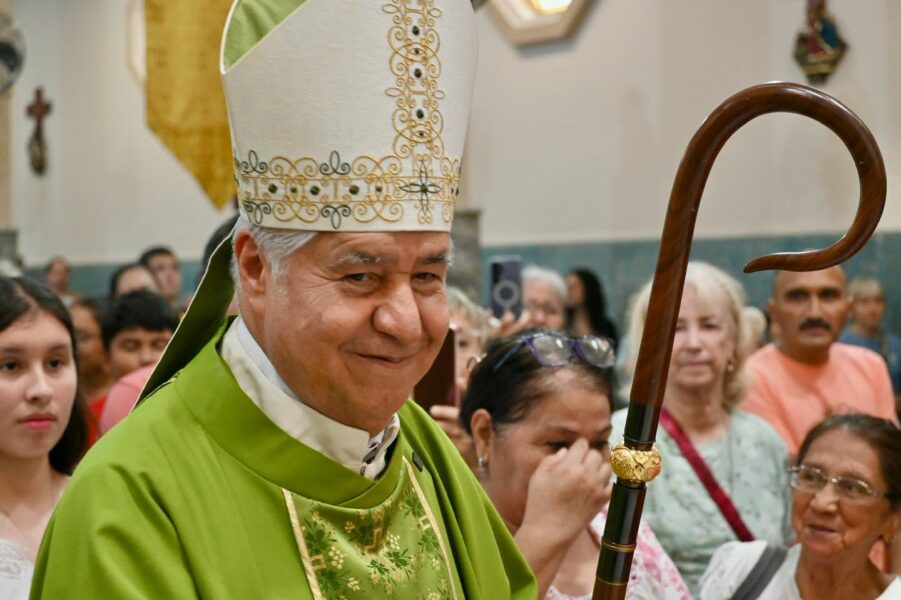
However, recently, the Archbishop of Monterrey, Rogelio Cabrera López, has given his archdiocese a document that announces the key: “What we have seen and heard we also announce to you” and which becomes the guiding thread of a text that seeks to turn memory into missionary responsibility; the very title, taken from the First Letter of Saint John, implies a communal testimony.
Some aspects are worth highlighting to encourage its reading. It is a projection toward the 250th anniversary of the Archdiocese of Monterrey, which, without a doubt, is one of the churches in Mexico with the greatest momentum toward 2031. The archbishop opens the document by situating both anniversaries as occasions to look with gratitude upon the path traveled and, at the same time, to renew the commitment to building communion in the sequence of hearing, seeing, contemplating, touching, as an itinerary of faith for a community. He also insists on the plural: it is not the experience of an individual nor the work of a group, but what a people has received and is called to transmit. This insistence runs throughout the letter and sets its tone. The recent history of the Church of Monterrey, he affirms, “does not belong to a bishop or to a particular group, but is the heritage of a believing community”.
That community has walked, the text recalls, cum Petro et sub Petro. In recent years it has welcomed the accents of three pontificates: that of Benedict XVI, which helped keep the gaze fixed on Jesus Christ and not to separate truth from charity; that of Francis, which promoted a Church going forth, merciful and synodal, attentive to the cry of the peripheries; and that of Leo XIV, which invites us to safeguard the dignity of every person and to rebuild fraternity in a world wounded by fragmentation.
The document does not avoid the cultural and technological context in which this welcome must take place. The rapid development of artificial intelligence appears as one of the most evident signs of a change that is modifying the way we learn, communicate, and relate. The Church, the archbishop points out, cannot remain indifferent nor proclaim the Gospel as if reality were not changing. In particular, bishops and priests have the responsibility to remain attentive and up to date, to know the questions and languages of the people to whom they are sent. Communion, he affirms in a formula he has repeated on various occasions, must always be affective, effective, and contemporary. Affective because it is born of love for Christ and his Church; effective because it translates into co-responsibility and concrete structures; contemporary because it is lived with the pastor the Lord grants at each stage and remains attentive to the present time. Anchoring it in the past or making it depend on personal preferences empties it of meaning.
The archbishop frequently asks what good it would do to defend the truth if communion were destroyed along the way. Truth and charity, he recalls, citing Saint John Paul II, cannot be separated. The Church is called to be “the home and the school of communion”.
Recalling the 25th anniversary of the First Synod, the document gives thanks that that event was not reduced to its texts. It sowed a conviction that has matured: evangelization requires listening, communal discernment, and participation. Long before the word synodality became common throughout the Church, the Archdiocese of Monterrey had begun pastoral planning processes. The Jubilee of Mercy renewed the method; after the pandemic and in the context of the convocation to the Synod on Synodality, the path traveled was reviewed and a new stage of the Pastoral Plan was projected with a horizon of 2031-2033, in consonance with the Global Pastoral Project of the Church in Mexico.
That learning has taken concrete form in parish assemblies, organization by dimensions, consolidation of pastoral councils, articulation between parishes, deaneries, and zones, networking with movements and lay ministries. Synodality, the archbishop emphasizes, does not diminish the episcopal ministry but places it in its true nature. The bishop is not called to walk the path alone, but to listen, discern, and interpret the dreams and desires that the Spirit awakens in the community. When promulgating the Pastoral Plan in 2023, Cabrera expressed this conviction with a simple phrase: “I did not do it; we did it together.”
The densest core of the letter is the account of how communion has taken shape. Cabrera takes up Francis’s invitation to foster a “missionary communion” and the horizon of Aparecida of being missionary disciples so that peoples may have life in Christ. From there he describes concrete processes. Co-responsibility has been expressed in the institution of lay ministers and in the closer accompaniment of permanent deacons and their families. Formation and dialogue with culture find spaces in the University of the Archdiocese, the Pope Francis School of Theology, and the Joseph Ratzinger-Benedict XVI Institute of Philosophy.
The care of vocations and of those who have given their lives to the service of the Church has been translated into the Vocational Animation Centers, the Priestly-Vocational Sanctuary of the Sacred Heart, the Priestly Health Plan, and the Father Jardón Clinic. Missionary presence has become visible in the thirty Parish Missions erected, more than half of which have already become parishes, in the University Parish, and in the mission in digital environments. Mercy and closeness are expressed in the attention to persons deprived of liberty, migrants, persons living on the streets, in the Pastoral Care of the Older Brother, the Oak Foundation, and the Diocesan Commission for Protection. Finally, organization and service have been pursued through systems such as GESPAR and SITEC, oriented toward more responsible and transparent management.
These processes, the archbishop warns, cannot be considered finished. The Spirit will continue to ask for new paths. What will matter is remaining faithful to the communion and mission that gave them origin. This honesty strengthens the text: it avoids the tone of a triumphal inventory and recognizes that the task continues.
To understand what lies ahead, Cabrera turns to the image of Nehemiah that Leo XIV proposes in his encyclical Magnifica Humanitas, a man who listens to the cry of a wounded city, brings it to prayer, discerns, and calls his people to rebuild the walls. Nehemiah does not rebuild alone; he helps others discover that everyone has a part of the wall to raise. In Monterrey, the archbishop points out, there are wounds in the social and ecclesial fabric that need to be addressed. What has been traveled does not allow us to settle into satisfaction; it commits us to what is still lacking. No one can remain a spectator.
Almost 500 years after the Guadalupano event, another image appears: the “sacred little house,” a house where everyone can find welcome, listening, consolation, and hope. The walls that must be rebuilt are not walls to separate us from others, but the shared effort to build that house and make it a place for all. The horizon of the Pastoral Plan—to be a disciple, united, merciful, missionary, and hope-filled Church—will only become reality if each one assumes the part that corresponds to them. That is why the document issues concrete calls: to priests so that communities may be places of encounter and closeness and no structure may distance them from persons; to deacons, consecrated, and laity, so that they may offer their charisms and no one may think their contribution is too small; to parishes and movements so that they may not preserve structures for their own sake and may continually ask themselves whom they are serving and whom they are still not reaching; to the entire community to keep eyes and heart open toward those who suffer, feel alone, or have not yet found a place.
The preparation of the jubilee of December 15, 2027 is approached with sobriety. It is not about multiplying activities or turning the celebration into a succession of events. Cabrera invites giving a jubilee meaning to the processes and encounters that already form part of pastoral life. He entrusts the Vicariate Episcopal for Pastoral Care and the Committee for the celebration of the 250 years to accompany and articulate this preparation. This horizon also coincides with the second stage of the Pastoral Plan 2026-2029, which invites continuing with the gaze fixed on Jesus, strengthening organization by dimensions and networking.
The document closes by returning to the words of Saint John. After making grateful memory, what has been seen and heard does not end with us; it must once again become proclamation, service, and life for those who will come. The path is entrusted to the Virgin Mary under the title of Our Lady of the Oak, patroness of the archdiocese, and the Venerables Father Raymundo Jardón and Sister Gloria María de Jesús Elizondo are invoked.
The 250 years are not presented as an occasion for institutional self-celebration, but as an opportunity to recognize God’s fidelity and renew missionary responsibility. In a context marked by polarizations and growing secularization in urban areas, the insistence on communion as witness remains fully relevant. The incorporation of Leo XIV’s horizon and attention to artificial intelligence and digital environments demonstrate a concern for contemporaneity that does not always appear so clearly in diocesan documents.
At the same time, a balanced reading must point out nuances. The text is predominantly introspective; it describes in detail the path traveled and the internal processes, but offers less prophetic density regarding the concrete wounds of the social fabric of Nuevo León and the metropolitan region of Monterrey. These realities are mentioned, but not developed with the same precision as the internal pastoral processes. In a diocese of great economic and demographic dynamism, the reader may miss a more specific challenge regarding the challenges of evangelization in environments of relative prosperity, high labor mobility, or the presence of new forms of poverty and exclusion.
Likewise, although the letter insists that history does not belong to a pastor, the fact that Cabrera presented his resignation upon turning 75 years old gives the document, in the perception of some, the character of a handing over of what has been lived and a possibility of maintaining his governance until 2031. The text itself does not present it that way; however, the intensity with which it synthesizes the path traveled invites reading it also as a point of departure for those who will continue the history. Its fruitfulness will depend on the community receiving it not as closure, but as an invitation to the implementation stage of the Synod and to the second phase of the Pastoral Plan.
The XII Pastoral Letter is a text of pastoral maturity that seeks to turn memory into responsibility. On the threshold of the 250 years, its principal value lies in recalling that true celebration does not consist in looking back with complacency, but in asking, with the community, who is still missing at the table and what part of the wall each one must raise. That is also what making communion is about.
The complete letter can be read here: