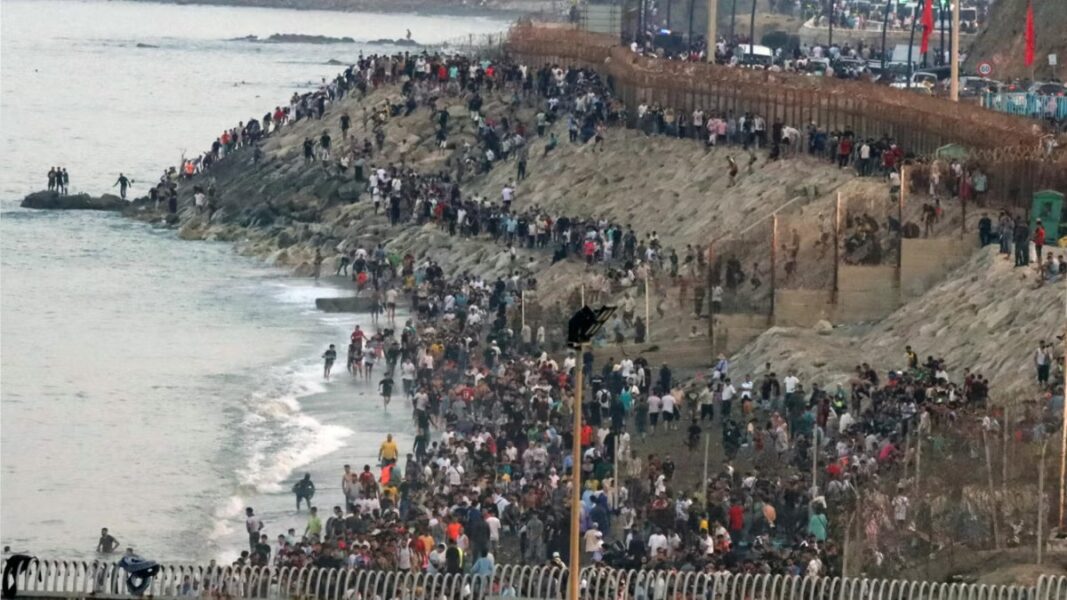
We have entered August, today we celebrate the feast of Our Lady of the Angels and in the Porziuncola of Assisi they do so in a special way. Saint Francis heard his vocation there, Saint Clare consecrated herself there, and it was the place of her encounter with Sister Death. The Pope Leo XIV: “I continue to follow with concern the alarming situation in the autonomous city, asking God, through the intercession of Our Lady of Africa, that solutions of peace, stability, and justice may be found.” The official death toll has reached 72 in Ceuta, but Morocco continues to find more bodies at sea, and official Spanish sources estimate that the figure will probably exceed one hundred. One day they will realize that we are not dealing with poor minors seeking a better future in Europe, which is very legitimate given the catastrophe in their countries of origin, about which no one speaks. Immigration is being used by some and by others for their unspeakable political interests. The Church’s and official discourses’ playing around could prove costly; every day more people are realizing the sad deadly game. We do not know if today it will be possible for the long-suffering Catholic faithful of Ceuta to attend Sunday Mass normally; we fear not. It sounds like a joke that their diocese can think of nothing else than “the collections taken up this weekend in the parishes of Ceuta will be entirely allocated to the Diocesan Delegation for Migration, in order to channel this aid through the San Antonio Migrant Care Center in Ceuta. Now we place the collections in the hands of politicians defined as ‘competent services,’ when they are demonstrating their absolute incompetence, very well paid. The number of fools is infinite, and in the curia of Cádiz they seem to hold sway. What is happening in Ceuta is an act of war that no one wants to talk about. Any use of migration as a form of blackmail will have European consequences, not only Spanish.
Pope Leo to the Youth of Medjugorje.
Official message dated early July to the annual youth festival in the form of Parolin. «On the occasion of the Medjugorje Youth Festival, Pope Leo XIV extends his cordial greeting to all participants and exhorts them to return AD FONTEM, that is, to Christ, fountain of new life and authentic joy. He therefore invites them, through prayer, listening to the Word of God, and the sacraments, to rediscover the beauty of the personal encounter with the Lord, who quenches the thirst of every heart and grants the strength to begin anew always».
The Cardinal Prisoner of the Communists.
Cardinal Ernest Simoni, ninety-seven years old, returned to celebrate the Eucharist in the place where he was imprisoned and subjected to forced labor. In the former prison camp of Spaç, in northern Albania, the cardinal presided over a Mass for the eternal rest of the souls of those who suffered and died in those mining tunnels under the communist dictatorship of Enver Hoxha. He was spiritually accompanied by a message from Pope Leo XIV, dated July 30, which was read at the conclusion of the celebration. “With deep emotion, I spiritually join His Eminence and all those gathered in the former prison camp of Spaç, where they return after so many years to celebrate the Eucharist, the Sacrifice of Christ that transformed the Cross from a sign of death into a promise of life.” The text recognizes that place as “one of the most painful pages” in the history of the Albanian people. Spaç “was a place where many bore the heavy cross of injustice”: the blood of those who suffered and died there “watered that land, turning it into a silent testimony of fidelity, courage, and hope.”
Simoni, born in Troshani, near Shkodër, on October 18, 1928, entered the Franciscan college Illiricum at an early age and was ordained a priest in 1956, after secretly completing his theological studies during his military service. Labeled an “enemy of the people” by the communist regime, he was arrested on Christmas Eve 1963 while celebrating the Midnight Mass in Barbullush. Initially sentenced to death on charges of praying for U.S. President John F. Kennedy, his sentence was commuted to forced labor: eighteen years of isolation, for a total of twenty-eight years spent mainly in the mines of Spaç and later in the sewers of Shkodër. Released in 1990, after the collapse of the regime, he openly resumed his priestly ministry in Albanian villages. In 2014, his testimony, given before Pope Francis during his visit to Tirana, moved the assembly; two years later, on November 19, 2016, Francis created him a cardinal, although he was exempted from episcopal consecration due to his advanced age.
Parolin in Guatemala.
Cardinal Pietro Parolin, Secretary of State of the Holy See, arrived in Guatemala yesterday and today will preside over the Mass in the Metropolitan Cathedral to celebrate the 90 years of diplomatic relations that the State of Guatemala maintains with the Vatican.
Delpini in Brazil.
On July 29, Monsignor Mario Delpini turned 75, celebrating it in Brazil with his priests. He has been Archbishop of Milan since July 7, 2017, when Pope Francis chose him as the 145th successor of Saint Ambrose.
Carlo Maria Martini inaugurated the discourses to the city on December 6, 1980, with «Give voice to each one «. Since then, the meeting has become a civic ritual more than a religious one, inherited from Tettamanzi and Scola before reaching Delpini, who turned it, speech after speech, into an examination of conscience shared with the city, even more than a lesson imposed from above. The archbishop always addressed institutions with a tone of praise rather than reproach, and concluded each speech with a blessing, a gesture that returned the text from the civil register to the liturgical one from which it had begun. In his last discourse to the city, Delpini chose as an image the house built on rock, immovable even to rain and wind. It is difficult not to think that that house, ultimately, also represents his Milan of the last nine years: battered by a pandemic, by distant and recent wars, by the demographic crisis, by the weariness of rulers and ruled, but never abandoned.
Don Mazzi has died.
Very well known in Italy for his dedication to drug addicts, and founder of the Exodus Foundation. The funeral will be held today in Sant’Ambrogio, after the closing of the funeral chapel in Exodus; he was 96 years old and from Verona. A great devotee of Pope Francis and defender of the «unresolved causes» in the Church: «The issue of women, that of divorce, that of abortion: they have been raised, but they have not yet been fully clarified. He even went so far as to say that he would do things ‘to a certain extent.’ It would not be fair to force him to say and do things he has not done. We will see if the next Pope will have the courage to continue with the ‘Francis method’.»
Cupich and Synodality.
Cupich of Chicago granted an extensive interview to katholisch.de . On the liturgical issue, and specifically on the debate surrounding the Traditional Latin Mass, he recalled that “the Church, in fact, is not an exclusive club,” explaining that it is unlikely that public opinion will listen to an institution perceived as divided by internal discord. For this reason, according to Cupich, it is necessary to prevent controversies—including liturgical ones—from becoming so public and notorious that they compromise the Church’s authority on broader issues. The cardinal linked this discourse to the principle of unity, defined as “the first distinctive sign of the Church.” He clarified that unity does not mean uniformity: the liturgical reform itself, the post-conciliar vernacular Mass, he observed, coexists with a plurality of languages and forms of cultural expression that enrich the Church. The decisive criterion, for Cupich, remains only one: every practice that departs from common practice must be evaluated by asking whether it contributes to unity or harms it.
Much of the interview focused on the theme of the synodal and dialoguing Church that Pope Francis longs for. Cupich explained that resistance often arises from the fear of departing from tradition, a fear that, in his opinion, must be addressed with greater trust in the action of the Holy Spirit in the life of the Church and in the sensus fidelium of the baptized faithful. When asked about the possibility of extending to the entire Church practices such as the participation of the laity in the selection of episcopal candidates—already practiced in Germany—Cupich clarified that a form of popular consultation already exists in the investigations carried out by apostolic nuncios, and that this practice also involves laity and religious from the Dicastery for Bishops.
On the issue of decentralization, Cupich acknowledged the measures already adopted by Pope Francis, emphasizing the importance of the principle of subsidiarity: decisions must be made at the lowest possible level, but always in balance with solidarity with the entire Church. Even when some episcopal conferences seem more advanced than others on certain issues, the criterion of verification remains fidelity to ecclesial unity. Finally, the cardinal focused on the doctrine of just war, denouncing its distorted use: born as a limiting principle, today it risks becoming an a posteriori justification for military interventions already decided. For Cupich, war should only be considered as a last resort, once all possible diplomatic avenues have been exhausted.
Synodality in the Dioceses.
Towards the Assemblies 2027-2028: Stages, Criteria and Tools for Preparation is the title of the new document prepared by the General Secretariat of the Synod for the final phase of this long journey, which will be of an implementational nature, although not conclusive, until the 2028 assembly. Assemblies will be held at the diocesan, national, and continental levels, and the final ecclesial assembly will take place in the Vatican in October 2028.
It is evident that the entire process has, on the one hand, an assembly character and, on the other, seems specifically designed to be manipulated, as happens in modern democracies. It is an assembly-type process because all members are on equal terms and because what is finally voted on has the right to be accepted even if it is erroneous, as observed in the report of Group 9 at the conclusion of the previous synodal phase. The idea of a sovereign assembly is based on a mystifying interpretation of the principle of the sensus fidelium. In all synodal documents, including this latest one, much is said about the fact that the basis of the synodal assemblies is not sociological, but rather a communal listening to the Spirit, although with little chance of convincing. What a synodal assembly structured in this way says has no value in the Church, and the faithful will not commit omissions if they do not pay attention.
This type of meeting seems designed to be manipulated specifically in order to achieve previously decided results. The participants will be very few compared to the total number of faithful, an elite designated from above. The synodal teams can be used to influence and atheists, representatives of other religions, or ideological militants can be specifically inserted to influence the so-called «discernment.» The secretariats that, at each level, will draft the final documents could do so according to vested interests, the structure, enormous and extremely complex, offers no guarantees.
The document, as already mentioned, simply states that the fruits will be placed in the hands of the Pope, but what the Pope will do is an unknown. Cardinal Raymond Burke stated that the new synodality lacks theological foundations. This is true if we are talking about the theology of the Catholic tradition. However, it remains a theology, that of contemporary modernism. Arnaud John-Lambert, in «The “seal” pastoral of theology», published in the latest issue of the journal Teologia , presents the theology of the new synodality: a practical, contextual, inductive, participatory, and polyphonic theology; a theology of experimentation and implementation; a theology of action according to which “without concrete changes in the short term, the vision of a synodal Church will not be credible.” These are not doctrinal documents, but concrete changes.
Synodality and Democracy.
In his Christmas address of 2020 to the Roman Curia, Pope Francis set out his vision of the controversial relationship between synodality and democracy. He explained the opposition between the two principles: “Without the grace of the Holy Spirit, even if one begins to think of the Church in a synodal key, it, instead of referring to communion with the presence of the Holy Spirit, will be interpreted as any democratic assembly, composed of majorities and minorities. Like a parliament, for example: this is not synodality. Only the presence of the Holy Spirit makes the difference.”
Democracy is understood here in a purely formal sense. However, when the fundamental core of the faith is at stake, there is no room for democratic coexistence.
It is true that many issues relating to the organization and structure of the Church can be regulated democratically. Not all issues are matters of faith or inseparable matters. But when it comes to matters of faith, in the end only the bishops decide; and even they do not simply by majority, but in unity with the college of bishops, visibly represented by the Pope.”
Karl Lehmann in 1971 published his essay «Zur dogmatischen Legitimation einer Demokratisierung der Kirche» . According to Lehmann’s analysis, democracy is “inspired by the heritage of Christian ideas” Lehmann comments on the example of the Dominican Order. For more than 800 years, its members have practiced a form of democratic life, both formally and ethically. The democratic constitution of the Dominicans has a double orientation: ad intra , in relation to the community life of the members of the Order among themselves, and ad extra , in relation to the common pastoral, socio-political, and scientific mission.
The Squatters of the Esquilino.
Housing is a serious problem in Europe and our governments announce the construction of thousands of social housing units, but they are never carried out; Rome, the diocese of the Pope, is no exception. On the night of July 29 to 30, due to a small fire, the Spin Time Labs building, located at Via Santa Croce, Gerusalemme 55, in the Esquilino neighborhood, was evacuated. The building was declared temporarily uninhabitable and judicially seized, preventing the return of the 400 residents who occupied it. Since August 1, with the support of the Department of Civil Protection of Rome and Municipality I, as well as numerous associations and local administrations, tents, canteens, and temporary emergency accommodations have been set up in the vicinity of Spin Time for many of the residents of the center. The most vulnerable, children and the elderly, have been housed in more suitable facilities or with family and friends.
The story is well known: the building, former headquarters of INPDAP, was abandoned in 2000 and put up for sale. In 2013, it was occupied by Azione , the movement for the right to housing, and since then it has sheltered 150 families, more than 400 people. In December 2025, the Court of Rome issued a ruling ordering the Ministry of the Interior to pay more than 21 million euros to the owner for not evicting the occupants.
The Allies and the Holy See.
The unpublished correspondence between the Vatican Secretariat of State and the Bishop of Como, discovered in the Vatican Apostolic Archives, sheds light on the search for twelve boxes attributed to Benito Mussolini. On January 13, 1946, late in the morning, U.S. Army Captain John Norton—of whom nothing else is known about this matter—was received in private audience by Pius XII. Three days later, Monsignor Giovanni Battista Montini, the Pope’s personal secretary, wrote to the Bishop of Como, Alessandro Macchi: an Allied officer had reported the presence, in the Gallio College, of twelve boxes containing documents of Benito Mussolini. The Allied commanders could claim them on their own account, but preferred to propose their transfer to the Vatican, reserving photographic copies of what interested them. Four weeks later, the bishop replied that there was nothing in the College.
The Vatican has been an extraordinary intelligence power for centuries: it channels enormous amounts of information, often exclusive, to Rome, and for this very reason, it is the target of intelligence service activities that analyze its behavior. But here something different is happening. A military power that has just won a war and is occupying territory turns to the Holy See not to supervise or inform it, but to request data that it cannot verify on its own. This constitutes the implicit recognition of a capacity for access.
This raises two questions. The first is a political calculation. In January 1946, Italy was on the eve of the institutional referendum and a year after the signing of the Peace Treaty; the Church was emerging as one of the bulwarks of anti-communist policy, and U.S. intelligence services were at the forefront on that front. An act of authority over the Holy See would have cost, at that moment, much more than twelve boxes of uncertain content. Renouncing force is not an act of courtesy: it is the management of a long-term relationship.
On December 12, 2025, when receiving the heads of Italian intelligence, Leo XIV urged maintaining rigorous vigilance to ensure that classified information is not used to intimidate, manipulate, blackmail, or discredit politicians, journalists, or other actors in civil society. In 1954, producing a credible letter required expertise, authentic letterhead, time, and money. Today, producing falsified documents, indistinguishable from the originals, costs practically nothing and is disseminated instantly. The most urgent issue for 21st-century intelligence is that the mind has become the ultimate battlefield for the conquest of power. Benedict XVI repeatedly cited Arnold Toynbee: “the transition from a dying civilization to a nascent one is entrusted to creative minorities and it is necessary to form them.
The Gypsy Martyr.
At the beginning of August 1936, Ceferino Giménez Malla, the first gypsy to be beatified, was martyred in Barbastro. He was killed by revolutionaries motivated by hatred of his faith. He died with a rosary in his hand. His martyrdom was the culmination of an exemplary Christian life. In these days of August, the 90th anniversary of the martyrdom of Ceferino, nicknamed El Pelé, is commemorated, linked to one of the greatest persecutions against Christians of all time, which occurred during the Spanish Civil War (July 17, 1936 – April 1, 1939). It is particularly linked to the martyrs of Barbastro, the episcopal see of the diocese that paid the highest price for the persecutions in Spain: among the clergy, the percentage of victims reached 80%. But among the laity there were also many martyrs, including Ceferino himself.
His liturgical memory is celebrated on August 2 , the possible date of his martyrdom. We say “possible” because, due to the chaos and terror of those days in 1936, when anarchists, communists, and socialists carried out numerous summary and collective executions, the exact date of Ceferino’s murder is uncertain. Saint John Paul II on May 4, 1997 in his homily during the Mass of his beatification, called him “a model to follow and a significant example of the universal call to holiness.” Ceferino was illiterate and had “a very poor childhood”: “When returning home after the sale, if I saw smoke, I was happy because there was something to eat; if there was no smoke, the women had not cooked.” At the age of 18, he married a gypsy named Teresa , two years older than him: it was a marriage according to Romani customs, that is, without religious rites. Much later, on January 9, 1912, when the future blessed was already 50 years old, they were married in the church of San Lorenzo, in Lérida. It is taken for granted that he received First Communion and Confirmation as a child and it is likely that he learned to pray from a young age, since his niece Maruja explained that her uncle prayed privately in Catalan. In 1920 he began attending Mass daily, and six years later he became a Franciscan tertiary. He went to confession weekly and loved Eucharistic adoration. His devotion to the Virgin Mary was great, whom he honored with pilgrimages and the recitation of the Rosary. A gypsy, known as El Bomba, testified: “I saw some beggars go to his house to ask for help. Pelé would pick them up, feed them, clothe them if they were in rags, and even give them money.”
The night of July 18 to 19, 1936, some 200 people, including anarchists, communists, and socialists, occupied the town hall of Barbastro and formed a revolutionary committee. On July 20, the revolutionaries closed all the churches and prohibited all religious services. On the 22nd, they began to arrest priests and three days later, Ceferino was also imprisoned, “guilty” of defending one or two detained priests before their eyes. El Pelé died with the rosary in his hand.
«…you will conceive in your womb and bear a son, and you shall name him Jesus».
Happy reading.