


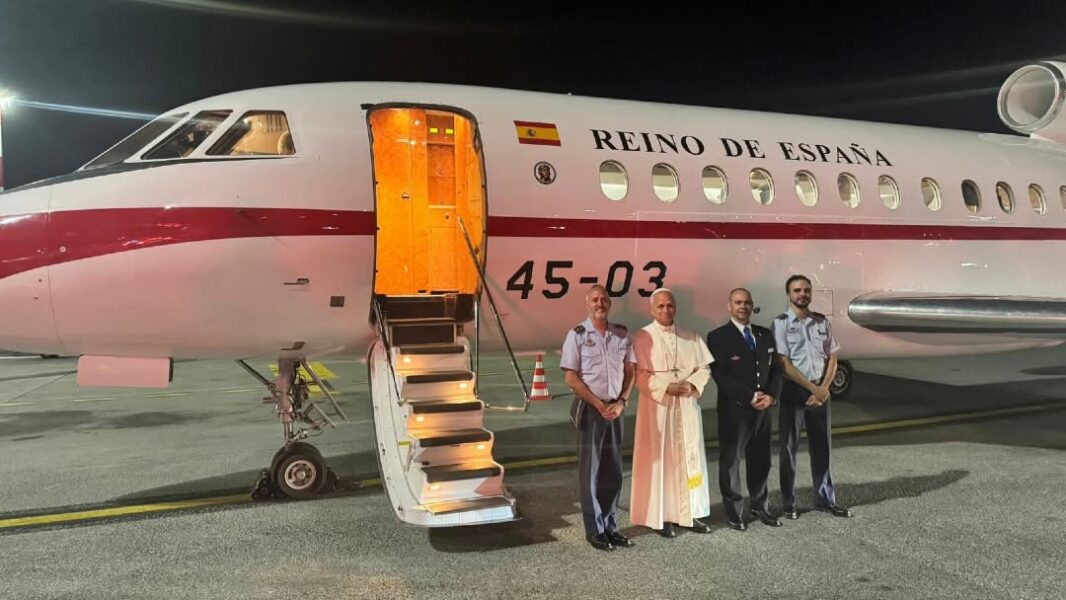
Pope Leo is in Rome after his eventful return from his trip to Spain. «Thank you very much for saving us», were the words of Pope Leo XIV to the crew of the Falcon from the 45th Wing, a recognition of the professionalism, dedication, and service vocation of those who work every day for Spain. Our image today shows the arrival in Rome of the King of Spain’s plane, offered for the Pope’s transfer. A gesture that will go down in history and that has undoubtedly sealed a trip with unexpectedly positive results. It will take time to process and interpret everything experienced in these days; we recommend Santiago Martín’s latest post Leo XIV upholds the non-negotiable principles of Benedict XVI on his trip to Spain, which offers an assessment of these days and their impact on the complicated beginning of his pontificate.
The Catholic heart of Spain.
The technical incident spared the Pontiff the usual press conference during the flight. The numerous speeches delivered over these seven days are more than enough to recount and understand what will undoubtedly remain one of the most successful apostolic journeys in the collective imagination. Leo XIV concluded his stay in Spain by paying tribute to the «great Catholic heart of Spain». A heart that, judging by the images of the crowds this week, still beats despite the relentless advance of secularization and the most secularist government in recent history.
The issue of immigrants, improperly called migrants, marked a delicate moment of the trip. After proclaiming the right, so often recalled by Benedict XVI, not to have to emigrate, and warning them about the «siren songs» of those who promise easy paradises, he condemned the traffickers who «turn the suffering of others into a business». He addressed them with what he himself described as «a clear message»: «Stop, convert!». A cry that recalls that of John Paul II in the Valley of the Temples in 1993. The same words he then directed at the mafia. Two days ago, on the island of Gran Canaria, Leo spoke plainly, calling the organizations that profit from illegal immigration what they really are: «Mafias that traffic in despair». He thanked the Spanish government for its cooperation in humanitarian aid, a small «caress» after the numerous «slaps» he has received in recent days for his stance on abortion and euthanasia, and even in parliament itself.
The politicized issue of migration.
In the official discourse, blame always falls on the rich countries, which do not know how to welcome and exploit. Thus it happens that even the faithful attending Holy Mass, even many who, after welcoming, have suffered bitter disappointments and harm, hear: «You must welcome! You must welcome!». It never mentions the large and small NGOs or the human traffickers who profit from this phenomenon, often fueling it with false promises of work and prosperity. It does not mention the heartfelt appeal that African bishops have made to young people to remain in their countries and contribute to their spiritual and economic development. It does not mention the prophetic, though ignored, warnings of the late Cardinal Biffi.
A Church reduced to being a humanitarian institution and a Red Cross nurse in a field hospital poses no threat to earthly power. It abandons its main mission: evangelization, education in the truth about humanity and God revealed in Christ crucified and risen. It has ceased to recall that everything else, as anyone with a minimum knowledge of the history of the Church knows, including works of charity and education, is simply a consequence of the discovery of that Love.
The city without walls.
In a «city without walls», before approximately four thousand people gathered in Plaza de Cristo, Pope Leo XIV delivered one of the most intense and politically uncomfortable speeches of his apostolic journey to Spain. Leo XIV built his entire speech around an image offered by the city that welcomed him: the Lagoon as a «city without walls», an open city. «The most difficult barriers to tear down are not always made of stone», but are hidden «in the gaze, in fear, or in indifference». The central moment of this speech comes when Leo XIII distinguishes the different facets of charity. «Welcome opens the door; integration helps cross the threshold. Help heals the wound, and integration rebuilds the future». Solidarity «goes beyond any reductionist concession or simple act of philanthropy»: it is not a gesture, but a process. Integration, he clarified, «is a reciprocal path»: those who welcome have the right to «expand their home without diluting their identity»; those who arrive have «a noble and necessary role»: «open yourselves with confidence to the community that welcomes you, learn its language, respect its laws, know its customs, participate in common life».
The moment of greatest intensity came with the direct attack on «those who exploit despair». Leo XIV listed those who «organize programs of death», «traffic in human beings», «withhold documents», «exploit workers», «threaten women», «deceive families», before issuing the evangelical imperative: «Stop! Convert!». Citing Jeremiah and the Letter of James, he warned that «money taken from the vulnerability of the poor will not bring peace, nor honor, nor future», and that for every life lost, those responsible «will have to appear before divine justice».
The thorny issue of abuse.
Pope Leo, just like Pope Francis a year and a half ago in Belgium, was confronted upon arrival, and in the same address by the King, with the unresolved issue of abuse. We have not forgotten the matter affecting Pope Leo during his time as bishop of Chiclayo, which would be good to clarify as soon as possible.
Pope Leo XIV on June 6 during the papal flight to Madrid, pressed on the issue of sexual abuse and his brief response: «As I announced, I will meet with some victims; unfortunately, it is impossible for me to meet with all those who request it». Pope Francis had a unique ability: he alternated biting outbursts against pedophile priests in general with silence (sometimes even outright lies) on specific cases, especially those involving his friends, such as the serial abuser Marko Rupnik or the bishop of Piazza Armerina, Rosario Gisana, who remains in his post, untouchable, despite being accused in a trial for perjury committed, according to the prosecution, to protect his parish priest, Giuseppe Rugolo, convicted by the Supreme Court of Cassation for sexual abuse of children under his care, but who still appears on the list of priests whose salaries are regularly paid.
Pope Francis, thanks to the empty formula of «zero tolerance», left behind the widespread belief that he was an inflexible executioner. On June 4, two days before the Pope’s arrival in Madrid, news broke that in the 1990s, a girl was sexually abused between the ages of 6 and 12 by Father Álvaro Martín Fuente, an Augustinian priest at the Buen Consejo school in Madrid. The girl reported him to the police in 2010, just after turning 18, and at that time the Prior General of the Augustinians was Robert Prevost. For sixteen years, the Augustinians, who knew everything, covered up the pedophile priest, who even became school director. He was removed only two months ago, after another complaint from the young woman, now around thirty. An Augustinian source stated that Prevost was never informed of anything because no official internal investigation had been opened, «due to negligence», the same source admits, explaining that «in those years there were no protocols».
Victims of sexual abuse are also furious about the visit to Montserrat Abbey. The three abbots preceding the current one covered up the abuses for decades. There were at least 15 young victims, of whom only one has received compensation. The abbey itself publicly apologized in 2019, admitting the devastation that had occurred within it for decades.
At the meeting with the Spanish Episcopal Conference: «Our path is made of encounters: one of the most painful is with those who have been harmed by the very people who were supposed to care for them, including members of the clergy. In the face of this scourge, the ecclesial community is called to respond with listening, truth, justice, reparation, and an ever-deeper commitment to prevention and a culture of care. Every wounded person must be able to find sincere listening, acceptance, protection, and genuine paths to healing»,
Felipe VI first expressed his praise for the «enormous social work of the Catholic Church in Spain» and then said the unthinkable: «There can be no greater contrast with all this than the pain caused by cases of abuse, which are not and cannot be representative of the vast ecclesial community. Their clarity and firmness, which I also wish to recognize, are essential in the process of healing and repairing the damage caused: they are essential for the victims, for the faithful, for the Church, and for society as a whole».
The Vatican’s commission for minors.
With the Rescriptum ex Audientia of May 20, 2026, Leo XIV approved the new Statute of the Pontifical Commission for the Protection of Minors, which entered into force immediately and will remain on a trial basis for three years. Eleven years after the first version, approved in 2015 on the basis of the chirograph with which Francis had established the body in March 2014, the structure regains much-needed legal clarity. In recent years, controversies surrounding the Commission have been numerous and often bitter, with the appointment of problematic figures and lack of legal clarity .
The best-known case remains that of Jesuit Hans Zollner , who quickly became a symbolic figure in the fight against abuse and then remained inactive in the face of complaints from alleged victims of Marko Ivan Rupnik , his Jesuit companion in the Society of Jesus. Zollner resigned from the Pontifical Commission, claiming that the Commission was not sufficiently autonomous.
The Statute and the Apostolic Constitution contradicted each other. The former described an autonomous entity, endowed with its own legal personality; the latter placed it within a Dicastery of the Curia; this normative overlap has been repeated in various areas during Francis’s pontificate. Leo XIV thus finds himself needing to resolve another inconsistency inherited from the past, as he has already had to do on several occasions in recent months. Article 1 of the new Statute establishes that the Commission «is established within the Dicastery for the Doctrine of the Faith, with which it collaborates» and refers to Article 3 —absent in the previous draft— for the regulation of such collaboration.
The most significant change concerns a body that never appeared in the 2015 Statute but now figures regularly: the Secretariat of State. The appointment of its members requires its authorization (Article 8, paragraph 1); such authorization is also necessary for the president to propose forms of collaboration to the prefects of curial institutions (Article 2, paragraph 7); an «informative consultation» with the Secretariat precedes the presentation of the Annual Report (Articles 2, paragraphs 6 and 7); and it is to the Secretariat that the Commission reports when a member is unable to perform his or her duties (Article 8, paragraph 7). In the 2015 draft, members were appointed by the Pope without any intermediate step. The most representative case is that of the Annual Report on protection policies, regulated for the first time at statutory level: Article 7 in its entirety is new, with the sections «Missio universalis» and «Missio localis ». Its publication is subject to the consent of the Roman Pontiff and prior consultation with the Secretariat of State.
Pilgrimage to Loreto.
Message from Pope Leo XIV to those preparing to undertake the 48th pilgrimage from Macerata to the Holy House of Loreto. He invites the pilgrims to «grow in following Jesus to be missionaries of the Gospel, especially in the face of the material and spiritual poverty of our time».
Rainbows are no longer a priority.
And they complain and long for their beloved Pope Francis. The link with the Vatican, strengthened in the audiences reserved for the transgender community of Torvaianica, gathered around Father Andrea Conocchia, is now just a distant memory: «Francis is no longer with us, and it’s as if everything has vanished. Today we are in limbo, waiting for a response that never comes». Pope Leo XIV’s interests in LGBT+ ministry are not the same as those of his predecessor, as he himself admitted to journalist Elise Anne Allen: «I don’t have a plan right now. It seems very unlikely, at least in the near future, that the Church’s doctrine will change its teachings on sexuality and marriage». Upon returning from his trip to Africa: «We tend to think that when the Church speaks of morality, the only moral issue is sexuality. In reality, I believe there are much broader and more important issues». The key lies in the difference between doctrine and pastoral practice, that is, between saying and doing: «If a pastoral program for homosexuals does not revise Catholic doctrine on the orientation that the Catechism defines as disordered, it will always be a half-hearted pastoral program».
Alessia, a regular at meetings with Pope Francis, complains and laments that she risks returning to invisibility: «There is no longer anyone who supports us, and I too am discouraged. I’m not saying there is latent transphobia, but rather a lack of interest», she admits resignedly, recalling a partially truncated process: «I know that Pope Francis was supposed to support the creation of a shelter for transgender people in a villa confiscated from the mafia between Rome and Ostia. Today, however, I don’t know where we stand». For Alessia, little can be done: «I wrote a letter to Pope Leo XIII, but I never received a response. It is also difficult to communicate with him, impossible to speak with him, surrounded as he is by a security cordon. There are no longer any channels of communication, and those that exist are sterile. They tell me to wait, but what is the point of waiting?».
The Cross angers the demons.
A French politician raised a cross and prayed the Hail Mary during a municipal council meeting presided over by a communist politician, who described his tribute to God and the Blessed Virgin as a «political crime». mKevin Nader, elected councilor of Ivry-sur-Seine, a commune on the outskirts of Paris, proposed during the meeting of June 11 a rule prohibiting the use of «signs or clothing that overtly manifest religious affiliation». This regulation would have affected several councilwomen who wear the hijab, including the deputy mayor of Ivry, Fenda Diarra. Nader’s proposal was immediately rejected by the mayor of Ivry-sur-Seine, Philippe Bouyssou, a member of the French Communist Party. According to Nader, «this amendment was not put to a vote» because Bouyssou stated that it was «morally unacceptable».
«Very well, since they refuse to be under the sign of secularism in this city council, they reject secularism. That is correct, indeed, they reject secularism in this city council. But, from now on, we will be under the sign of the cross at every city council meeting», Nader responded during the session while raising a wooden cross. «May the cross bless you all. May God bless you. And I will pray a Hail Mary», said Nader, while continuing to hold the cross and proceeding to pray the Hail Mary, concluding with the sign of the cross.
Mayor Bouyssou immediately condemned his religious act. « What you have just done, Mr. Nader, clearly constitutes a political crime». «And I remind you, in any case, that you are being filmed. And I, who have a deep and unwavering respect for all religions, although I do not practice any, firmly believe that the Christian and Catholic community of Ivry will deeply appreciate the way in which you have humiliated them with this attitude». Immediately afterward, furious, he attempted to expel Nader. «I invite you to leave this municipal assembly immediately».