


It is Sunday, we close the month of May with the rosary at the Lourdes grotto in the Vatican Gardens, where the original altar stands on which so many have celebrated Mass from the time of the apparitions until it was replaced in the 1970s by the current stone. We begin another day, more restrained in news but no less rich in content.
The Catholic Charismatic Renewal.
Audience with members of the Catholic Charismatic Renewal Worldwide (CHARIS) at their first meeting with Pope Leo. He opened his address with a greeting not only to those present, but also to the communities, groups, and schools of prayer and evangelization they represent, as well as to the leaders of the national and international Communion Services that organized the gathering. Leo XIV recalled how the years following the Second Vatican Council marked a time of expansion and growth for the Renewal, but also of progressive integration into the life of the Church and consolidation of its service structures. He remembered Saint Paul VI, who at Pentecost 1975 described the witness of this spiritual renewal as the most necessary for an increasingly secularized world, and Saint John Paul II, who valued its missionary impulse. Benedict XVI recognized its merit by recalling the relevance of the charisms in the Church.
The address was structured around five central aspects of the charismatic spiritual experience. First, baptism in the Spirit, which the Pontiff described as that personal experience capable of making the grace of baptism effective and leading to a living awareness of God’s love; to illustrate this, Leo XIV drew on the words of Saint Augustine in the Confessions, where the Bishop of Hippo recounts the unexpected sweetness with which, after his conversion, the deprivation of “frivolous pleasures” became light for him. He recalled the prayer of praise, noting adoration and thanksgiving as essential aspects of Christian prayer that the movement has helped bring back to the forefront; and the Word of God, source of spiritual nourishment and discernment for daily decisions. On the theme of communion, the Pope recalled Leo XIII’s invitation to pray a novena to the Holy Spirit for Christian unity each year between Ascension and Pentecost.
Leo XIV invited them to place themselves at the service of dioceses and parishes, offering their own experience and methods of evangelization, to follow faithfully the guidance of priests, and to listen, with common discernment, also to the voice of wise persons outside the groups. The Pope recommended cultivating harmony and cooperation among communities, “taking care never to yield to the desire for self-promotion or the pursuit of personal power or prestige.”
The Pope with the young people of Villa Nazareth at the Vatican.
Audience with members of the Villa Nazareth Community: the Holy Family of Nazareth Foundation, the Association and Foundation of the Domenico Tardini Community, and the students of the Roman University College. Presented, of course, by Parolin, Secretary of State and current president of the organization. He recounted the history of Villa Nazareth: its founding in 1946 by Cardinal Domenico Tardini, its welcome to war orphans and children from the poorest families, its guidance under Antonio Samorè and then Achille Silvestrini, until its transformation into a college of excellence.
Villa Nazareth is not only the noble charitable intuition of Tardini. It is also, and above all, the place where Cardinal Achille Silvestrini, the energetic and public opponent of Joseph Ratzinger, exercised his teachings for decades. A diplomat by training, heir to Casaroli’s Ostpolitik, Silvestrini was one of the architects of that circle of cardinals known in history as the “Saint Gallen group”: the group that in the 2005 conclave attempted to block the election of Benedict XVI and that in 2013 did everything possible—and succeeded—in having Jorge Mario Bergoglio elected. In fact, on the eve of that conclave, the cardinals belonging to this group were received at Villa Nazareth. In 2016, a grateful Pope Francis even visited Villa Nazareth.
Silvestrini was, on the national level, one of the most tenacious opponents of the Wojtyła-Ratzinger line. In civil society, he was the spiritual father of Italian democratic Catholicism and the center-left: friend of Romano Prodi, mentor of Giuseppe Conte, who studied at Villa Nazareth. From the college’s classrooms emerged ecclesiastics and government figures whose paths, to put it mildly, divided both the Church and public opinion.
The Tardini Foundation is now presided over by Claudio Maria Celli, originally from Romagna like Silvestrini, one of the architects of the agreement between the Holy See and the People’s Republic of China. One of those prelates who introduce problematic figures into the Vatican, granting them access without any particular reason, often for inconsequential dinners and to deliver souvenirs later displayed as if they had been received “directly from the Pope.”
Leo XIV declined to preside over the Mass, which was celebrated by Cardinal Pietro Parolin. The Pope arrived and delivered an address that, read between the lines, carries a restrained eloquence. Leo XIV recalled the original vocation of the work: to form young people as “leaders in doing good,” making a spiritual, intellectual, and moral path accessible to those rich in talent but lacking resources. He remembered his predecessors: Saint John Paul II, who in 1996 exhorted the community to a wisdom capable of freeing the intellect “from the prison of pride and the logic of domination”; and Benedict XVI, who in 2006—before the same reality—asked that young people be formed “in the courage of decisions,” with “reference to reason purified in the crucible of faith.”
It sounded very strange to hear Leo XIV in this context recall the words of Benedict XVI. The Pope reiterated, before the heirs of Silvestrini, the warning of the man whom Silvestrini opposed; he warned against the “logic of domination” and the temptation of Babel, precisely in a hall filled with those who have long practiced certain logics. It is unknown how many of those present grasped the implications. It is a community that always speaks of its purest origins—the orphans, the star, the Founder’s charity—and never of its more ambiguous periods.
The family in Aparecida.
Pope Leo XIV, in a video message addressed to participants in the XVI National Symposium on the Family, sponsored by the Commission for Life and Family of the National Conference of Bishops of Brazil, held in Aparecida. It is necessary to look at families with realism and compassion, recognizing the many difficulties that afflict them: their fragility, crises, anxieties, and many other situations of suffering.” All this requires a merciful attitude and prudent, mature discernment on the part of the Church and pastoral agents. The Pope also reiterated that the family is a community “formed by a man and a woman, united in love until they become ‘one flesh.’”
Centesimus Annus Pro Pontifice.
In the Clementine Hall, Leo XIV received participants in the annual meeting of the Centesimus Annus Pro Pontifice Foundation and offered an important reflection on freedom, pluralism, and the anthropological roots of contemporary crises, linking it to his recent encyclical Magnifica Humanitas. This foundation is known as one of the gateways through which brothers with suitable characteristics are selected to occupy spaces in the Vatican universe.
The Foundation was personally established by Saint John Paul II in 1993 and takes its name and inspiration from the encyclical Centesimus Annus, promulgated by Pope Wojtyła on May 1, 1991, on the centenary of Leo XIII’s encyclical Rerum Novarum. Its distinctive feature lies in its lay character: it brings together Catholic entrepreneurs, bankers, professionals, and academics from around the world, called to study and spread the Church’s social doctrine and translate it into economic and civil practice. Its initiatives include formation courses, international conferences, and the “Economy and Society” Award.
The starting point is the diagnosis of an era “characterized by wars and growing polarization,” marked by cultural and social divisions. The Pope recalled that “in the midst of fragility, a new hope is born”: what truly unites people, beyond fractures, is our common humanity. “Where are we going? Toward what goal do we want to orient ourselves?”—a manifestation of the thirst for truth and for God and of the gifts of reason and freedom. The Pope insisted on the latter, reiterating the teaching of John Paul II in Evangelium Vitae: authentic freedom is not simply doing what one wants, but is realized in the “gift of self and acceptance of others,” that is, when it is used to love; when, however, it is absolutized in an individualistic way, it is emptied and contradicts its own dignity.
It is the appropriate context to recall that behind “the crisis of contemporary democracies and the weakening of multilateralism” lies in reality “an anthropological crisis” stemming from forgetfulness of the Creator. The response is not discouragement, but daily fidelity: “the civilization of love is not born of a single spectacular gesture, but of the sum of small, tenacious loyalties that act as a barrier against dehumanization.” In such a fraternal setting, reference cannot be lacking to dialogue “founded on truth” and to “healthy pluralism”: the recognition of the intrinsic dignity of every person allows us to overcome selfishness and particular interests in the name of the common good and to value the richness of contributions from different origins, in peaceful coexistence.
The Magnifica Humanitas in the New York Times.
The New York Times recently suggested that Pope Leo XIV’s first encyclical could help Catholicism free itself from its supposed obsession with so-called “pelvic theology,” the body of Church teachings on sexual morality. According to this interpretation, decades of focus on “sins below the belt” have distracted the Church from its social mission, weakening its voice in defense of workers and the marginalized. This seems to be the thinking of many, even within the Church, and among the clergy, including those holding mitred positions. Extensive interview with Dominique Wolton (Pape François. Politique et société, 2017/2018): “There is a great danger for preachers: that of condemning only the morality that is—pardon—‘below the belt.’ But the other sins, more serious: hatred, envy, pride, vanity, homicide, murder… are rarely mentioned.” He added that sins of the flesh are “the lightest, because the flesh is weak,” while the most dangerous are those of the spirit. He cited with admiration a cardinal who, in response to confessions of this kind, replied: “I understand, let us move on.” Pope Leo XIV also echoed similar themes, recalling that the unity (or division) of the Church must not revolve primarily around sexual issues and that morality cannot be reduced to them. On the return flight from a trip (April 2026), he said: “We tend to think that when the Church speaks of morality, the only moral issue is sexuality. In reality, I believe there are much broader and more important issues, such as justice, equality, freedom… that should take priority over that particular topic.”
Noelle Mering, in her article published on eppc.org, dismantles this thesis with solid arguments: “those who separate sexual morality from social doctrine take for granted a dichotomy that the Church has always rejected. Sexuality does not belong to a private and irrelevant sphere: ‘Sex creates obligations. It creates mothers, fathers, children, dependencies, bonds, and vulnerabilities.’ It is, in other words, the connective tissue of every society. Mering demonstrates this with concrete and undeniable examples. Is the exploitation denounced by the MeToo movement simply a private matter? Does not the epidemic of fatherlessness reveal the deep connection between chastity, charity, and social stability? Are not the crises of loneliness and distrust affecting our communities linked to reducing sex to ‘private preferences and personal satisfaction’?”
Pope Leo XIII, in Rerum Novarum, denounced the treatment of workers as “instruments of production or units of economic utility.” That same utilitarian logic, Mering observes, “did not stop at the factory gates. It extended to all areas of human life,” to the point of commodifying the body, fertility, and intimacy. Therefore, “pelvic theology” is an integral—not antagonistic—part of Catholic social doctrine. Many recognize the dangers of commodification in the economy, but systematically ignore them in the sexual and family spheres. They rightly oppose precarious work, but “celebrate a sexual revolution that has generated enormous profits for industries based on instability, appetite, and alienation.” Dating apps, industrial pornography, pharmaceutical companies profiting from gender ideology: all are manifestations of the same dehumanization. “The industrial revolution risked reducing man to a labor force. The sexual revolution risked reducing him to an appetite. The AI revolution risks reducing him to a machine.” The Church’s response is always the same: the human person is “a creature made in the image of God, endowed with an inviolable dignity that no market, state, ideology, or technology can erase.” Separating sexual morality from social justice is not a sign of intellectual sophistication, but an error that impoverishes and destroys both.
Solidarity with the “Society of Saint Pius X”: “Je suis Pie X.”
Joachim Heimerl offers his view on the relationship between the Society of Saint Pius X and the Vatican. “Perhaps you agree with me? I do not belong to the Priestly Society of Saint Pius X, but I follow their work closely and am grateful. Without the Society, the traditional Mass would be forgotten today, and I myself would never have known it. Certainly, there are many traditionalist communities that celebrate the ‘old’ Mass, but none of them would have been born without the Priestly Society of Saint Pius X; it is the first community that has preserved the traditional faith of the Church and the only one that defends it without concessions, even when other traditionalist communities remain silent.”
I regularly receive the newsletter of the Priestly Society of Saint Pius X and read it with great interest. I have never found in it anything that contradicts or obscures the Catholic faith, unlike what constantly occurs in the official texts of the Church and the Pope. There is no doubt about the Catholicism of the Society; it recently published an impressive “Critique of the Faith,” summarizing those fundamental principles that the Church has always taught but rarely shares today.
The Church has always affirmed, based on the testimony of Sacred Scripture, that the new covenant replaced God’s covenant with the people of Israel. Today, it considers this affirmation offensive and monopolistic, and maliciously accuses those who insist on its earlier doctrine of “antisemitism.” Unfortunately, this also applies to the revealed truth that there is no salvation outside the New Covenant and that only the Catholic Church administers this salvation through the sacraments. Heimerl recalls his personal process, which is not unlike that of many other priests: “I was born after the Second Vatican Council and lived my Catholic education—redundancy intended—with a scandalous lie that, like many others, I took a long time to recognize and that today horrifies me even more. I refer to the lie of supposed continuity, the lie that claims the Church has remained the same after the Council and has not radically changed its doctrine or its liturgy.” The Church today resembles a landscape of ruins, and its faith is presented as a ruin.
Heimerl expresses what many other Catholic priests think but do not dare to say publicly: “It is understandable that the Society of Saint Pius X decided to consecrate its own bishops in this situation, and I am glad that they did so. However, if this occurs without a papal mandate, it only evidences the desolate state of the Church. This also means that it could entail excommunication. The question is no longer ‘excommunication.’ Rather, the question should be whether it is really possible to excommunicate those who alone profess the Catholic faith, while popes proclaim heresies and kneel before false idols. I believe such an ‘excommunication’ would not hold before God, and for this reason alone, no one is obliged to accept it. This is all the more true if we consider that, in general, today no one is excommunicated, not even for heresy or apostasy, not even the bishops of Germany, Austria, and Switzerland.”
The episcopal consecrations of the Priestly Society of Saint Pius X raise the following question: on which side are we? On the side of the new pseudocatholic faith of the post-conciliar Church and, therefore, on the side of the “new” Mass? Or on the side of the traditional faith, which is expressed only in the traditional Mass and nowhere else? There is no simple middle ground, and even traditionalist communities that nominally recognize the Second Vatican Council are ultimately excluded from answering this question; it is all or nothing.
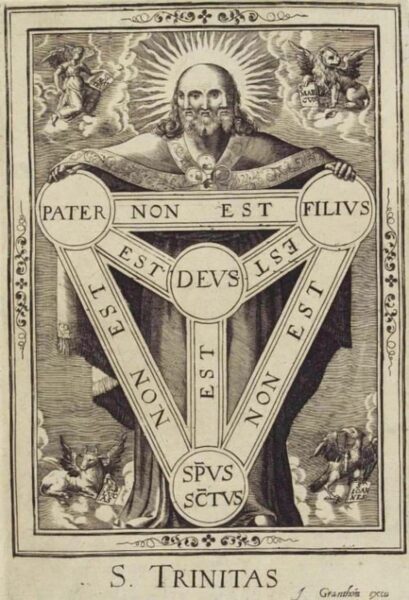
The Most Holy Trinity.
Today is the Feast of the Most Holy Trinity, which began to be celebrated around the year 1000, perhaps a little earlier. It seems that it was the monks who assigned the Sunday after Pentecost for its celebration. Previously there existed a votive Mass and Office in honor of the Trinity, but no feast day as such. The diocesan churches began to follow the example of the Benedictines and Cistercians, and, in the following two centuries, the celebration spread throughout Europe. Rome was slow to admit the new feast, and finally, in 1334, Pope John XXII introduced it as a feast of the universal Church.
The Sunday of the Most Holy Trinity is a devotion that originates from the New Testament itself; but what gave it special impetus was the Church’s struggle against the heresies of the fourth and fifth centuries. Arianism denied the divinity of Christ. In 325, the Council of Nicaea affirmed that Christ is coeternal and consubstantial with the Father, and thus condemned Arianism. This was reaffirmed at the Council of Constantinople in 381, which further declared that the Holy Spirit is distinct from the Father and the Son, but consubstantial, equal, and coeternal with them.
In what way should we approach this mystery? Shall we begin with the unity of nature or with the Trinity of persons? For centuries the Church’s teaching has emphasized the unity of being, and this was also done in popular catechesis. A popular Irish prayer, translated by Thomas Kinsella, illustrates this idea:
Three folds in a single cloth,
but there is only one cloth.
Three segments in a finger,
but there is only one finger.
Three leaves on a clover,
but there is only one clover.
Frost, snow, ice…,
the three are water.
Three persons in God
are likewise one God.
“…that whoever believes in him should not perish but have eternal life.”
Good reading.