


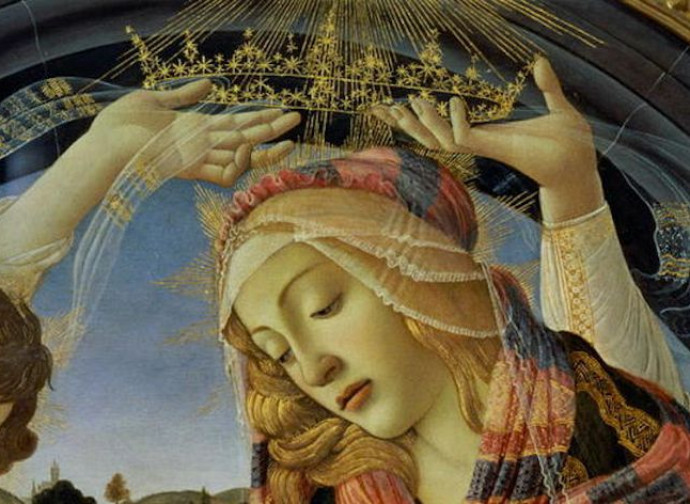
Saturday, we are wrapping up the week. Pope Leo is making a pastoral visit today to San Marino and Rimini. Feast of Saint Mary Queen, and a day very focused on articles about synodality of great interest. On a topic about which no one really knows what we are talking about, and we all have the impression that, under a layer of verbiage, they are trying to pull the wool over our eyes. This absurd situation must be exposed, as it has little or nothing to do with the treasure of the faith we have received and must safeguard.
Leo XIV to Catholic legislators.
While receiving the International Network of Catholic Legislators at the Vatican, the Pope reminded governments and parliaments of their responsibilities: regulations, independent oversight, and protection of rights to prevent algorithms and platforms from becoming instruments of domination. He also warned about new forms of “ideological or economic colonialism.” We are facing very substantial changes in many professions driven by the combination of robotics and so-called artificial intelligence. Many processes are already being streamlined and drafted with the new systems, rendering useless many professions that until now were indispensable. The problem with this change is that it is happening in a very short time; other historical processes have taken generations to be implemented, but now we are talking about very few years, and an entire generation may be left out of the market as their trades disappear. Without a doubt, it is an enormous, unpredictable challenge that cannot be easily steered by the ruling classes. Our developed societies generate thousands of new regulations at all levels that attempt to regulate a thousand aspects of the social and even personal lives of citizens. We are facing a new world that will change our societies. The challenge for the Church is to recover its essence and offer the only possible way, truth, and life; otherwise, it will disappear, swallowed by the sinkhole of history.
Stabilizing Lebanon.
Aoun began a two-day visit to Italy, today in Rome and tomorrow in Taranto for the Mediterranean Games. The conversations at the Secretariat of State “focused substantially on the Trilateral Framework Agreement, signed by the United States, Israel, and Lebanon, whose goal is to stabilize the southern borders of the Republic of Lebanon and achieve a just and lasting peace.” The Holy See, while expressing satisfaction with the signing of the document, voiced its deep concern over the difficulties being experienced in its implementation and assured its support for the efforts being made. The UN mission, deployed since 1978, is about to expire, and Rome and Paris are working on a mechanism to continue its legacy without leaving, as the Beirut media wrote today, “a security vacuum in the region.” New rounds of talks between Beirut and Israel are expected to take place in Rome in the coming weeks, confirming the role Italy is carving out as a platform for negotiation in the Lebanese case.
In San Marino and Rimini.
The Pope arrived in San Marino by helicopter: he is the third Pontiff to visit the rock, after John Paul II and Benedict XVI, and was received by the Captains Regent of the Republic, Alice Mina and Vladimiro Selva. Later, a private visit is planned to the Augustinian nuns of the monastery of Sant’Antonio da Padova. This is his sixth pastoral visit in Italy. The Pope will be taken to the Basilica of San Marino, where he will be received by Bishop Domenico Beneventi; the adoration of the Blessed Sacrament and the veneration of the relics of Saint Marinus will take place, accompanied by priests, consecrated persons, and representatives of the diocese.
This afternoon in Rimini, where he will visit the exhibitions on Saint Augustine and Leon Harmel, greet the participants of the Caritas meeting at the Children’s Village, followed by a meeting in the Grand Auditorium. The Pope will visit Rimini Cathedral to meet with the sick, disabled, and poor assisted by Caritas. A Mass will be celebrated at the port of Rimini before departing for Rome.
Friendship among peoples.
The bond between the Holy See and the Meeting for Friendship among Peoples has deep roots in time and is marked by numerous events that have influenced its history; today the Pope Leo XIV at the meeting. The meeting is based on a constant commitment that has been maintained for more than forty years and has counted on the participation of three pontiffs. Since the first edition in 1980, without exception, the pontiffs have sent their message to the meeting every year. These words have consistently offered fundamental reflections on the theme of the meeting, accompanying the work of the volunteers and the reflections of the participants, as demonstrated by the message sent by Pope Leo XIV for the 2025 edition. Pope Leo XIV also included the title of this year’s meeting (“In deserted places we will build with new bricks”), inviting us to “dare to prophesy, letting ourselves be led into the desert and seeing now what can be born from the rubble and from so much, too much innocent pain.” One of the milestones in this history is the visit of Saint John Paul II to the meeting on August 29, 1982. In that famous speech, the Pope charted a course that still guides the event today.
John Paul II in Rimini.
The appeal that Pope John Paul II made: “Peace today is seriously threatened; science and technology run the risk of creating an imbalance fraught with negative consequences in the relationship between men, between man and nature, between nations. From this contradiction, which seems unstoppable because it is structurally linked to the mystery of evil, we must turn our gaze to the ‘architect of our salvation’ to create a civilization born of truth and love. A civilization of love! To agonize, so as not to be extinguished in unbridled selfishness, in a blind insensitivity to the suffering of others! Brothers and sisters, tirelessly build this civilization!”
In the summer of 1991, during a meeting at Castel Gandolfo that included Mass and breakfast with the Pope, some of the organizers of the meeting had the opportunity to exchange views with John Paul II. It was then that, understanding the uniqueness of the meeting, he uttered a phrase destined to endure: “You are creating a culture of the frontier.” Pope Wojtyla provided another deeply moving moment on August 22, 2004, when a live connection was made at the end of the Holy Mass celebrated in Rimini, presided over by the then bishop, Monsignor Mariano De Nicolò.
After greeting Father Luigi Giussani, who, like him, was gravely ill (both would die the following year), John Paul II recalled that “Christianity, despite human limitations and errors, constitutes the greatest factor of true progress, because Christ is an inexhaustible principle.”
Ratzinger and Benedict XVI in Rimini.
Although he never visited the pavilions of the Fair, Joseph Ratzinger was one of the key figures of the meeting. On September 1, 1990, the then Cardinal and Prefect of the Congregation for the Doctrine of the Faith delivered a historic speech entitled “A Company Always Reformed.” It is a text of such depth and relevance that it has been cited on several occasions, even by his successor, Pope Francis. The Cardinal Ratzinger addressed the theme of the renewal of the Church, overcoming the prejudices that reduce it to a mere stifling institution. The Cardinal rejected proposals for reform based on activism or purely democratic logic, which risk turning faith into opinion and the Church into an artificial human product. True reform is defined, instead, as “ablatio,” or a work of purification that removes human superstructures to allow the authentic image of God and what is essential to shine forth. This path requires an openness to the Eternal through faith, the grace of forgiveness, and the capacity to accept suffering, finding true guidance in the saints. Pope Francis continued the tradition of papal messages, receiving in audience at the end of the event some of the witnesses and protagonists who have animated previous editions of the meeting.
Synodality, a media myth.
In the media and in journalistic debate surrounding the topic of synodality, more and more interpretations are emerging that risk distorting the profound nature of the Church, overlaying secular, sociological, or explicitly political categories. When synodality is separated from its inseparable dogmatic foundation and from Tradition, misunderstandings arise that come into open conflict with authentic Catholic faith. The first and most widespread deviation is the parliamentarization of the Church, which does not even translate into a true dialectical clash between different positions, but rather into a hackneyed reinterpretation of political correctness. As happens in contemporary parliamentary democracies—where the opposition between parties is often a theatrical fiction that never dares to question the true powers that be or the dominant ideological directions—the secularized synodal model also risks being reduced to a mere echo chamber for cultural homogenization.
This entire process is accompanied by the demagogic reductionism of the sensus fidei, which confuses the deep sentiments of the baptized, rooted in grace, with simple opinion polls or dominant cultural trends. Catholic faith, on the contrary, recognizes the Church as a mystical and sacramental body, whose hierarchical structure and doctrinal continuity cannot be modified either by parliamentary dynamics or by obedience to a single way of thinking.
The International Theological Commission published in 2018 the document “Synodality in the Life and Mission of the Church” in which it clarifies that synodality is not a concession to the modern democratic spirit, but the constitutive form of the Church as the people of God on the way. The document reiterates that the synodal process is carried out not by the arithmetic of the majority, but solely by the decision of hierarchical authority. However, a critical and deconstructive analysis of the synodal texts reveals how the underlying categories of thought are different. Although the documents explicitly avoid managerial jargon, they conceptualize and structure the life of the Church by dividing it according to a corporate model that separates the phase of investigation and consultation (decision-making) from the moment of deliberation and final approval (decision). Behind the term “discernment,” a technocratic mentality has infiltrated that conceives grace and listening to the Holy Spirit according to the procedural dynamics of a board of directors.
Synodality in canon law.
The 1983 Code of Canon Law, in canons 342 to 348, defines the Synod as an assembly of bishops whose conclusions have the value of a consultative vote offered to the Pope, who remains the sole legislator, even when the presence of the laity is permitted. At the level of the local Church, canon 466 categorically establishes that in the diocesan Synod, the sole legislator is the bishop, while the other members, including the laity, enjoy only a consultative vote. In diocesan and parish pastoral councils, governed by canons 514 and 536, the lay vote retains a purely consultative character, aimed at examining and proposing pastoral activities under the presidency of the parish priest. The Church’s legal technique thus demonstrates that consultation involves the entire people of God to identify the good, while the decision remains anchored in the personal responsibility of the ordained priest before God.
The practice introduced during the last World Synod on Synodality reveals profound aporias arising from the decision to grant the laity a formally equal vote to that of the bishops in the approval of the Final Document. Although from a strictly formal point of view this vote remains consultative with respect to the final decisions reserved to the Pontiff, the numerical equivalence of a layperson’s vote with that of a successor of the Apostles within an assembly called the Synod of Bishops creates a substantial inconsistency. Allowing a baptized, non-ordained person to cast a vote with the same arithmetic weight as a bishop within a body of judgment effectively separates the exercise of pastoral discernment from the Sacrament of Holy Orders. The resulting institutional and epistemological incongruence empties the apostolic representation of the bishop of meaning, reducing ecclesial suffrage to an indiscriminate count that ignores the sacramental structure of the Church.
Preconciliar synodality in the reform of the Curia.
The reform of the Roman Curia, implemented with the apostolic constitution Praedicate Evangelium, and the transition from the historic Congregations to the Dicasteries highlight a clear tension with the authentic concept of synodality. The preface of the text affirms the possibility that any layperson may preside over a Dicastery, theorizing that potestas regendi does not derive from the Sacrament of Holy Orders, but solely from the missio canonica, that is, from the vicarious delegation conferred by the Pope. This theological-juridical approach represents a rupture with the theology of the Second Vatican Council, which had solemnly affirmed the inseparable unity of sacrament and power. To maintain that the government of the Church can be independent of the Episcopate implies a return to a positivist and preconciliar conception, in which the Pope becomes the original and exclusive source of all jurisdiction, transforming all other rulers into mere delegates. The replacement of the Congregations—traditionally structured as episcopal colleges called to debate doctrinal and disciplinary questions—with Dicasteries accentuates the transformation of the Curia from a collegial-episcopal body into a bureaucratic-functional structure at the direct service of the central executive power. Under the discourse of decentralization and the valorization of the laity, a vicarious centralization and an unprecedented hyperpapalism in recent history is being implemented.
Central Authority at the Service of Desacralization
A coordinated reinterpretation of the admission of the laity to the synodal vote and the reorganization of the Curia into Dicasteries clearly reveals the highly coherent and structured theological and governmental plan of Pope Francis. It is a political and ecclesiological strategy that seeks to dismantle clericalism by desacralizing the power of governance. To dismantle the identification between the priestly order and authority. Pope Francis deliberately separated jurisdiction from the Sacrament of Holy Orders: in the Dicasteries, leadership is entrusted to papal delegation, while in the Synod, the vote is based on Baptism. Only an unlimited recourse to the Petrine primacy makes it possible to circumvent traditional canonical practice, which requires bishops to share the vote with the laity and accept the curial jurisdiction of non-ordained members. A synodality promoted “from above” is being created that uses monarchical authority to deconstruct the intermediate hierarchy.
The Irreparable Break with Lumen Gentium
The reformist framework for ecclesial governance contrasts directly and sharply with the dogmatic definitions of Lumen Gentium, particularly number 21. The Second Vatican Council overcame the centuries-old separation between the power to sanctify and the power to govern, teaching that with episcopal consecration the fullness of the Sacrament of Holy Orders is conferred, which contains within itself, in a unified way, the three munera of teaching, sanctifying, and governing. Jurisdiction, therefore, is not an administrative mandate imposed from outside, but the pastoral activation of an ontological grace received from the Holy Spirit. The Praedicate Evangelium affirms that jurisdiction arises from the missio canonica and that, therefore, the laity may govern the Church by virtue of a pontifical delegation; this means dismantling the sacramental architecture of the Council. The consequences are devastating: if the potestas regendi and judgment over bishops can be exercised independently of the Sacrament, the Sacrament of Holy Orders is stripped of its pastoral dimension and reduced to a mere ritual and liturgical function. This creates the absurd situation of laypeople who, acting in the name of the Pope, exercise governing and supervisory authority over consecrated bishops, subverting the sacramental hierarchy desired by Christ.
The Correct Interpretation of Ministry.
Faced with the true vice of clericalism, understood as a worldly deviation of priestly authority, the Church possessed in its Tradition an exquisitely evangelical response: to trace authority back to its roots of servitium, reminding the minister that he must become minus, that is, a servant of all. The hierarchy has preferred the path of legal engineering and the separation of power from the Sacrament. Modern culture conceives power as a finite quantity that must be redistributed or democratized; instead of purifying the nature of priestly authority by transforming it into a voluntary self-giving, it has preferred to accept the logic of power as domination, opting to “share it” or assign parts of it to the laity through administrative means.
The Lesson of the Holy Fathers.
For the Fathers of the Church, such as Saint Augustine and Saint Gregory the Great, the relationship between episcopal authority (auctoritas) and service (servitium) did not constitute a problem of balance of power, since both realities coincided perfectly. Episcopal authority found its only ontological truth in being a service given even to the point of annihilation for the good of the flock, experienced as a fearsome burden (onus) rather than as a privilege (honos). Saint Augustine constantly reminded himself and his faithful that the function of being at the head of the people (praeesse) was worthless if it did not translate into an effective benefit for souls (prodesse), declaring himself bishop for the people, but Christian with the people. Saint Gregory the Great, in defining the figure of the Pastor in his Regula Pastoralis, coined the title Servus Servorum Dei, warning that the guidance of souls is the art of arts and that the Bishop must consider himself by nature equal to all other men, distinguished only by greater holiness. From the patristic perspective, authority was never dominium or potestas jurisdictionally separated from the Sacred, but caritas, compassion, and spiritual fatherhood. For the Fathers, the response to the temptation of power did not consist in desacralizing the ministry or separating jurisdiction from the Sacrament, since any worldly use of authority was considered a sacrilege: true reform required the Pastor to strip himself of all logic of domination in order to become a servant of the Bride of Christ.
The Trojan Horse against the Bride of Christ
The concrete risk is transforming synodality, from a spiritual dimension of the Church, into an ideology incompatible with Catholic faith. The synodal ideology acts as a true “Trojan horse”: it uses a noble, traditional, and desirable concept—communion, listening, walking together—to introduce structural transformations within the ecclesial citadel that destroy the sacramental form of the Church. The traditional categories of grace and salvation of souls are being replaced by terms taken from sociology and politics, such as inclusion, governance, and redistribution of power. Added to this is the moral blackmail that arbitrarily equates the decisions of commissions with the voice of the Holy Spirit, labeling anyone who advocates fidelity to the Depositum Fidei as “rigid” or “enemy of the Spirit.”
The Break with Vatican II.
Between current synodal practice and the ecclesiology of the Second Vatican Council there is no homogeneous continuity, but a flagrant and blatant discontinuity. The constant and exalted reference to the Council by the progressive wing is revealed as a fictitious artifice, a rhetorical cover used with the same convenience as to dismantle Tridentine discipline. The dogmatic constitution Lumen Gentium represents for the ideologues of progressivism a true doctrinal obstacle that they openly seek to dismantle, since it affirms the sacramental origin of jurisdiction and the hierarchical structure of the Church. While traditionalism devalues the Second Vatican Council, dismissing it as a merely “pastoral” or ambiguous event; secularized progressivism considers it obsolete and surpassed by the “spirit of the times.” True belonging to the Church of Christ, outside of which there is no salvation, is at stake today in a genuine, integral, and not at all “synodal” adherence to the magisterium.
Saint Mary, Queen.
«Do not be afraid, Mary, for you have found favor with God.»
Good reading.