


We finished the month of July, the feast of Saint Ignatius of Loyola, and continue with an activity unsuited to these dates. In August, the Pope will hold a meeting with young Europeans in Assisi, two celebrations related to his summer stay at the Pontifical Villas of Castel Gandolfo, and a pastoral visit to Rimini. These are the only liturgies personally presided over by the Pontiff: the visit to Rimini, for example, includes events that do not appear on the calendar of the Office because they are not strictly liturgical, such as the meeting at the Fair or the visit to the Republic of San Marino.
Patti Smith with Leo XIV.
It is a secondary matter, no doubt, but any excuse is good for Spedaro SJ to adorn himself. Patti Smith is at the Apostolic Palace of the Vatican for a private audience with Pope Leo XIII. She is accompanied by Father Antonio Spadaro, Undersecretary for Culture, who frequently collaborates with Smith on various initiatives, always in support of peace and their shared commitment to multiple causes. Smith recently concluded a series of concerts in Italy, including one with a large audience at the Circo Massimo. Smith is originally from Chicago, like Robert Prevost, a rock music icon but also an artist and poet; she will turn 80 in December.
Leo repeals Francis: another Fundamental Law of the Vatican.
It is the most important news of the day, representing yet another amendment, and already several, to everything approved by Pope Francis. The Vatican City State is governed by a new Fundamental Law that Leo XIV promulgated this morning, the liturgical memorial of Saint Ignatius of Loyola, and the provision came into force immediately, without the usual period of inactivity. The text completely replaces the one signed by Francis on May 13, 2023, which in turn succeeded the 2000 law promulgated by John Paul II, which derives directly from the first Constitution of the Papal States, established by Pius XI in 1929 after the Lateran Pacts. It is strange to see such haste in the Vatican. Seventy-one years between the text of Pius XI and that of John Paul II, and twenty-three until the change by Pope Francis. The document signed by Leo XIV arrives just over three years after the last revision, and less than nine months after a motu proprio with which Leo XIV himself had already addressed a single article of the law inherited from Pope Francis.
Leo XIV preserves in the document the structure desired by Francis: the division into five Titles for the functions of government (general provisions, legislative, executive, judicial, and final provisions), which had already replaced the old structure of progressive articles. The Pontifical Commission remains as the legislative body, the Governatorate as the executive body distinct from the Roman Curia, and the same architecture of delegations and oversight. Continuity is evident: the new text reproduces in full much of the preamble and the articles of 2023, including those relating to the budget, the flag, and the coat of arms of the State.
What has changed are a dozen specific adjustments, designed to remedy the gaps that have emerged in governance practices over the past three years. The Supreme Pontiff can now delegate legislative power to a body other than the Pontifical Commission, and can no longer simply retain it for himself.
The position of Deputy Secretary General of the Governatorate, mandatory in Pope Francis’s text, becomes optional: the expression “when appointed” appears several times in the new text. The Secretary General is now appointed on the proposal of the President of the Governatorate and receives formal custody of the State seal. The General Counselor may be invited to meetings of the Pontifical Commission as an advisor, a possibility that the 2023 text did not contemplate. In the judicial sphere, where Pope Francis’s law was limited to a generic reference to the “bodies established according to the judicial system,” Leo XIV’s law explicitly names the Tribunal, the Court of Appeal, the Court of Cassation, and the Office of the Procurator of Justice, thus completing a plan already announced in the 2023 preamble.
Article 8 governs the composition of the Pontifical Commission for Vatican City State, an organ presided over by the President of the Governatorate. The text signed by Francis in May 2023 established, without any ambiguity, that the Commission would be “composed of cardinals, including the President.” On January 19, 2025, Pope Francis announced in an interview that he would entrust Sister Raffaella Petrini with the presidency of the Pontifical Commission and the Governatorate, a position that took effect on March 1, even though she is not a cardinal. On February 25, the Secretariat of State attempted to legally justify the appointment through a statement mentioning an amendment to the 2023 Fundamental Law and to Law No. CCLXXIV of 2018, coinciding with the appointment of the two new Secretaries General of the Governatorate, Archbishop Emilio Nappa and lawyer Giuseppe Puglisi-Alibrandi, the first layperson to hold that position. For nine months, the contradiction remained unresolved. Then, on November 19, 2025, Leo XIV signed the apostolic letter issued motu proprio repealing and rewriting the first paragraph of Article 8. From that day on, the Pontifical Commission was composed of “Cardinals and other members, including the President.”
It reproduces without changes the text of the motu proprio of November, incorporating it permanently into the body of the law instead of leaving it as a patch alongside the 2023 text. The intervention thus moves from an emergency correction to a definitive solution. Leo XIV closes a file that for months had exposed the Holy See to the suspicion, not unfounded, of having allowed the Papal States to maintain a presidency without a clear legal basis for an entire year. Without a doubt, it is urgent to begin removing those who supported the previous text and dragged the Holy See into a series of scandals that have only harmed the Church and the Pope.
Roche and the Traditiones Custodes.
Cardinal Arthur Roche, Prefect of the Dicastery for Divine Worship, has clarified that Pope Leo XIV has no intention of revoking Traditionis Custodes. In an interview with the magazine The Tablet, published on July 29, Roche stated that “Pope Leo XIV will not modify Traditionis Custodes” and that the pontiff will not return to the previous, more permissive regulations introduced by Benedict XVI in 2007. Traditionis Custodes requires priests to obtain authorization from the bishop to celebrate the old Mass and obliges communities associated with this liturgy to meet in places other than the usual parish churches. In contrast, with his motu proprio Summorum Pontificum, Pope Benedict XIV did not establish these restrictions or authorizations.
Leo XIV has not changed his official stance: the reformed liturgy after the Second Vatican Council remains the only recognized form of the rite. In January, during the Consistory, a text signed by Roche and distributed to the cardinals reiterated that there should be “one single rite for the celebration of the Mass.” He rejected accusations of “persecution” made by some traditionalist groups, emphasizing that existing concessions disprove this narrative.
During the interview, Roche described the conversations he had with groups linked to the Traditional Latin Mass. According to Roche, he asked them what their complaint was when, in his opinion, Francis had already allowed celebrations under the current norms. “When I meet with groups that desire the antecedent liturgy and I tell them: ‘Well, the Holy Father has given it to you, so what’s the problem?’ But then they go and say: ‘We are still being persecuted!’ ‘In what way are they persecuted? Why does the band keep playing a tune that is out of tune with the life of the Church?’”
When asked if an elderly woman formed by the Tridentine Mass should conclude that her previous religious life had been wrong, Roche responded unequivocally: “No.” “The abundant teaching of the Scriptures that is now offered to us through the celebration of the Mass and the sacraments is something we did not have access to before, but now we do.” “When the Mass is celebrated, since the baptized are a priestly people, they also celebrate with the priest.” Roche told him that the Eucharist is “the place where we should all be able to be together.”
The Church in China.
Phil Lawler in Catholic Culture comments on the current situation of the Church in China. Father Ma Xianshi was released last week, according to AsiaNews. His release coincided with the ordination of Bishop Joseph Chang Yanfeng as pastor of Chifeng. The Vatican announced that the new bishop of Chifeng was ordained with the approval of Pope Leo XIV, “by virtue of the Provisional Agreement between the Holy See and the People’s Republic of China” which gave its approval on June 15. The Vatican only announced the papal appointment after the consecration of the new bishop. Normally, the formal announcement from Rome precedes the ordination ceremony, scheduled for a few weeks later. The curious lack of prior notice in this case raises suspicions that Rome and Beijing had not reached a complete agreement on the ordination. The strange circumstances clearly suggest that the Chinese Catholic Patriotic Association went ahead with the ceremony before the Vatican was fully prepared, or perhaps, fully informed. Could Beijing have presented the Pope with a fait accompli, intending to proceed with the ordination with or without his approval?
We do not know the details of all episcopal appointments in China since the “provisional agreement” came into force in 2018, as its terms have never been made public. The widespread belief—which the Vatican has never formally confirmed or denied—is that Chinese authorities propose candidates for papal approval. Chinese officials have never shown the same enthusiasm for the agreement and in practice have tested the Vatican’s patience by interpreting the agreement according to their own interests. For example, after the death of Pope Francis, Beijing quickly proceeded with the appointment of two new bishops, apparently arguing that papal approval was unnecessary in the absence of a pope.
Father Ma Xianshi was released in November 2024, after having been detained for eighteen months on charges of “illegal commercial activity” for selling hymnals. Obviously, this was not a “commercial” activity, as he made no profit from the sales. However, government officials in Wenzhou province are relentless in persecuting Catholic priests who may be involved in “unauthorized” religious activities. July 22 was a day that revealed much about the freedom of Catholicism in China and the news is not encouraging.
A miracle arrested.
Invasion of Europe by Spain.
Since Thursday morning, the Spanish enclave of Ceuta has been experiencing a true invasion. Thousands of people from Morocco have arrived in European territory by scaling the border barriers or swimming across the Tarajal breakwater, while Moroccan security forces, according to several witnesses gathered at the scene, have made no attempt to stop them. Some observers link this increase to a ruling issued in recent weeks by the Spanish Supreme Court, which ruled that migrants intercepted while swimming toward Ceuta or Melilla cannot be repatriated through the summary procedure applied until now and, therefore, remain the responsibility of the Spanish authorities.
Ceuta is not an indifferent place. Saint Francis of Assisi died on October 3, 1226. A year later, on October 10, 1227, seven brothers and companions of his, all from southern Italy, died as martyrs in Ceuta: Daniel, head of the expedition, Ángel, Samuel, León, Hugolino, Nicolás, and Domno, the latter a lay brother, the others priests. They embarked from Italy, touched ports of the kingdom of Aragon in Spain, and arrived in North Africa. They first preached to Genoese, Pisan, Venetian, and other sailors and merchants, and then began to publicly proclaim the Gospel of Christ in the streets of Ceuta. They were soon arrested. Identified and their intentions known, the Muslim authority urged them to renounce the Christian faith and embrace the Muslim one, or suffer the death penalty. They remained steadfast in their faith and were beheaded.
The incident in recent days immediately provoked diplomatic tensions in Europe. The Italian government announced that it was considering suspending the Schengen Agreement with Spain. Prime Minister Giorgia Meloni wrote on social media that the images from Ceuta demonstrate how uncontrolled irregular immigration represents a concrete threat to the security of European borders, and added that she had spoken with the Minister of the Interior, Matteo Piantedosi, and that she was willing to resort to extraordinary measures.
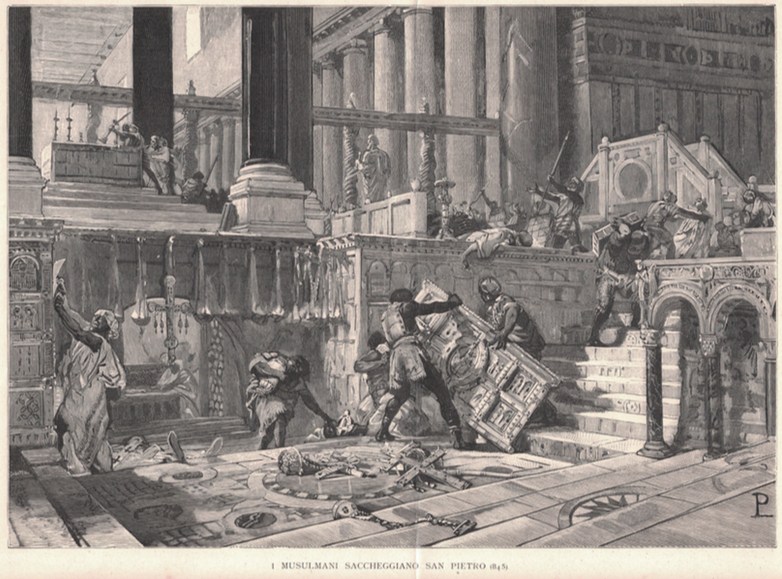
In Rome, it is not forgotten that on the night of August 25, 846, the bronze sarcophagi of the apostles Peter and Paul were opened by Muslim pirates who eagerly sought riches inside them, our image of today. They had arrived in Rome from the ports of al-Andalus, North Africa, and Sicily, led by Abu Massar al-Asturqi, a renegade who, through adventure after adventure, ended up becoming chief of mercenaries and, de facto, the true lord of Benevento. The two great Vatican basilicas, St. Peter’s and St. Paul’s, were set on fire and their immense riches, accumulated there over five centuries by Roman emperors and kings from all over Europe, were loaded onto the Saracen ships anchored in the Tiber.
Morocco’s celebration in Rome.
Normalizing the Pope’s image.
With his period of rest in Castel Gandolfo, which ended on Monday, Leo XIV once again “normalized” the figure of the Pontiff in comparison with the exception of Pope Francis. Vatican audiences have resumed, but he will return to Castel Gandolfo in August to celebrate the Solemnity of the Assumption and the Feast of Our Lady of the Lake on the last Saturday of the month. The last pope to set foot there for a long time was Pius IX, who loved to play billiards, until the breach of Porta Pia interrupted this tradition for more than 60 years. Pius XI, in 1934, reestablished papal vacations in the properties of the Castelli, which the Lateran Pacts granted extraterritoriality. On April 30, 1938, Pope Ratti advanced his vacation to Castel Gandolfo to avoid receiving Hitler at the Vatican. During the war, Pius XII opened the doors of the papal villas to welcome local evacuees, as well as those suffering political persecution. Among them, after September 8, was Alcide De Gasperi, who would later return to live on the shores of Lake Albano. In 1958, Castel Gandolfo was also the scene of the agony and death of Pacelli, who had been staying there from July until the end of November. During his summers in Castel Gandolfo, John XXIII became a nightmare for protocol, as he had the habit of surprising everyone with picnics by the lake and the nearby shore. The Vatican Observatory, in fact, was located in the Apostolic Palace, moved there in the 1930s by Pius XI due to the excessive pollution of the Roman sky. Montini, like Pacelli, died in the summer residence a few months after trying to save his friend Aldo Moro. In 1980, some photographers managed to take several photographs of John Paul II in a swimsuit as he came out of the pool he himself had built. The pool remained unused during the pontificate of Benedict XVI. Another great lover of the castle refuge, where he stayed for a time after his resignation. His last appearance as reigning Pontiff was from the loggia of the palace on that historic February 28, 2013.
“…he did not do many miracles there because of their unbelief.”
Happy reading.