


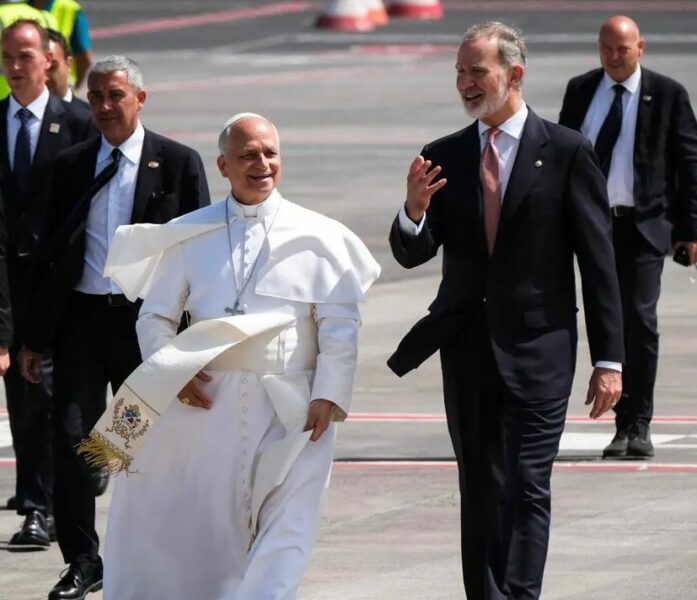
Mid-June is approaching, time flies, the trip to Spain has ended on a positive note, and Pope Leo XIV has passed the test of his first complicated international journey. A quiet Monday in Rome, the hangover after the intense news days of the trip to Spain is noticeable.
There were not a few voices advising against the papal trip at this time and with very serious arguments. The political situation in Spain is surrounded by bottomless corruption, with a government immersed in judicial processes that become increasingly tangled, a web of figures whom Pope Leo necessarily had to greet with a smile. We have never doubted the good response of the faithful people, who remain faithful even after being repeatedly mistreated by pastors who are far from ideal, and this is largely due to Vatican decisions. Thanks be to God, the presence of the episcopal conference went unnoticed. The official part in Madrid, especially at the congress, set the tone of the trip. His presence in Barcelona was known to be an attempt to place him on the side of the outdated Catalan separatist theses. In the Canary Islands, “migration” is a battleground throughout Europe and was a point on which, to put it plainly, the exit or permanence in the Sao Paulo group was at stake. It is not easy to know if we have come out of it completely; surely not, but it certainly seems that we are no longer entirely inside, which is already something.
In yesterday’s Angelus, recalling the trip to Spain, interesting for those he names and those he prefers to forget: “First of all, I express my gratitude to the Lord for the Apostolic Journey I was able to make in Spain. I thank the Spanish people, who welcomed me with great enthusiasm and devotion; and in a special way, His Majesty the King. My affectionate gratitude also goes to the bishops, the communities I visited, and the entire Church in Spain. May God always bless Spain!
The wastefulness of the Sagrada Família.
The majestic basilica of the Sagrada Família in Barcelona is an ancient and very costly project. What is its current value? Could the funds allocated to its construction have been used differently, considering that work began in 1882? What is its spiritual value in a modern European city like Barcelona, which is experiencing a distancing from the faith? What place does the sacred still occupy in our cities? Does it still make sense to build a great basilica at a time when many believe that resources should be devoted exclusively to social and welfare purposes?
The Sagrada Família is not simply a religious building. It is a unique work, an architectural masterpiece without equal, born from the genius of an extraordinary man: Antoni Gaudí. A great exponent of Modernisme, Gaudí bequeathed to Barcelona such celebrated works as Park Güell, Casa Batlló, and Casa Milà, today recognized as UNESCO World Heritage Sites. The Sagrada Família, however, represents something even greater. It is not only a work of art, but a profession of faith engraved in stone. Every façade, every column, every tower tells a passage from the Gospel. Upon entering its interior, one feels as if in a forest of light, where the architecture naturally draws the gaze upward, toward the heavens.
A civilization does not live by bread alone, but also by meanings, symbols, and beauty. The cathedrals, basilicas, and great works of art we admire today were often born thanks to the sacrifice and generosity of entire generations. No one today would say that the Sistine Chapel or our cathedrals were useless or excessively costly investments. Authentic beauty takes nothing away from the human person: it restores an essential part of their humanity and transcendence. In a Europe marked by the loss of the sense of the sacred and the distancing from religious practice, especially among younger generations, the Sagrada Família continues to fulfill a silent but powerful mission. Through its extraordinary artistic and architectural beauty, it bears witness to the existence of a people who still seek God, celebrate Him, and venerate Him.
Millions of visitors enter the basilica each year as mere tourists and leave with far deeper questions, because art still has the power to move the heart. Art, when authentic, introduces us to mystery. Beauty does not impose faith, but opens a glimpse of hope toward the Infinite. The basilica thus becomes a visible sign of the invisible, a place where contemporary humanity can still perceive the presence of God who accompanies His people, pitches His tent among their homes, and covers them with His shadow, as the Sacred Scriptures recount.
When asked why construction was advancing so slowly, Gaudí replied with a now-famous phrase: “My client is not in a hurry.” “God has all the time in the world.” Perhaps this is the secret of the Sagrada Família. In a world dominated by frenzy, efficiency, and immediacy, it reminds us that there are realities that require time, contemplation, and hope. Described by many as a “lay mystic,” Gaudí left a monument to faith in the heart of Barcelona. A visit to the Sagrada Família is not only a cultural experience; it also represents an interior and spiritual one. It is a testimony to how beauty can still elevate the spirit beyond the material. When our forebears began a great project, they always did so for the glory of God and the confusion of heretics; in the Sagrada Família, it seems both objectives have been achieved.
The sluggish management of abuses.
The time has come for Leo XIV to address the issue of abuses. After his trip to Spain, during which the Pope met for about an hour with a group of survivors of clerical violence, the updated Statutes of the Pontifical Commission for the Protection of Minors were published yesterday. This update, experimental for a three-year period, was approved by Robert Francis Prevost on May 20 in an audience with Parolin. This new Rescript confirms the desire of the canonist Pope to simplify the often-confusing normative framework inherited from his predecessor’s pontificate, yet another “correction” of the legislative disaster of Pope Francis.
The Pontifical Commission for the Protection of Minors was established in 2014 by Francis with the task of “proposing the most appropriate initiatives for the protection of minors and vulnerable adults.” In April 2015, its Statute was approved (again on a trial basis for three years), recognizing it as an “autonomous institution linked to the Holy See.” In 2022, without really changing anything, the reform of the Curia established, in the first paragraph of article 78 of Praedicate Evangelium, that the commission be created within the Dicastery for the Doctrine of the Faith. In view of this, a revision of the Statute was deemed necessary, and indeed the new text incorporates the formula “created within the Dicastery.”
Leo XIV felt the need to clarify the legal ambiguities and the respective responsibilities of both bodies. Addressing the participants in the commission’s plenary assembly, the Pope reminded them that prevention was their responsibility, while the Dicastery for the Doctrine of the Faith was to exercise “vigilant discipline.” He also exhorted them to engage in “dialogue with the dicasteries,” keeping in mind that these form part of the Roman Curia and are integrated into a Dicastery.
The new Statute maintains intact the commission’s direct consultative relationship with the Pope through its president, although the presentation of the annual report now includes the phrase “after an informative consultation with the Secretariat of State,” absent in 2015. This also represents an adjustment to Praedicate Evangelium, which recognizes a specific mission for the Secretariat of State. The Rescript appears to confirm Leo XIV’s intention to set aside the anti-curial prejudices of his predecessor. Despite these complicated balances, the Pontifical Commission for the Protection of Minors has in recent years “saved” the Holy See’s reputation on several occasions in the case of Marko Rupnik.
The Day of the Poor.
The message for the 10th World Day of the Poor, signed yesterday, June 13, 2026—in memory of Saint Anthony of Padua—takes as its guiding thread the verse from Psalm 14: “The Lord is the refuge of the poor.” From this word, the Pontiff draws a criterion for judging Christian existence, considering the condition of the poor not as just another social problem, but as a theological space where the very face of God is revealed. The text is divided into five parts. Leo XIV begins with a diagnosis: the loss of the sense of transcendence no longer manifests itself so much as a theoretical denial of God’s existence, but as indifference to His mercy in the building of justice, with a “logic of abuse and rejection” that falls above all on the most vulnerable. Next, we find a surprisingly timely passage: the cry of the poor is stifled today by increasingly subtle techniques, and the digital environment “radicalizes prejudice” against them, thickening the veil of indifference.
The Christological core of the message identifies Jesus as the visible refuge: in the Incarnation, God descends “to the lowest depths,” sharing human poverty even to the Cross. The Pope articulates a series of questions for an examination of conscience: Do we reach where the poor are? Do we pronounce their names with tenderness? The final section features Saint Augustine, with his commentary on the parable of the rich man and poor Lazarus: God conceals the name of the rich man and reveals that of the poor, and the eighth centenary of the death of Saint Francis of Assisi. It concludes by entrusting itself to the Virgin Mary, she of the Magnificat who sees the rich sent away empty-handed, asking her to intercede for a world “wounded by arrogance.”
No end to surprises in Germany.
Stefan Diefenbach, a former secularized priest after 25 years of religious life and currently in a civil union with a same-sex partner, was the main author of the document “Segen gibt der Liebe Kraft” (“Blessing strengthens love”), published on April 4, 2025, by a joint body of the German Bishops’ Conference (DBK) and the Central Committee of German Catholics (ZdK).
In an interview dated May 22, to which we have referred, on the website katholisch.de, Diefenbach stated that, prior to publication, there were contacts and consultations between the German authorities and the Vatican, particularly with the Prefect of the Dicastery for the Doctrine of the Faith, Cardinal Víctor Manuel Fernández. This version contradicts Fernández’s claim that there was no detailed agreement or Vatican approval of the text.
When asked directly about Fernández’s position, Diefenbach repeatedly emphasized that there were no detailed agreements with the Church in Germany and certainly no Vatican approval for the text. But he maintains that “this is probably also a matter of interpretation.” Diefenbach acknowledged that, following these criticisms, the text was “completely revised once again,” and stated that he was surprised by the vehemence of the reactions, questioning whether the critics had read the document carefully or whether the translation was correct. He described the attempt of the text as “squaring the circle,” trying to reconcile the resolutions of the German Synodal Way with the limitations imposed by Rome. The document was criticized both by Pope Leo XIV (April 23, 2026) and by Fernández (May 6, 2026), who argued that German practices go “beyond” what is foreseen in Fiducia Supplicans.
“Give to the one who asks you, and do not turn away from the one who wants to borrow from you.”
Good reading.