


Sunday XXIV of Ordinary Time. Twenty years and a day after Regensburg, and we are still dealing with the same issues: who may celebrate with which missal, whether the Pope we have is the Pope he claims to be, and whether the faithful are being accompanied or waged war upon. Let us take it piece by piece. Good reading.
What has truly changed with Leo XIV regarding the traditional Mass.
While cardinals and bishops clash in declarations about the traditional rite, Silere Non Possum has done something almost no one else does: look at the decrees. Reviewing the authorizations signed by the Dicastery for Divine Worship to celebrate with the 1962 Missal, the conclusion is sober and refutes both sides: the pace of concessions has remained virtually unchanged compared to the previous pontificate, and a large part of the permissions signed under Leo XIV are not new openings, but renewals of already existing concessions. In other words: neither the thaw some hoped for nor the lockdown others feared. The documents tell a less epic story than the headlines—the story of an administration that continues to function by inertia while the public debate heats up on its own. It is worth remembering this when reading, below, the words of Sarah and those of Prefect Roche himself.
Sarah: the Church cannot declare war on its own faithful
Cardinal Robert Sarah, former Prefect of Divine Worship, returned to the matter in an interview with the newspaper Il Giornale published on August 27. He praised Benedict XVI’s 2007 decision to expand access to the Latin Mass with Summorum Pontificum, and described the restrictions introduced by Francis in 2021 with Traditionis Custodes as “neither sensible nor respectful.” His most quoted phrase: “We cannot, as a Church, declare war on those who devoutly participate in the Mass simply because they prefer one form over another: it is a myopic and entirely ideological attitude, and therefore neither pastoral nor Christian. It is harmful, destructive to the Church”.
Sarah attributes the hostility toward Latin and Gregorian chant to “certain self-referential cultural circles,” describing it as more psychological than well-founded, and above all generational: when the generation of ’68 disappears, he maintains, these one-sided positions will also disappear. The intervention came just two days after Jesuit Thomas Reese published an article bluntly titled “Why I hate the old Latin Mass: a confession.” The contrast between the two texts maps the conflict better than any analysis.
Is the See vacant? A question that no longer comes from sedevacantists
On Aldo Maria Valli’s blog, Maurizio d’Orlando signs a letter that raises, with almost notarial method, an uncomfortable question. For years, merely uttering the word “sedevacantist” was enough to shut down any discussion. Now, says d’Orlando, the most stinging question does not come from a schismatic pamphlet, but from the pages of the Annuario Pontificio.
The fact is this, and admits little interpretation: comparing the editions of the Annuario from 2017 to 2026 in the Library of the Catholic University of Milan, up to the 2019 edition the titles “Vicar of Jesus Christ,” “Successor of the Prince of the Apostles,” and “Supreme Pontiff of the Universal Church” preceded the Pope’s name. From 2020 onward they appear after the name and biography, separated by a line and grouped under a new heading: “Historical Titles.” The 2026 Annuario maintains the same arrangement for Robert Francis Prevost. The datum is a datum: the modification exists and has been confirmed after the transition from Bergoglio to Prevost. The interpretation is another matter: the Vatican Press Office, already in 2020, explained through Matteo Bruni that the expression “historical titles” indicates the link with the history of the papacy and that the elected Bishop of Rome equally acquires the qualifications linked to the office; no title has been abolished. Jumping from a change in layout to the thesis of a vacant see is a step the letter suggests but does not demonstrate, and which we do not take. What remains, however, is the question of why the Vatican decided on that change in 2020 and why it has maintained it. Sometimes typography says more than it would like.
Twenty years of Regensburg: the one who has not done self-criticism is Islam
It is exactly twenty years since the lectio of Regensburg, delivered by Benedict XVI on September 12, 2006 and still described by many as an “unfortunate stumble.” The one who now denies this, and from an unexpected quarter, is a Muslim theologian. In the pages of the journal Communio, and reported by UCCR, Ahmad Milad Karimi—philosopher, Islamologist, and Afghan theologian, professor of Islamic Philosophy at the University of Münster—maintains that the Muslim world’s reaction to Regensburg stopped at protest and never transformed into serious theological self-criticism.
The heart of the conference, it is worth recalling, was not the quotation from Byzantine Emperor Manuel II Paleologus that unleashed demonstrations and violence, but the defense of the bond between faith and reason: Benedict warned at once against a religion that breaks its ties with reason and against a Western reason that has expelled from itself every metaphysical question. Karimi takes up the glove on the side that almost no one wanted to take up then: that linking faith to reason offers a potential for “domesticating” violent interpretations of God, in Christianity and in Islam. Twenty years later, the “stumble” turns out to be one of the few things that remain in memory.
A Brazilian bishop and a creed to a “goddess”
At the Mass of the “Cry of the Excluded” celebrated on September 7 in the Cathedral of Our Lady of the Conception, Bishop José Valdeci Santos Mendes of Brejo (Maranhão) and president of the Episcopal Commission for Socio-Transformative Action of the National Conference of Bishops of Brazil (CEPAST-CNBB), presided over the reading of the so-called “Creed of the Youth of the CEBs.” He entrusted the reading to two young people and presented it as a “supplication of the youth of Latin America.”
The text, according to ACI Digital, professes faith in “a God/Goddess who is present in the different experiences of the communities,” declares “we do not believe in a static, patriarchal, clerical, and hierarchical Church” and proclaims a “Great Homeland without racism, without norms for loving, including all sexual diversity.” The communications office of CEPAST clarified to ACI Digital that the CNBB commission did not participate in drafting the document—a nuance that, rather than exonerating, portrays: the creed circulated as a suggested liturgical outline for the mobilizations, and a bishop placed it on the altar. Little more needs to be added; the text comments on itself, and so do the qualities of the living being.
Torreciudad: the commissioner who presides and remains silent
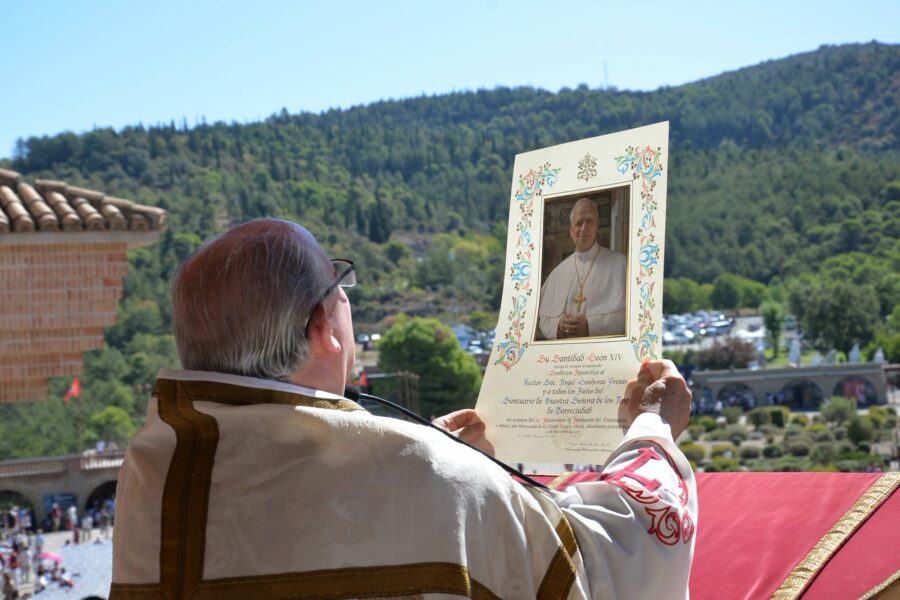
Torreciudad celebrated this Saturday its 34th Marian Family Day—and did so, no small detail, on the 50th anniversary of the new temple, inaugurated in 1975—presided over by Monsignor Alejandro Arellano, archbishop, dean of the Tribunal of the Roman Rota and pontifical commissioner plenipotentiary appointed by the Holy See for the Torreciudad question. In his homily, focused on the family, faith, and the Virgin, he described the sanctuary as a “true school of faith” where the faithful learn to recognize Mary and, in her, Christ. He warned that today’s family faces loneliness, silent wounds, and the difficulty of living an indissoluble love; he recalled that there is no perfect family, but the one that knows how to ask forgiveness and return to Christ, and that every act of patience and self-giving can turn the home into “a workshop of holiness.” The day brought families together on pilgrimage, with Mass, offerings, and the rosary, and at the end the rector invited Leo XIV to visit the sanctuary, for which many pray, and proudly showed a blessing from Leo XIV to the Sanctuary, our image of today.
Despite his condition as plenipotentiary commissioner, Arellano did not enter into any of the concrete matters of the controversy: neither the ownership and location of the image of the Virgin, nor a future resolution of the Holy See. The silence is all the more eloquent for being twofold: it comes just one day after the diocese raised the documentary stakes, and it occurs while the half-century of the temple whose legitimacy to retain the statue is precisely what is in dispute is being celebrated. The continent is commemorated without mentioning the dispute over the content.
Indeed, on September 11—the eve of the day—the Diocese of Barbastro-Monzón published a note of clarifications that orders its version of events with the precision of a dossier. It is worth emphasizing that it is the version of one of the parties; we present it as such. According to the diocese: the original statue of Our Lady of the Angels remained for more than a thousand years in its hermitage; in the deed of the emphyteutic census of September 24, 1962, granted to Inmobiliaria General Castellana, S. A.—an entity associated with Opus Dei—the obligation was expressly established “not to remove the image from the hermitage”; in 1975, on the occasion of the completion of the new temple, the image was taken to Madrid for restoration and, once the restoration was completed, it did not return to the hermitage but was deposited in the new temple. The then bishop, Ambrosio Echebarría, requested its return in writing; the current one, Pérez Pueyo, has reiterated it, among other channels, by certified mail on September 7, 2022.
The knot is documentary and deserves careful distinction. The diocese maintains that authorization for the permanent transfer is not recorded either in the acts of the Cathedral Chapter or in the diocesan archives, and that the notarial testimony provided by the Prelature—relating to a private document attributed to a previous bishop, Jaime Flores Martín, who supposedly authorized its placement in the new temple—is based on an original that has never been delivered to it. The Prelature, for its part, defends the validity of that testimony and of a subsequent 1966 agreement, and denies that one can speak of theft or illegal retention; it does acknowledge, however, that after sixty years it no longer retains the original document. Summarizing the plane of verifiable facts: ownership of the statue belongs to the diocese (on that there is no dispute), and of the decisive documentary piece—the one that would authorize the definitive transfer—neither party exhibits the original.
And that is where Arellano’s silence makes sense. The conflict dates from 2020, the bishop himself requested the appointment of a commissioner in 2024, two years later Rome still has not resolved it, and Pérez Pueyo has gone so far as to warn that he will resign if the statue does not return to its hermitage. That the plenipotentiary commissioner should go to the sanctuary, call it a “beacon of hope,” cordially greet both parties, and not say a single word about the matter he is supposed to settle—the day after one of them has put its documents on the table—is, in itself, a message. What that message may be remains to be seen. For now, the resolution remains in the drawer and the Virgin where she was. The children of Barbastro-Monzón, in the words of their bishop, do not want her as a visitor: they want her at home.
Leo XIV: entering the shipyards of history
We change register, because the week also brought news of the Pope in a constructive key. In a speech reported by AgenSIR, Leo XIV invited people to “enter the shipyards of history to rebuild what has fallen.” And to the Benedictine nuns gathered around the CIB (Communio Internationalis Benedictinarum), between Montecassino and Subiaco, he directed a simple and evangelical image: “From a small seed a great tree has grown”, regarding the formation of the nuns.
We record these interventions without overinterpreting them; they belong to the Leo XIV of reconstruction and accompaniment, the one who—according to the analysis we already cited in previous weeks—understands a good part of his mission as “calming spirits.” That this tone should coexist with the liturgical and financial tensions running through the pontificate is precisely what makes him difficult to read. The seed and the shipyard: two images of patience. We will have to see what is built.
The court of Francis, again
Two pieces from the week return, each in its own way, to the figure of the previous Pope. In Stilum Curiae, Marco Tosatti publishes a second installment by Americo Mascarucci on the so-called “Mafia of San Gallo”, and does so—worth underlining—to dismantle the myth, not to feed it. Mascarucci maintains that attributing Benedict XVI’s resignation and Bergoglio’s election to a plot by the San Gallo group is “fake news repeated to infinity,” lacking evidence; that at those meetings reforms in the Church were discussed, not the elimination of anyone; and that the 2013 election was the product of transversal agreements—with Bertone determined to stop Ruini’s candidate—rather than a conspiracy. It is healthy to see a medium of traditional sensibility ask for evidence instead of taking it for granted. The second, in Il Giornale, about the Vatican’s “embarrassment” regarding an encounter with Bergoglio by Emma Bonino. The matter is sufficiently tangled that we will not consider it closed here; we note it and move on.
Viganò: the “capital schism” and the katéchon
We close with the theologically most ambitious and also most extreme topic of the week. In an interview granted to LifeSiteNews (to Gaetano Masciullo) and reproduced by Marco Tosatti, Monsignor Carlo Maria Viganò—excommunicated for schism by decree of the Dicastery for the Doctrine of the Faith on July 4, 2024—develops the thesis of his new book, Lo Scisma Capitale.
We present his argument without making it our own. Viganò distinguishes the Papacy as a divine institution from the person who occupies the Chair, and calls “capital schism” what he describes as a separation that starts from the caput, from the head: not a part of the body that separates from the head, but the head that—in his judgment—separates from the Mystical Body and from Tradition. To the question about the katéchon—“the one who restrains” of whom Saint Paul speaks in 2 Thessalonians—he responds that the Fathers saw in that figure both the Christian Roman Empire and the authority of the Church and, eminently, that of the Papacy, which for centuries would have contained the mysterium iniquitatis; and he attributes to Leo XIV the task of “making synodality irreversible.” That the crisis of the Church is grave and real is one thing; that the solution is to declare an enemy of the Papacy the one who occupies the Chair of Peter is a leap. Already in its day—recall the case of the constitutional bishops of France and the firmness of Pius VI—the Church rejected even invoking the “state of necessity.” Without doubt we share the shared diagnosis; what is more debatable is the proposed remedy.
“Whoever wishes to come after me, let him deny himself, take up his cross, and follow me.” Between the one who hates the old Mass and the one who declares the Pope schismatic, between the shipyard and the conspiracy, the week leaves us with the impression of a Church that discusses everything except the one thing necessary.
“I do not say to you seven times, but seventy times seven.”