


Easter Sunday, which is advancing, this Thursday the Ascension, and we don’t have a serene day, not even the dies Domini. Many balances of the first year of pontificate and a tour of each of the events that have marked it, wanting to glimpse the path that Leo XIV is undertaking in fundamental issues.
Leo XIV in Naples with the priests.
The chronicle is in all media, we don’t repeat it. Leo XIV insisted on priestly fraternity as a «constitutive element of the identity of ministers» —citing the apostolic letter «A fidelity that generates the future »— and evoked the possibility of new forms of common life in which priests can support each other and jointly plan their pastoral work. In an era in which the priest finds himself increasingly isolated —not by choice, but by structure—, it is urgent to reinvest in fraternal life. «Let us practice the art of closeness».
The speech also addressed the diocesan synod recently held in Naples, with a specific invitation: above all, preserve the method —mutual listening, commitment to the marginalized, synergy between different charisms—. The synod, said Leo XIV, returned to the diocese the image of a Church «called to emerge from itself, to transform its style, to incarnate itself among the people as a light of hope». From there, the final request: to move from a pastoral ministry of conservation to a pastoral ministry of mission. This distinction has been present in the magisterium for decades, but the Neapolitan context —youth unemployment, school dropout, family fragility— gives it a specific weight that theological abstractions alone cannot convey.
Serre Verweij in Rorate Caeli . «In the first days of his pontificate, two narratives emerged almost spontaneously: that Pope Leo XIV represented a return to institutional normality and that he was a moderate. The prevailing opinion was that Leo was «more institutionalist and more reserved than Francis», but that he would retain at least some of his predecessor’s key reforms, particularly the concept of synodality. Leo XIV skillfully fed this ambiguity, appearing in the traditional papal vestments that Pope Francis had systematically avoided, and delivering a first speech that combined references to unity so appreciated by the conservative bloc of cardinals with a general call for a synodal Church. Remaining enigmatic, at least initially, could only benefit him.
From the beginning, a minority of commentators suspected that behind the facade of moderation lay something more concrete: a return to orthodoxy after the death of John Paul II, and the belief that Prevost had been, in secret, the conservative candidate from the start. One year later, according to some observers, this interpretation has gained considerable strength. Among his first clear stances was his unequivocal support for priestly celibacy and for Humanae Vitae, the encyclical of Paul VI. He delayed several documents from the Dicastery for the Doctrine of the Faith signed by his predecessor, and ensured that the document on monogamy was thoroughly reviewed to reaffirm with force «the indissolubility of marriage and its openness to life». He clearly opposed religious syncretism in his messages to Africa and Latin America. His condemnation of abortion before the diplomatic corps was described as «singularly biting», to the point that, according to reports, it undermined an informal agreement that the Andorran government was trying to reach with the Holy See under the pontificate of Pope Francis; an agreement under which the Church would have tacitly accepted the decriminalization of abortion.
One of the most revealing aspects of Leo XIV’s pontificate is the profound influence that canon law exerted on his vision of ecclesiastical government. It is not a secondary skill, it is «a fundamental part of his identity». This is confirmed by his appointments: a canonist at the head of the Dicastery for Bishops, another among his personal secretaries, and a third as secretary of the Dicastery for the Clergy. While Pope Francis ignored or rewrote the law, Leo XIV «tries to bring clarity». Where his predecessor governed in a personalistic and often chaotic manner, the new Pope acts with deliberation, plans, and «once he decides to act, Pope Leo tends to be quite firm».
In the area of the Curia, Leo XIV clearly broke with Francis’s approach. While his predecessor had been deeply influenced by a progressive tradition that attacked the Curia as a bastion of conservatism, Leo XIV immediately praised it for that role: «Popes come and go, the Curia remains». The Praedicate Evangelium has been «largely in limbo».
One of the most delicate issues concerns synodality. Pope Leo XIII continues to use the terms «synodal» and «synodality», but omits them in several important speeches and, more importantly, has stripped them of their most revolutionary content. Under his pontificate, synodality «seems to refer to episcopal collegiality, to bishops serving as pastors of their flock and to communion», far from the assembly-based trends that many progressives expected. The Fiducia Supplicans is reinterpretated to reaffirm «the Church’s teaching on the blessing of individual sinners rather than sinful relationships». The practical result is that it is now used against the positions of the German bishops rather than against conservatives; it is a «nullification by reinterpretation».
As Prior General of the Augustinians, he did not support either liberation theology or syncretism, and organized a visit to the Valley of the Fallen in Spain, considered a monument associated with the far right. As bishop of Chiclayo, he got along well with the local Opus Dei clergy, was «doctrinally clear and meticulous in liturgical matters», and never implemented Amoris Laetitia . As prefect of the Dicastery for Bishops, he developed a strong aversion to Archbishop Montanari, Pope Francis’s main ally and his predecessor’s main candidate for the leadership of the dicastery, an aversion confirmed by the fact that Montanari was systematically ignored for promotions. His professional trajectory revealed him as «an anticommunist, an orthodox canonist, and a dedicated evangelizer», deeply marked by the pontificate of John Paul II and in solidarity with Latin American conservatism.
The motu proprio Traditionis Custodes , with which Francis had drastically limited the Tridentine Mass, is practically dead. Bishops are no longer encouraged to suppress it, but to adopt an inclusive attitude. The persecution of traditionalist communities seems to have ended, and the Priestly Fraternity of Saint Peter is «clearly out of danger». He ordered the nuncio in the United Kingdom to communicate to the bishops that the Dicastery for Divine Worship would automatically grant dispensations from Traditionis Custodes, thus forcing the prelates to stop pressuring their dioceses.
Solid appointments in the Curia, excellent nuncios, few problematic bishops, and above all, a restoration of the dignity of the papacy. The question of how far the return to orthodoxy will go will be resolved in the coming years, with definitive decisions on Amoris Laetitia , the reform of the Curia, the future of synodality, and appointments to the great episcopal sees of the world. For now, the course points toward the Rome of all time.
Despite the clear distancing from the cumbersome and much-debated figure of his predecessor, the current pope has not yet clearly articulated the nature of his pontificate. He seems to prioritize the unity of the Church above the reaffirmation of certain fundamental doctrinal principles. This particular emphasis on unity comes from the deep tectonic fractures generated by Francis’s papacy.
The next steps of Pope Leo.
Undoubtedly, he will soon have to address two important issues: the insistence of the German bishops on blessings for same-sex couples and the announced appointment of bishops by the Society of Saint Pius X without papal mandate. The solutions he proposes to these two problems will help define more precisely the papal personality of Prevost.
They have an excellent summary of the German situation in The German Rebellion: Gay Blessings and the Pope’s Authority at Stake. Santiago Martín offers a clear summary of the state of the situation in which the stubborn German bishops, almost all of them, not all, find themselves.
Another element of clarity will come from how he evaluates the report of Study Group 9 of the Synod on Synodality which, as we have highlighted in several articles, seems to dismantle and undermine the Church’s doctrine on marriage and homosexuality.
In the sacred palaces, it is insistently rumored that Parolin is leaving for Milan. On January 17 he will turn 70 and would have a possible ten-year Milanese pontificate; it is one of the largest dioceses in Christendom that would become cardinalatial again and thus everyone happy, or not so much, but satisfied. If it happens, and everything points to it being done, now the challenge is who will be his successor, something that will clearly indicate the direction that Leo XIV wants to give to his pontificate.
A pontificate at the crossroads.
Pulling on the Pope’s jacket.
It is noticeable, and everyone tries to carry water to their own mill, it is natural, but ours is to recount the reality of the facts and let each one draw their conclusions. With Leo XIV, a true generational leap occurred, not only because of the obvious age difference, but also because Prevost is a post-conciliar man in every sense. In a world where vocations seem to be resurging, although sometimes in ultra-conservative circles, and where «liberal» opinions lead some episcopates to make unfortunate decisions. It marks his personal style, by returning to live in the Apostolic Palace and dressing as Pope, but above all in his preaching, increasingly less political and more doctrinal.
The problem is that not everyone has understood it yet, and they are trying to «pull on his jacket». We are tired of debates on social networks. The People of God is happy to have a «normal» Pope, like Benedict XVI, who bases himself on sound doctrine. Pope Francis had opted for a more «popular» style that left much work to his successor, he had focused on character, on his individual decisions. Let us hope that he knows how to return the life of the Church and faith to the center of the world, following in the footsteps of his predecessors and the Tradition of the Church.
Pope Leo with the Muslims of Senegal.
Audience with leaders and representatives of the Muslim community of Senegal, together with members of the local Catholic Church. Leo XIV condemned «all forms of discrimination and persecution based on race, religion, or origin» and reiterated his rejection of any «exploitation of God’s name ». The Pope highlighted Senegal’s experience as a model of religious and cultural coexistence, evoking the tradition of «teranga», which means hospitality and solidarity, and which he defined as a valuable heritage for all humanity. «Interreligious dialogue is a valuable means to alleviate tensions and build lasting peace». He then issued a particularly clear warning against any ideological use of religion in conflicts: invoking God to justify wars or political interests represents a profound distortion of the religious message and a threat to coexistence. Leo XIV concluded by entrusting the future of coexistence among peoples to the ability to listen to each other and to the choice of fraternity as an alternative to violence.
The Vatican Bank back in the news.
The previous director managed to control the information, we notice that we are back in the media frequently. Today we have a long article about the 2013 investment in the former Budapest Stock Exchange building. The Optimum fund demands substantial compensation for the obstruction of its client, the Vatican Bank which claims: «We are the ones harmed». A recent ruling by a Maltese court, which keeps 29.5 million euros of the IOR frozen in the Banca Popolare di Sondrio , once again puts in the spotlight an issue that seemed to have been forgotten: the investment in the former Budapest Stock Exchange building, Hungary . If things really end badly, the IOR could face compensation of 135 million euros . This figure is unprecedented and is beginning to generate concern, as, after years of litigation, the ruling is expected shortly after the summer, between September and October. What is at stake in the courts of Malta , Budapest , and Luxembourg goes far beyond that figure and has the potential to paralyze the already scarce finances of the Vatican: the 135 million are the total damages claimed by the fund in which the IOR had invested under the direction of the former managers Paolo Cipriani (general director) and Massimo Tulli (deputy general director), who were subsequently convicted in a civil process by the Vatican court of appeals to return 40 million euros to the IOR . The splendid early 20th-century palace in the center of Budapest, opposite the United States Embassy, was acquired in December 2024 by a company in the Liberty group for approximately 34 million euros. A price that the Vatican considers «vile» and therefore the Matta fund demands that the IOR reimburse that lost money.
Rebuilding ties between the Holy See and the United States.
This was the objective of Marco Rubio’s visit to the Vatican, a «friendly and constructive» meeting. «There was then an exchange of views on the regional and international situation, with special attention to countries marked by war, political tensions, and difficult humanitarian situations, as well as on the need to work tirelessly for peace». Parolin had not ruled out the possibility of a direct conversation between the US president and the pontiff in the future. Let us not forget that the Catholic electorate is crucial in the United States: Trump won it by an overwhelming majority in 2024 and needs it again ahead of the November midterm elections. This electorate, the Catholic one, could also be decisive in the 2028 elections. It is no secret that both Rubio and J.D. Vance, both Catholics, aspire to obtain the Republican Party’s presidential nomination in two years.
Nor should we overlook the issue of religious freedom: this is a topic that US conservative circles often mention in reference to the controversial agreement on bishops that the Holy See signed with China in 2018. This agreement was rejected by the first Trump administration and Rubio himself, as a Florida senator, criticized it harshly. It is plausible to hypothesize that Washington has requested a correction of the line historically followed by Parolin, who was one of the main architects of the agreement with Beijing. Perhaps here begins the revitalization of relations between the Holy See and the White House. And who knows, if Trump manages to resolve the Iranian crisis, the US president could collaborate again with the Pope on peace in Ukraine.
The MEGA Prevost.
The two speak at least once a week, commenting on current events, the Pope’s short- and long-term plans, and even finding time to exchange jokes. Luis recalls with irony the day of his election, May 8 of last year: he was in bed with the flu when his wife, Deborah, alerted him to the election. Upon hearing his brother’s name mentioned by Cardinal Dominique Mamberti, he jumped out of bed, suddenly cured. «Perhaps it was his first miracle». For the first anniversary of his pontificate, he told ABC, the family sent a package with Christmas gifts that his brother had not yet opened. The new daily routine requires a bit more caution: after the conclave, the governor called to congratulate him and warn the family, which now travels with additional security measures and must protect itself from anyone who tries to approach simply to gain access to the Pope.
As for political ideas: «I understand my brother’s point of view and can say sincerely that, from time to time, we disagree on policies or government measures, but never to the point of getting angry». «I see him continuing to unite people, working for peace, ending current conflicts and preventing new ones from arising. Some might see it as a weakness, but it is a strength». «We agree to disagree and continue laughing and enjoying life».
Sarah and moral challenges.
What does the Society of Saint Pius X think of synodal document 9.
Article published on its website . «Speaking of «disintegration» remains a euphemism for the final report of Study Group No. 9 on «Theological Criteria and Synodal Methodologies for a Shared Discernment of Doctrinal, Pastoral, and Ethical Issues». In reality, it would be better to speak of annihilation: nothing remains, neither of theology nor of morality». «The approach of the authors is presented as follows: «Proposing a purely ‘abstract’ or ‘general’ reflection would have led the document to adopt a perspective of problem-solving , or that of those who pretend to deduce actions from the simple application of rules, or even that of those who take a position in a controversy; precisely the perspectives that our document seeks to overcome.» So what is it about? «Our aim is to conduct a deep analysis of the narratives —despite the limitation of not having the presence of the people as direct interlocutors— to identify the stages of development within these narratives». «It should be remembered that the members of the study group intend to offer a model for the entire Church. The reading reveals a report completely biased toward error and determined to change morality and, hence, doctrine». «To top it all off, the indicated paths will end up losing doctrine and morality in the quicksands of personalism, of a new hermeneutic of Sacred Scripture, and of an historicism that shows humanity —redeemed, in this case— launching itself toward progress». «Introducing the concept of homosexual marriage is the penultimate destructive blow to morality, before the final blow, which raises the question of «how the Christian community is called to interpret and address issues related to educational commitments toward children in family, ecclesial, and social life, with regard to de facto unions between same-sex believers». «In other words, these de facto unions are not questioned, and the raising of poor children within these «unions» is fully accepted. One only has to interpret it… It offers a long study where the foundations of this destruction are analyzed.
Bernini: the master of the world.
On Tuesday, May 19 at the Vatican Museums, the book by Giovanni Morello is presented, « Giovan Lorenzo Bernini. The Master of the World » which traces the life and work of the brilliant Baroque artist —sculptor, architect, painter, and set designer—, covering every stage of his extraordinary career, from his beginnings in his father Pietro Bernini’s workshop to his privileged relationships with popes, cardinals, and aristocrats. When mentioning the name Bernini, he prefers the term Giovan Lorenzo, considered more in line with the artist’s own signatures, who always signed as «Gio. Lorenzo Bernini»— he also recounts lesser-known anecdotes, thus completing the panorama of a career that spanned more than half a century, during the 17th century, when he was crowned «master of the world». «
Saint John of Ávila.
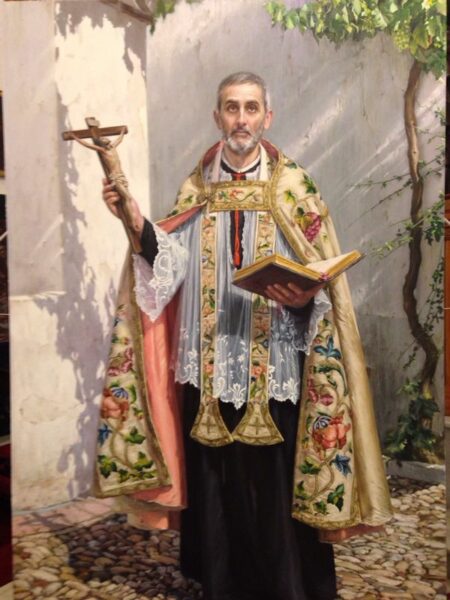
Today is the feast of the patron of the Spanish clergy who these days is celebrating his feast, many of them are readers of Specola and we are pleased to join their celebration. Last January, Leo XIV echoed an invitation from the Spanish saint John of Ávila, writing to the presbytery of Madrid: «Be his». Not be good. Not be efficient. Not be presentable. Be his. These three words contain, condensed, his entire priestly vision, the rest —fraternity, mission, credibility in life— comes after and can only arise from there. Today many young people are ordained and feel happy to give their lives to God and the Church. They are the same young people who are often misunderstood and, newly ordained, find themselves forced to argue with the outgoing parish priest from the sixties, who tries to fit them into his own schemes and labels them as modernists or traditionalists. They are the same young people who, full of enthusiasm, find themselves in old parishes, made up mainly of elderly priests and parishioners. They wear the cassock without problem, despite their youth, because that habit is the cry of their only reason for living their priesthood.
«I will not leave you orphans, I will come back to you».
Good reading.