


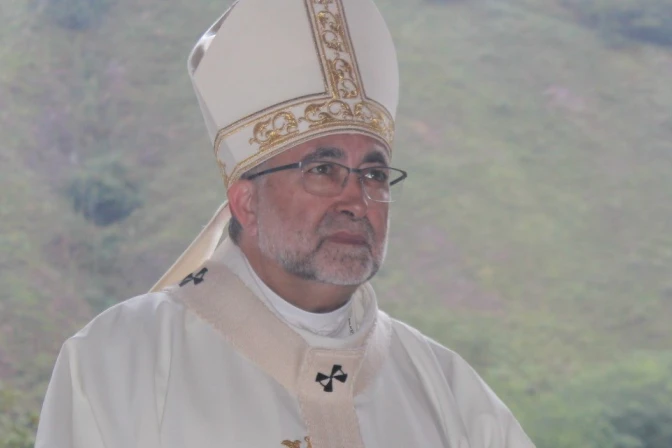
HOMILY OF THE ARCHBISHOP OF OVIEDO, MSGR. JESÚS SANZ MONTES
AT THE INAUGURATION OF THE CHAPEL OF THE HEADQUARTERS OF THE
HERALDS OF THE GOSPEL IN GIJÓN. 9-5-2026
Dear Don José Francisco and other concelebrating brothers.
Dear Heralds of the Gospel and friends who this afternoon come to a special appointment.
We have heard a distinctly paschal text taken from the book of the Acts of the Apostles, chapter 8, where it says as a conclusion that after presenting the announcement of Christ’s Easter, the city was filled with joy.
And it is also filled with joy in Gijón and our Asturias, by the new headquarters that we are inaugurating with this chapel that we have just blessed a moment ago.
I give thanks to the Lord for the presence of this charism that the Church has recognized, the Heralds of the Gospel.
A charism is, in short, a reminder of that Spirit, the Holy Spirit that Jesus promised.
Well, He promised it because the function of the Holy Spirit would be to remind and lead to the truth in fullness.
Why remind? Because we tend to forget.
Why lead to fullness? Because we do not always understand what God shows and points out to us.
The history of the Church is full of charisms that the Spirit of the Lord has been raising up as a reminder in time of words already spokenby the lips of the Lord, but which were forgotten, by gestures of His lived by the Lord that were perhaps betrayed.
A forgotten word or a betrayed gesture that come to be remembered and pointed out again by what the Holy Spirit was raising up.
And this is the history of the saints.
I belong to a meritorious religious order, the order of the Franciscans.
Saint Francis of Assisi is a cry that reminds and shows what at that moment and afterward was also being forgotten or betrayed.
And so Saint Augustine, and so Saint Bruno, and so Saint Benedict and Saint Scholastica, and so Saint Clare and Saint Ignatius, up to the last saint canonized when these are founders of a new community.
That is why the city is filled with joy and that is why our city of Gijón and our Asturian diocese can be filled with joy, the diocese of Oviedo, because through a charism recognized by the Church we are reminded and it is shown to us what we tend to forget or perhaps to betray as well.
The Heralds of the Gospel have as their charism three white loves: the Eucharist, the Most Holy Virgin and the Pope successor of Saint Peter.
Three white loves that are not always lived with due memory, that are not always embraced with due gratitude.
And God raises up this path through the remembered Father João Clá Dias, whom I had the gift of being able to know and treat so much in Brazil, especially in Brazil.
It is a new charism that through him God raises up in His Church. That in Asturias this triple white love of a charism so essential as around the Eucharist, around Our Lady, around the one who presides over us in charity, who is the Holy Father, is very good that you remind us and point it out to us, in case we are forgetful or distracted.
The history of the Church is the history of a pilgrimage.
In the book of Genesis, the original sin is recounted, original and originating, of those who then came personally afterward.
That original sin gives rise to that separation that originates in Adam and Eve.
(Before the murmurs of the children, Monsignor Sanz comments:) The children don’t bother me, eh? Quite the contrary. They add a note of innocence and lower the average age quite a bit in this liturgical assembly.
By the way, I didn’t say anything before, but we have little Sofia around here, who is turning three years old. Then we have to congratulate her, in such a way thatthe children do what they are doing and in this way they concelebrate. So we relax and give thanks for all of them and for the parents who bring them, who bring them to life and to Mass.
Well, we are saying that the history of the Church is the history of a pilgrimage.
That house that had the form of a garden in Eden of the Beginning, suddenly becomes hostile.
And in that house in the form of a garden, Adam and Eve perceive that God no longer accompanies them at the time of the breeze each afternoon to come walk and chat with His two most important children.
The Creator of all became absorbed in man and woman.
But something happened where a rupture occurs, a distancing and a strangeness.
They have committed an infraction, a transgression, a sin, that has made them strangers and aliens to that close God, Father and Friend, whom they had enjoyed until that moment.
It will not only be that rupture with God, from whom they have to hide, because they felt shame for their nakedness before the Most High.
Before, no, after the sin.
A second consequence of this original sin is not only the rupture with God, but the rupture with themselves. Adam and Eve cease to be the suitable help. “I will give him a suitable help.” When God added to Adam, His best creature, He found him sad, lonely and wilted.
What is he missing if with him I have taken care like with no other creature?
What is he missing? He was missing Eve. And when Eve gave it to him, He said, I am going to give you a suitable help that corresponds to you so that your life is not frustrated and reaches the destiny of holiness for which it was created.
But original sin interrupts and frustrates this project of destiny of holiness.
And Adam and Eve do not understand each other, they persecute each other, they self-incriminate, they accuse each other, the human relationship breaks.
And the third and last rupture is that it will also be a division with life as such. Man, Homo Faber, will have to work but sweating on his brow.
And the mother of the living, Eve, will have to give birth suffering labor pains.
Adam’s brow and Eve’s womb will also suffer the consequences of this rupture.
What does God do? Go to another galaxy? Try it with others who were more docile and obedient? He stayed to accompany the people that was being born there so clumsily.
And that history that begins there will have as its culmination the arrival of the expected Messiah, when God Himself sends to humanity His own Son to come revive us and save us.
The Gospel of John begins, the first time a human voice appears in the Gospel of Saint John, it is a question.
Where do you live, master? Andrew and John asked Jesus, pointed out by His cousin the Baptist, the Baptist as the lamb who takes away the sins of the world.
Where do I live? Come and you will see. They went and stayed with Him.
They are the first two disciples.
John 1:35 recounts that moment.
That self-expulsion from that house in the form of a garden is redeemed with a house that opens to welcome.
In such a way that the house of Jesus, where He lived, becomes a place of encounter, a place of welcome, where a new begins
history that tastes of redemption and salvation.
And there those two disciples will begin who preceded us in time and in faith.
To bless a house, to bless a chapel as we are doing, is to give thanks, because in this place and at this moment, that is, in this space and in this time, we are reliving what Jesus offered to His disciples who were then John and Andrew.
What are you going to do in this headquarters? What is going to be done in this chapel?
Listen to the Word of God, adore the Holy Eucharist, celebrate the Sacred Mysteries, pray to the Most Holy Virgin, our Mother, give each other peace and duly prepared, approach to receive Holy Communion of the Body of Jesus Christ.
We bless this chapel as a house in which we, our nomadic pilgrimage, here ends, because we have found a place where we are known, we are loved and we are always expected.
Someone knows us, someone loves us and always waits for us.
This is the meaning of blessing a chapel dwelling of the Most High to listen together to His Word, to adore together His eucharistic presence, to pray together to His blessed Mother who gave Him to us at the foot of the cross, also as our Mother and to give each other peace, nourish ourselves with the Holy Eucharist.
That is why I am happy and that is why I can say, as Archbishop of Oviedo, that this appointment, this afternoon, will also be a joyful afternoon.
To those of you who are here who come from afar or to those of you who are here and are close, all of you be welcome. And our little ones who continue concelebrating, let them continue with their prayers, because putting their prayers praise the Lord.
We will do it in another way, we stand up.