


Content sponsored by Homo Legens.
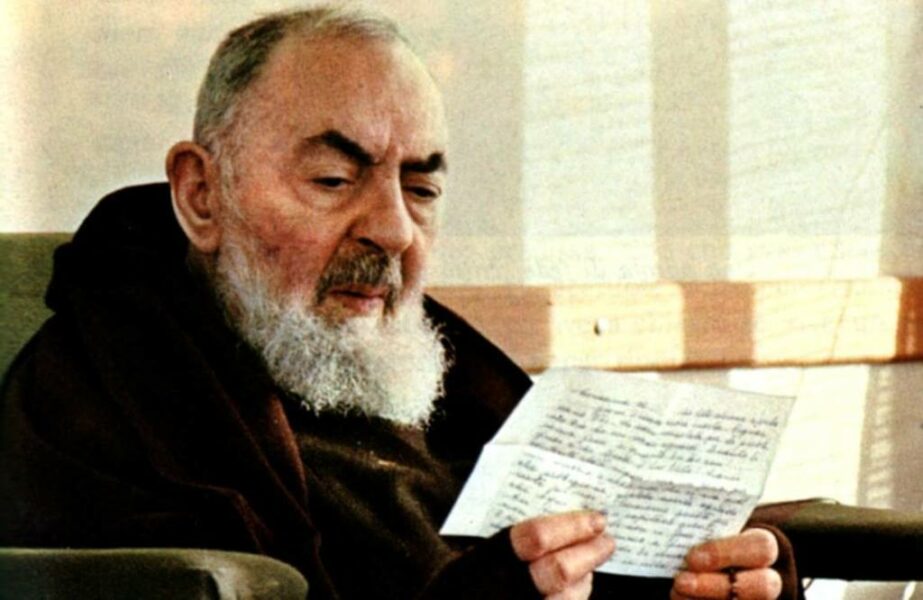
One day, while speaking with one of his spiritual sons in the parlor of the convent of San Giovanni Rotondo, Padre Pio realized there was a hidden microphone. The friar who for four decades had endured with almost disconcerting obedience all the suspicions from Rome could not conceal it this time, and the bitterness of seeing how far things had gone escaped him aloud. He was over seventy, had borne the stigmata since 1918, and thousands of people lined up to confess with him. Someone, within his own house, was listening to what he said.
This is recounted by Gabriele Amorth, the Pauline priest who would serve for decades as exorcist of the diocese of Rome, in Padre Pio: A Brief History of a Saint, which Homo Legens publishes in English. Amorth does not write from hearsay: he visited the Capuchin for twenty-six years, from 1942 to 1968, and treated him as a spiritual father. He calls that period the “second decade of tribulations,” dating it between 1952 and 1962, and recounts it with a tone he rarely allows himself elsewhere in the book.
According to his account, the siege began in 1952. The Holy Office reported to the Capuchin superior general certain irregularities in San Giovanni Rotondo, and that summer eight books published about the friar were banned. Religious were forbidden to circulate his writings or images and to organize pilgrimages; Amorth recalls Capuchin friends from various regions of Italy who were barred from visiting him. The superiors of the convent changed one after another. In 1954 he was removed from the affairs of the House for the Relief of Suffering, the hospital he had built with donations from around the world.
Money, the author recounts, poisoned everything. Between 1955 and 1958 the banker Giambattista Giuffrè, to whom many Capuchin houses had entrusted their savings, went bankrupt. It was known that large sums reached Padre Pio for the hospital, and the temptation to use them to cover the shortfall was strong. The friar refused: what was given for the sick was for the sick. From there, according to Amorth, arose the suspicion that the donations were not reaching their destination. And from suspicion came actions.
In 1960 he was forbidden to receive women outside the confessional, even an elderly woman who was almost deaf and could not confess otherwise. That same summer Carlo Maccari arrived in San Giovanni Rotondo, an apostolic visitor sent with the approval of John XXIII. He spent about seven weeks there, from late July to mid-September, and his dispositions, which Amorth describes as odious, were implemented in the following months. An iron grille was installed around the confessional, which is still there and which the faithful saw as a cell. Bishops and priests were forbidden to assist him at Mass, something about which he wrote: “I do not believe such a prohibition has ever existed in the history of the Church.” And he was ordered to finish Mass in thirty minutes, forty at most, a man who in his early years as a priest in Pietrelcina took four hours to celebrate it.
The most striking part of the chapter is Padre Pio’s own reaction. According to Amorth, he never ceased to side with the authorities. To those who told him he was imprisoned and spied upon, he replied that he felt very free; to those who protested about the grille, that it had been placed to protect him. And woe to anyone who criticized the visitor in his presence. The author admits only two exceptions. One, the microphone. The other, the length of the Mass: he confided to his superior, almost in tears, that he would like to do as others did, but that at certain moments he could not go on and felt he was about to collapse.
Amorth takes it for granted that there were microphones in the parlor, but does not believe they reached the confessional, as two Italian journalists, Chiocci and Cirri, maintained years later in a three-volume work; the accusation was denied. The faithful, meanwhile, did not remain idle. Emanuele Brunatto, the man who had already fought for the friar in the 1930s, prepared a white paper with explosive documentation for the UN governments and called for its presentation in a hotel in Geneva. When everything was ready, the order came from Padre Pio to suspend it. Brunatto, Amorth recounts, made a fool of himself before the diplomats he had mobilized, but obeyed.
The denouement came with Paul VI, who in 1964 made it known that the Capuchin should exercise his ministry with full freedom. Amorth adds a detail he claims to have from a reliable source: in the Vatican they realized the failure of that visit and, to save appearances, named the visitor a bishop. Maccari did, in fact, receive the mitre in 1961. The sculptor Messina, the book recounts, later placed Padre Pio’s face on the Cyrenian in a Way of the Cross.
The episode occupies few pages of a brief and very personal book, which ranges from his poor childhood in Pietrelcina to the stigmata, from the first decade of punishments, when between 1931 and 1934 he was forbidden to confess, to the construction of the hospital and the dawn of September 1968 when he died. The question that runs through the entire account remains: how could a man watched like a criminal continue to say that he felt free.
 |
Section sponsored by Homo Legens Padre Pio: A Brief History of a Saint Gabriele Amorth · Bibliotheca Homo Legens · 9,90 € |
Read also