


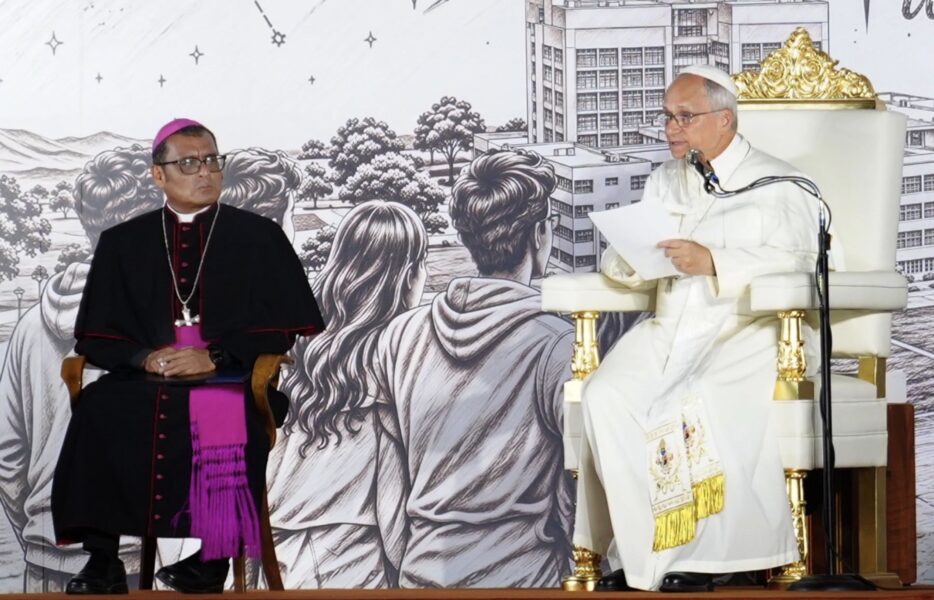
Pope Leo XIV warned this Friday, November 13, against transhumanism and posthumanism at the meeting with the academic community of the Universidad Católica Santo Toribio de Mogrovejo, in Chiclayo (Peru), the last event of his day in the diocese where he was bishop. Before professors, researchers and students, the Pope recalled that his years as Grand Chancellor of the university taught him that authority is service, that governing requires listening and that “education is a noble act of hope,” according to the text of the speech published by the Holy See. The meeting is part of the apostolic journey to Uruguay, Argentina and Peru, and came after the Mass and the visit to the shrine, whose homily we already covered in “The Pope cites Benedict XVI in Chiclayo”.
“The limit is not a factory defect”
The Pontiff described the Catholic university as a space for the search for truth, integral formation and service to society, and called for research to be placed at the service of justice, charity and human dignity, without being subordinated only to the market or efficiency. In that context he criticized currents that promise that technology will eliminate disease, pain, aging and even death, and spoke of “the illusion of human beings optimized by cybernetics and biotechnology.” In the face of that mirage, Leo XIV proposed Christian anthropology: “the limit is not a factory defect, but the condition of human greatness.”
He explained that recognizing fragility opens the way to solidarity and transcendence, while the myth of self-sufficiency leads to selfishness. He added that those promises of immortality end up being a “privilege for millionaires” while entire peoples suffer misery and oppression.
Saint Toribio, a model for the university mission
The Pope proposed as a model the patron of the university, Saint Toribio de Mogrovejo, who defended the dignity of indigenous peoples when they were frequently subjected to exploitation and discrimination. He recalled that the Archbishop of Lima learned their languages, proclaimed the Gospel in their culture and wrote a catechism in native languages, and that he experienced physical limitation in his exhausting journeys. Today, he said, the “deserts” are the new moral and civic illiteracies that exclude the poor, so he asked the university to put scientific innovation at the service of reducing social distances. He also asked teachers to be consistent witnesses and “free thinkers, for whom truth precedes opinion,” and encouraged them to translate their scientific competence into justice, especially for the poorest and the care of creation.
A message to young people: faith, prayer and study
He invited students to live the opportunities of their time in the light of faith, which he described as “a torch in confusion and darkness.” He assured them that their relationship with God, prayer and study will give them the hope and strength to face difficulties, and stressed that “both prayer and study transform our minds until they change our lives.” Leo XIV concluded by entrusting the educational work of the university to the Virgin Mary, invoked as Sedes Sapientiae, so that she may accompany the entire academic community “with courage and faith.”