


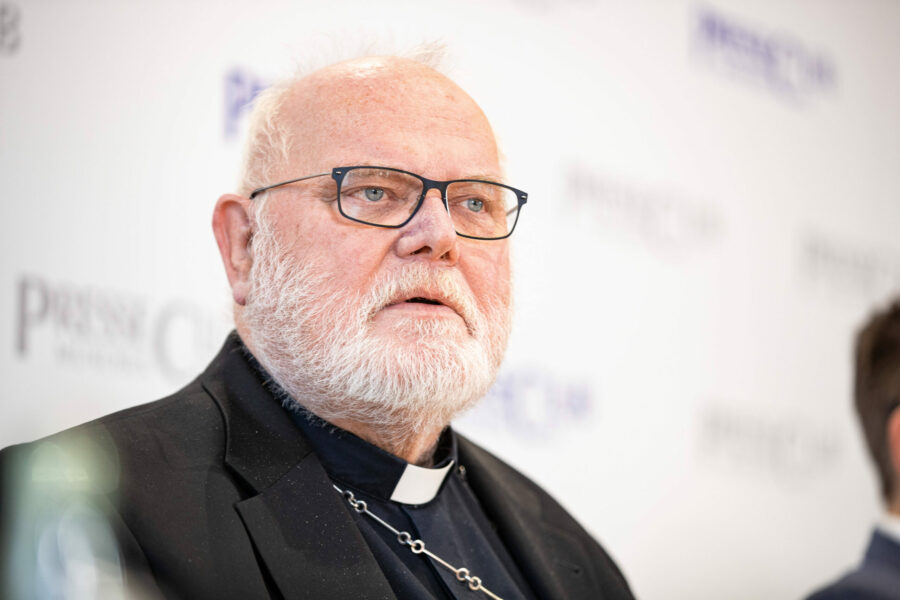
The Archbishop of Munich and Freising made these statements on November 4 at a colloquium at the Catholic Academy of Bavaria, moderated by journalist Tobias Haberl, alongside writer Nora Bossong, who presented her latest book. According to the portal AdVaticanum, which in turn cites information published by Herder, the liturgy and the place of women in the Church occupied a large part of the conversation.
Bossong explained that she never imagined herself as a religious sister, but that the priesthood would have appealed to her, and that not being able to access it causes her more sadness than anger. “I take it very seriously; I ask myself: do I have some fundamental defect?” she stated.
“That is no longer the case”
Marx responded by acknowledging that his way of thinking has changed. Twenty years ago, he said, he held different positions, and as a child he would not have conceived that a woman could be a police officer or a professional soccer player. He described a much more open German ecclesial climate on the issue and illustrated it with episcopal appointments: “Ten years ago, no one who could imagine the ordination of women would have been considered as a candidate for bishop. That is no longer the case.”
The cardinal did not specify which appointments he was referring to or give concrete examples. Nevertheless, his words indicate that, at least in Germany, accepting a doctrine declared definitive has ceased to be a requirement for choosing future bishops.
Marx also recounted a conversation with Pope Francis, who had explained the different vocations of men and women with the distinction between the Petrine and Marian charisms. The cardinal said he was not convinced: “The Marian charism also concerns me. In the seminary we learned that we were to be Marian priests.” He added that he does not see it as having been taught infallibly that “sexuality is a matter of the sacrament” and wondered whether the Church takes into account the charisms of all those who could preside at the Eucharist. “Is half of them simply undesirable? I can no longer accept that position,” he concluded.
What the Church teaches
These words clash with the express teaching of the Holy See. In the apostolic letter Ordinatio sacerdotalis (1994), Saint John Paul II declared that the Church “has no authority whatsoever to confer priestly ordination on women” and that this judgment must be considered definitive by all the faithful. The following year, the Congregation for the Doctrine of the Faith clarified, in a response approved by the Pontiff, that this doctrine requires definitive assent because it has been proposed infallibly by the ordinary and universal magisterium.
Marx himself defended that position only a few years ago. In September 2019, when he presided over the German Bishops’ Conference, he told the Frankfurter Allgemeine Sonntagszeitung that John Paul II had settled the question definitively in 1994: “It is decided, although the discussion has not ended.” In November 2024, before the Committee of Catholics of Bavaria, he already stated that the ordination of women “will come.”
A “clear signal” vis-à-vis Rome
The cardinal admitted that the universal Church still has “a long way to go,” but called for “a clear signal about where we want to go.” His intervention aligns with the objectives of the German Synodal Way, whose permanent Synodal Conference still cannot be constituted because it lacks the approval of the Holy See.
Marx also rejected the idea that nothing should change in the Church, caricaturing it with a reference to Archbishop Marcel Lefebvre: “Under no circumstances must anything be changed! That is Lefebvre. I say: no way!” Both he and Bossong agreed, however, that any reform must be theologically grounded.
The issue has also resurfaced in Austria. The Archbishop of Vienna, Josef Grünwidl, said on October 31 on public radio ORF that he would like the ordination of women, although he considers that only a council could decide it and that for now he sees “no realistic possibility” of that happening.