


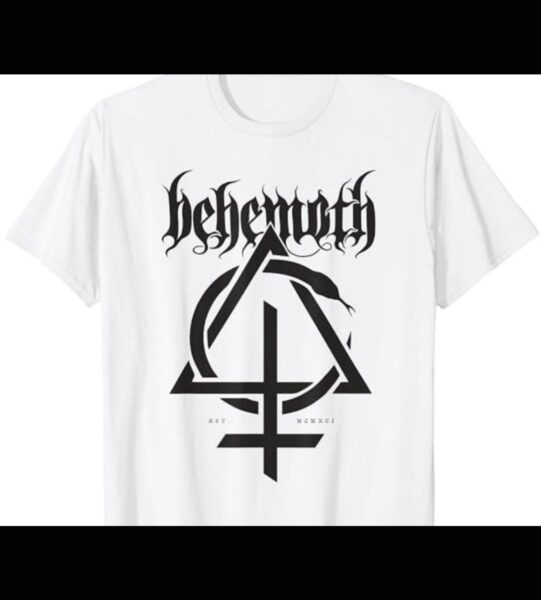
The T-shirt that Jordi Wild wore in his interview with the Prime Minister, Pedro Sánchez, is from Behemoth, a Polish extreme metal band whose leader declares himself a Satanist and whose albums, symbols and concerts are expressly directed against Christianity. The recording dates from Tuesday and the premiere arrived this Friday at midday, the first day of the general election campaign on 29 November, on The Wild Project, a YouTube channel with around 7.5 million subscribers.
The specialist portal Más Decibelios, which applauded the choice and described Behemoth as “an openly satanic band”, identifies the model: Opus Sigil, in white. Below the band’s name, the design features a triangle, a serpent coiled in a circle and an inverted cross, with the legend “EST. MCMXCI”: 1991, the year of its foundation. The three candidate interviews published that day share casual attire: a Godzilla T-shirt for Ada Colau, another from the American band Queens of the Stone Age for Alberto Núñez Feijóo and the Behemoth one for Sánchez, as reported by Diario Crítico. Wild’s fondness for rock and metal is well known, and band T-shirts are common on his show. There is no record that he has explained the choice.
Behemoth’s story begins in Gdansk in October 1991 under another name: Baphomet, the figure with a goat’s head that the Church of Satan adopted as its emblem. The initiative came from two teenagers aged fourteen and fifteen, Adam Darski and Adam Muraszko, with the aliases “Holocausto” and “Sodomizer”. The current name, taken from the beast in the Book of Job, dates from 1992, and Nergal, which Darski later adopted, corresponds to a Babylonian deity. The sound started with black metal and from the late nineties incorporated death metal; the lyrics revolve around occultism, Aleister Crowley’s Thelema, anti-Christianity and Satanism.
Darski’s memoirs, born in Gdynia in 1977 and raised Catholic, devote a passage to his act of apostasy. Anton LaVey’s “Satanic Bible” reached him in the early nineties, the years when he was launching the band, although he says the Church of Satan as an organisation never hooked him. In the press the label is constant: confessed Satanist for The Irish Times, Satanist celebrity for The Village Voice. “For me, Satan represents human values,” he told Decibel in 2014, when releasing the album “The Satanist”; in another interview he described it as a symbol or archetype that empowers the individual.
The Gdynia concert of September 2007 is the most cited episode: a broken Bible on stage, presented as a book of lies, and the Catholic Church defined as “the most murderous sect on the planet”. On the musician’s social media later appeared, on 8 March 2018, a video with a crucified Christ attached to artificial male genitalia and, in September 2019, a photograph in which a shoe steps on an image of the Virgin Mary.
For acts like these he has accumulated proceedings in Poland for offending religious feelings, several of them closed with acquittal or dismissal. One, with three charges, ended in 2024 with two acquittals and, for the 2018 video, a conditional dismissal in which, according to the Polish Catholic portal Opoka, the District Court of Gdansk-South found the offence proven: two years of probation and 2,000 zlotys for a fund to help victims. Finality came on 5 February 2025, after the second instance.
Among the titles in the discography are “Satanica” (1999), “The Apostasy” (2007), “Evangelion” (2009) and “The Satanist” (2014). “I Loved You at Your Darkest” (2018) includes tracks such as “God = Dog”, “Ecclesia Diabolica Catholica” and “Rom 5:8”, and takes its title, according to Nergal, from a biblical verse: “You can’t be more blasphemous than this,” he said when presenting it. The cover of “Opvs Contra Natvram” (2022) displays, according to the description in Revolver magazine, several skeletal crucified figures, bathed in gold, on an inverted cross. The following album, “The Shit Ov God” (2025), owes its title, as Nergal himself explained to the British magazine Kerrang!, to reading the IHS monogram backwards, an abbreviation of the name of Jesus.
Regarding the inverted cross, which in Christian tradition refers to the martyrdom of Saint Peter, the meaning Nergal gives it is in that same interview: a gesture of rebellion dating back to when he was fifteen and which he has now repeated with the IHS. The 2025 European tour, titled “The Unholy Trinity”, brought to the stage a crucified figure on an inverted cross and the IHS reversed, according to the review of the London concert on 12 April.
The serpent in Scripture is the figure of the tempter, and the Apocalypse identifies “the ancient serpent” with the Devil and Satan; coiled in a circle it refers to the ouroboros, an ancient symbol adopted by alchemy and the occult. The band calls its emblems “sigils”, the term ceremonial magic reserves for signs to which it attributes power, and one of them has been given the name “The Unholy Trinity”.
The three videos were approaching two million views within hours of release, according to Diario Crítico.
Read also