


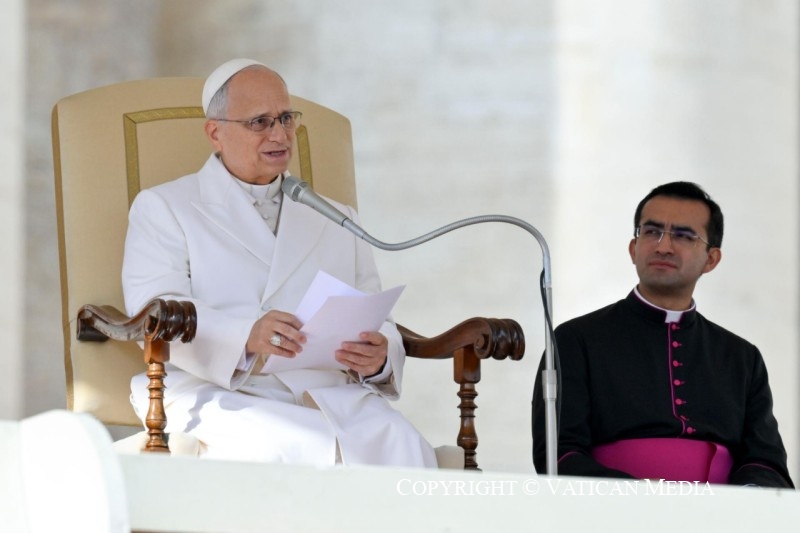
Pope Leo XIV dedicated this Wednesday, November 4 general audience to the social dimension of the Christian faith, recalling that the economy and politics must serve human dignity and the common good. The Pontiff stressed the importance of work, social justice, and the responsibility of those who exercise public authority, while also calling on Christian communities to recover formation in the Church’s social doctrine.
During the meeting with the faithful in St. Peter’s Square, Leo XIV continued his cycle of catechesis on the documents of the Second Vatican Council, focusing his reflection on the chapters of the pastoral constitution Gaudium et spes dedicated to economic, social, and political life.
The Pope recalled that economic development must serve the human person and that work constitutes an essential dimension of human dignity, since it allows people to support their families, develop their own abilities, and collaborate in God’s creative work.
He also underlined that political authority exists to promote the common good and that the Church and the political community, though independent in their respective spheres, can collaborate in service to individuals and society.
In the final part of his catechesis, Leo XIV especially encouraged young people to follow the example of those who have given Christian witness in public life. He also exhorted ecclesial communities to renew the teaching of the Church’s social doctrine.
During the subsequent greetings, the Pontiff recalled that his apostolic journey to Uruguay, Argentina, and Peru will begin next Friday, November 6, and asked for prayers that this visit may strengthen faith and evangelization.
Leo XIV also announced the beatifications scheduled for Saturday, November 7: that of the Franciscan Augusto Rafael Ramírez Monasterio, murdered out of hatred for the faith in Guatemala in 1983, and that of Father Francisco González de Córdova and his 79 companion martyrs of religious persecution in Spain.
Below is the Holy Father’s catechesis, delivered during the general audience of November 4, 2026:
Catechesis – The Documents of the Second Vatican Council. IV. Constitution Gaudium et spes. 7. Faith and Social, Political, and Economic Life (GS, 53-62)
Dear brothers and sisters, good morning and welcome!
The social dimension is an integral part not only of human nature but also of our faith in Jesus Christ, as a precious inheritance we receive from the Incarnation of the Son of God. The Constitution Gaudium et spes (GS) recalls this in Chapters III and IV of Part Two, dedicated to economic and social life and to the life of the political community. In these areas as well, the Christian faith offers criteria for discernment.
The Council Fathers highlight above all the danger to world peace arising from imbalances linked to economic development that is neither equitable nor respectful of creation (cf. GS, 63). This is a long-term vision that, unfortunately, found confirmation in the latter part of the last century and that we observe even more today. To correct the course – the Document warns – technical development alone is not enough; “many reforms are needed in economic and social life, and a change of mentality and of customs on the part of all” (ibid.).
For this reason, Gaudium et spes presents in summary form the Christian vision of economic development, which must always serve the human person and remain under human control (cf. GS, 64-65). Here the concept of integral development already clearly emerges, which Saint Paul VI would later place at the center of his Encyclical Populorum progressio (1967). More timely than ever are the calls to work for the elimination of discrimination against the weakest social groups and against migrants (cf. GS, 66).
The heart of the economy is work. Through work, the human person develops as a person, meets the needs of his or her family, expresses personal talent, participates in social life, and builds a better world by collaborating in God’s creative work. Work can never be distorted to the detriment of persons, the common good, or creation. The real challenge is to offer everyone opportunities to put their abilities into practice: unemployment, exploitation, and working conditions that endanger health and life itself are unacceptable (cf. GS, 67). Workers have the right and the duty to participate in decisions that affect their activity, including through associations, addressing conflicts through dialogue and non-violent actions (cf. GS, 68).
In this context, the Council recalls one of the fundamental principles of social teaching, namely the universal destination of the goods of the earth (cf. GS, 69), and applies it to the financial sphere, stating that “those responsible for investments and for the organization of economic life, whether individuals, groups, or public authorities, must […] see to it that, on the one hand, the necessary provision is made for a decent life both for individuals and for the whole community, and, on the other hand, that the future is provided for and a just balance is maintained between the present needs of individual and collective consumption and the requirements of investment for the sake of future generations” (GS, 70).
Gaudium et spes then turns to the theme of the political community, appreciating the various positive signs of the contemporary era, especially the fact that “a more lively awareness of human dignity has given rise in various parts of the world to a desire to establish a political-juridical order that will better protect the rights of the person in public life” (GS, 73).
The political community exists for the sake of the common good, which consists in “the sum of those conditions of social life which allow social groups and their individual members relatively thorough and ready access to their own perfection” (GS, 74). And it is always toward the common good that the exercise of political authority must be directed, structured and carried out according to local and historical circumstances, yet always keeping in view the good of the entire human family (cf. ibid.).
Gaudium et spes reaffirms that “the political community and the Church are autonomous and independent of each other in their own fields. Both, though under different titles, are devoted to the personal and social vocation of the same human persons. The more that both foster sounder cooperation between themselves, with due consideration for the circumstances of time and place, the more effective will their service be exercised for the good of all” (GS, 76).
Dear brothers and sisters, to engage in the economy and in politics according to these criteria is a way of building peace. As Pope Francis recalled, “war is a failure of politics and of humanity, a shameful capitulation, a defeat before the forces of evil” (Encyclical Letter Fratelli tutti, 261). On the contrary, politics that cares for the wounds of peoples and of those who suffer injustices offers reasons for hope for the future of humanity.
For this reason, I encourage young people to follow the example of those men and women who in these fields have given good witness. And I renew my exhortation to the communities