


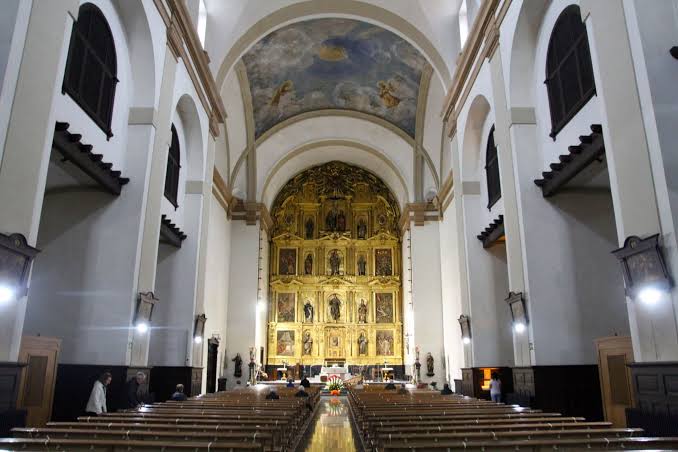
The Franciscan community of Tolosa (Gipuzkoa) bid farewell to the town last Sunday, October 25, ending more than four centuries of religious, pastoral, and cultural presence. The lack of vocations and generational renewal has forced the last three friars to leave the historic Convent of San Francisco and move to Zarautz. Their departure also marks a change for the monumental complex, whose acquisition has been agreed upon by the Town Council, which plans to dedicate the church to cultural activities.
The final farewell Mass was celebrated in the Church of San Francisco and was presided over by the Bishop of San Sebastián, Fernando Prado Ayuso. The diocese had announced the celebration, which brought together numerous faithful and neighbors to thank the community for its work, deeply tied to the town’s history.
The lack of vocations forces the closure of a historic community
The departure of the Franciscans is due to the decline in the number of religious and the inability to ensure the community’s continuity.
The last three friars assigned to Tolosa, Juan José Muniain, José Luis Agirretxe, and Florentino Arruti, will move to the Franciscan convent in Zarautz, where the order will concentrate part of its members.
Muniain, who has spent 38 years in Tolosa, explained in statements reported by Radio San Sebastián that the decision was not due to financial difficulties or specific problems within the community, but rather to the lack of new vocations.
“We have no vocations. There are no replacements, and we cannot maintain all the houses,” the friar acknowledged.
The decision is part of a broader reorganization process of Franciscan communities, which are facing a progressive reduction in the number of friars.
During the farewell Mass, the Franciscan provincial, Joxe Mari Arregi, also explained that the lack of religious forces communities to concentrate. According to figures released on the occasion of the farewell, while in 1960 there were 140 friars in Arantzazu, today only about 80 remain, spread across the various convents of the religious province.
The departure from Tolosa thus reflects a reality affecting numerous religious congregations in Spain: the aging of their members and the absence of enough vocations to keep historic houses open.
More than four centuries of Franciscan presence in Tolosa
The history of the Franciscans in Tolosa dates back to the 16th century. According to the Town Council of Tolosa, the presence of the order began in 1587, although other historical references place its first steps a few years earlier.
In 1577, Pedro Mendizorrotz, a resident of Ibarra, requested authorization to establish a Franciscan convent and offered land for its construction. The religious complex was built over the following decades and became one of the main spiritual and cultural landmarks of the town.
The Church of San Francisco, whose construction was completed at the end of the 16th century, preserves a notable artistic heritage, especially its Renaissance main altarpiece, created by Ambrosio Bengoetxea at the beginning of the 17th century.
The Franciscan presence endured numerous historical events, including wars, the disentailment, and various fires that affected the convent.
In 1814, a fire destroyed much of the complex, although the church survived. During the 19th century, political and military circumstances forced the religious to temporarily abandon their facilities, which were even used as barracks, a hospital, and a warehouse.
The community returned permanently in 1915, when the convent that remained in operation until this year was built.
An important religious, educational, and cultural role
The influence of the Franciscans in Tolosa went far beyond liturgical activity.
For centuries, the community participated in the religious and educational formation of generations of townspeople. Among its historic initiatives was the Colegio de San José, founded in the 17th century, which contributed to the education and intellectual life of the town.
The friars also played a significant role in promoting the Basque language and culture, especially during the 20th century.
The convent was linked to various cultural and publishing initiatives, including the journal Jakin, a reference publication in the Basque cultural sphere that developed part of its trajectory in connection with the Franciscan community.
The Town Council has expressly recognized this contribution and highlighted that the religious served thousands of residents, both in spiritual life and in promoting the local language and traditions.
In its October 23 statement, the council recalled that the church and convent were for centuries places of gathering and refuge for generations of Tolosa’s inhabitants, both in times of hardship and during community celebrations.
The Town Council will acquire the church and convent for new uses
The departure of the religious will also bring an important change in the future of the monumental complex of San Francisco.
The Town Council of Tolosa and the Franciscan Province of Arantzazu have reached an agreement for the church and convent to become municipal property, after nearly a year of negotiations.
The council has committed to preserving the artistic and architectural value of the complex and to making its facilities available to the public.
However, the future of the church will no longer be primarily tied to its religious function.
The mayor of Tolosa, Andu Martínez de Rituerto, explained in an interview with Radio San Sebastián on October 26 that the municipal intention is to convert the Church of San Francisco into a cultural space.
Although the activities it will host have not yet been specified, the Town Council is considering possibilities such as concerts, conferences, or other cultural initiatives.
The mayor even mentioned European examples of former churches transformed into libraries or cultural facilities, although he did not announce a final decision on such a model for Tolosa.
One of the main constraints will be the preservation of the church’s artistic heritage, especially its main altarpiece, whose historical value requires specific protection measures.
Regarding the convent, the Town Council had initially considered allocating it to social housing. However, the building’s architectural features could make that transformation difficult, so its use as a cultural facility is also being considered.
For now, the final economic conditions of the operation and the precise timeline for adapting the buildings have not been publicly disclosed.
Another religious community disappears from Tolosa
The farewell to the Franciscans adds to other recent closures of religious communities in the town.
In 2023, the Poor Clares also left Tolosa, as part of a reorganization process caused by the aging and decline of their communities.
The departure of the Franciscans now leaves without a stable presence an order that for centuries contributed to the spiritual, educational, and cultural life of the town.
The Town Council wanted to bid farewell to the religious with a public recognition and adopted their traditional Franciscan greeting, “Peace and All Good,” to wish them well in their new stage.
The preservation of the church and convent will allow an important part of Tolosa’s historical heritage to be maintained. However, the closure of the community marks the disappearance of a religious presence that had accompanied generations of the faithful and raises a broader question about the future of historic convents and churches in light of the vocational crisis affecting numerous congregations in Spain.