


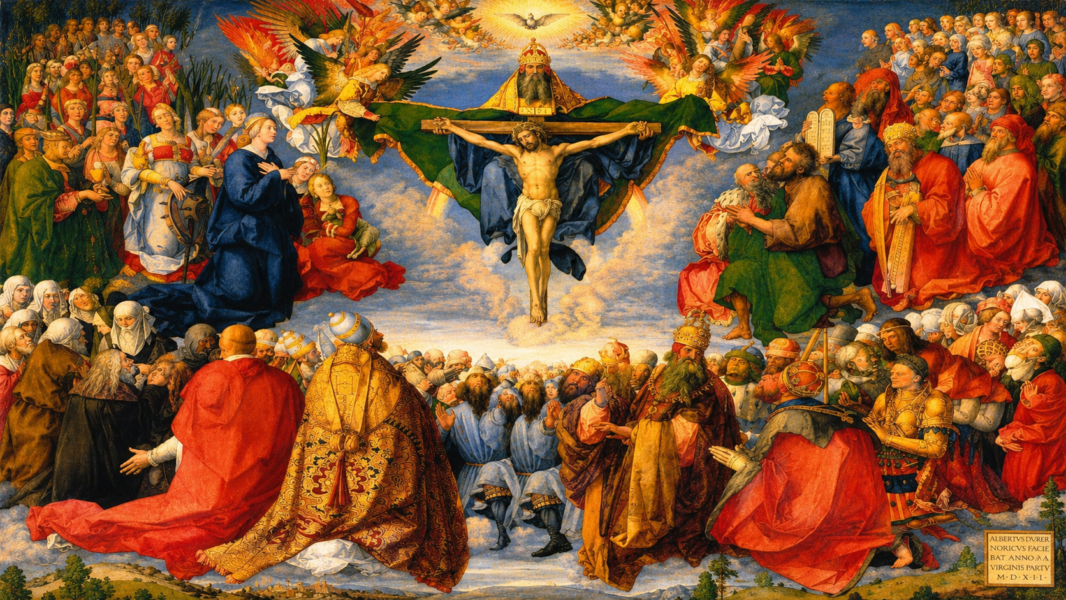
The Catholic Church celebrates this Sunday, November 1, the solemnity of All Saints, one of the great feasts of the liturgical calendar, dedicated not only to those who have been officially canonized, but also to all men and women who have attained heavenly glory and whose holiness is known only to God.
In these eve of the solemnity, the celebration invites the faithful to contemplate the destiny to which every Christian is called: eternal life with God. The feast reminds us that holiness is not a privilege reserved for a few, but a universal vocation, and that the Church is not made up only of those who are pilgrims on earth, but also of those who already share in the glory of heaven.
A countless multitude before the throne of God
The liturgy of All Saints presents a passage from the Book of Revelation in which Saint John beholds “a great multitude, which no one could count, from every nation, race, people, and tongue” (Rev 7:9), gathered before the throne of God and of the Lamb.
This vision expresses the universality of the call to salvation and reminds us that holiness does not belong exclusively to one era, nation, or social condition. Among the blessed are martyrs, confessors of the faith, religious, priests, fathers and mothers of families, and countless Christians who lived the Gospel faithfully without becoming publicly known.
The solemnity has its roots in the veneration that the first Christian communities paid to the martyrs. Over the centuries, this memory extended to other faithful recognized for their holiness until it became a common celebration of all the saints.
The date of November 1 became linked to this feast in the Western liturgical tradition during the Middle Ages, especially from the ninth century onward.
The triumphant Church and the communion of saints
The solemnity recalls one of the fundamental truths of the Catholic faith: the communion of saints, professed in the Creed.
The Church teaches that there is a spiritual union between the faithful who are pilgrims on earth, the souls who are being purified after death, and those who already enjoy the vision of God in heaven. Traditionally, these realities are known as the Church militant, the Church suffering, and the Church triumphant.
The saints do not remain indifferent to the needs of those who continue their earthly pilgrimage, but intercede for them before God. Their example also serves as a stimulus to persevere in the faith and to live according to the teachings of Jesus Christ.
The Catechism of the Catholic Church reminds us that the intercession of the saints constitutes their highest service to God’s plan and that the faithful may ask for their help to attain holiness.
This veneration must not be confused with adoration, which belongs exclusively to God. The Church distinguishes between the worship of latria, reserved for the Most Holy Trinity, and the veneration given to the saints, among whom the Virgin Mary holds a singular place.
In his Angelus address of November 1, 2012, Benedict XVI explained that the solemnity allows us to contemplate the communion between the pilgrim Church and the heavenly Church, reminding us that all the baptized are called to share in the same glory.
Holiness is also attained in everyday life
All Saints reminds us that holiness is not reserved for those who hold great ecclesiastical responsibilities, perform extraordinary works, or embrace the consecrated life.
The Church teaches that all the baptized are called to the perfection of charity, each according to his or her state of life and the concrete circumstances in which God has placed them.
This vocation can be lived out in marriage, the education of children, daily work, the priesthood, religious life, and the faithful fulfillment of one’s own duties.
The Second Vatican Council, in the dogmatic constitution Lumen gentium, recalled that all the Christian faithful, whatever their condition, are called to the fullness of the Christian life and to the perfection of charity.
Holiness, therefore, does not necessarily consist in performing great visible actions, but in responding to God’s grace through faith, hope, and charity, persevering in the fulfillment of His will.
From All Saints Day to the Commemoration of All the Faithful Departed
The solemnity of All Saints precedes the Commemoration of All the Faithful Departed, which the Church celebrates each November 2.
Although both days are closely related, they have distinct meanings. While on November 1 the Church celebrates the glory of those who already behold God, the following day is dedicated especially to prayer for the departed who still need purification before entering heaven.
Catholic doctrine teaches that the souls in purgatory, destined for eternal salvation, can be helped by the prayers of the faithful, especially through the Eucharistic sacrifice, as well as by almsgiving, indulgences, and works of penance offered for them.
For this reason, Christian tradition has for centuries maintained the custom of visiting cemeteries, praying for the departed, and offering Masses for the eternal rest of their souls.
During these days, the Church also grants indulgences under certain conditions to the faithful who piously visit cemeteries and pray for the departed, especially during the first days of November.
Thus, the two celebrations manifest Christian hope in the resurrection and eternal life. All Saints directs our gaze toward heavenly glory, while the Commemoration of All the Faithful Departed reminds us of the duty of charity toward those who have departed from this world.
On the eve of November 1, the solemnity invites Christians to renew their desire for holiness, following the example of those who have already reached the definitive goal of the Christian life: eternal union with God.