


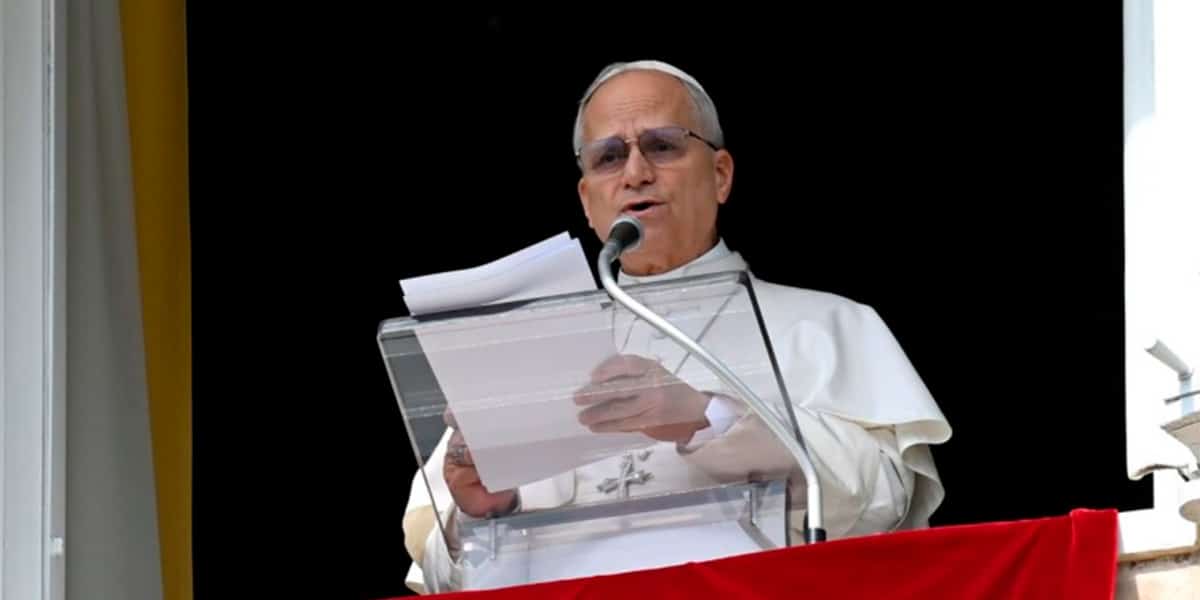
Pope Leo XIV stated this Sunday, during the Angelus prayed in St. Peter’s Square, that “we cannot truly love God if this love does not overflow into love for our brothers and sisters.” The Pope commented on the passage from the Gospel of Saint Matthew in which a teacher of the Law asks Jesus what the greatest commandment is, and the Lord summarizes it by citing Deuteronomy, according to the text published by the Holy See.
In his reflection, the Pontiff emphasized that it is not enough to recognize that God exists, that He is the only one, or that He is almighty. “The Lord seeks a personal relationship with us: the one true God wants to become our God,” he said. From there, he explained that the commandment of love is not an imposition, because “one cannot love on command.” Human love is authentic when it responds to God’s love, which, he added, “always precedes us,” and demands a total gift of heart, soul, and mind.
Pope Leo XIV then focused on the second commandment, “you shall love your neighbor as yourself,” which, he explained, springs from the same source as the first. Whoever lives close to God learns to look at themselves and others with the eyes of Christ, so that selfishness is overcome “and even love of oneself becomes charity.” Therefore, he concluded, we cannot truly love our neighbor except as children of the same Father who first loved us in His Son Jesus.
The Pope also quoted Saint Thérèse of the Child Jesus, for whom only love makes the members of the Church act. Without it, he warned, faith would be deprived of its essence, good works would be reduced to moralism, and hope would be in vain. He ended by asking for all “the grace of a new heart, capable of embracing and living the greatest of the commandments,” and entrusted that petition to the Virgin Mary, in whose Immaculate Heart “there is nothing but love.”
After the Marian prayer, Pope Leo XIV expressed his concern over the grave humanitarian situation in Yemen, particularly in Taiz, and called for an end to hostilities and respect for the population’s right to live in peace. He also joined in the grief for the victims of the terrorist attack against the Orthodox Church of Saint George in Hamoud, Jordan, carried out last Friday, and expressed his closeness to that community.
The Pope also recalled that on October 27, leaders of Churches and religions will gather in Assisi to commemorate the 40th anniversary of the meeting convened by Saint John Paul II, and asked that the Lord inspire decisions of dialogue and peace. Finally, he greeted groups from Spain, Ireland, and Poland, protocol officials from Italian ministries, the association “Solidarietà in Buone Mani” from Castiglion Fiorentino, and a group of friends from Concorezzo celebrating their seventieth anniversary.
This Angelus comes one week after the first one following the lung operation the Pope underwent on October 13 at the Gemelli Polyclinic, during which the Pontiff reappeared in public to give thanks.