


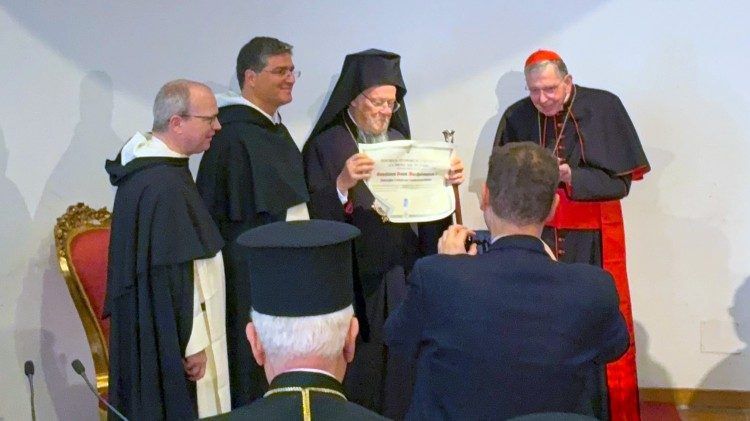
The Pontifical University of Saint Thomas Aquinas in Rome, known as the Angelicum, awarded the honorary doctorate in Theology on Friday, October 23, to the Ecumenical Patriarch of Constantinople, Bartholomew I, in recognition of his work in the dialogue between the Catholic Church and the Orthodox Churches.
The ceremony took place during the inauguration of the 2026-2027 academic year, on a day dedicated to the tenth anniversary of the Council of Crete, held in 2016. Among those in attendance were the Vatican Secretary of State, Cardinal Pietro Parolin, and the Prefect of the Dicastery for the Eastern Churches, Cardinal Claudio Gugerotti.
Koch highlights his ecumenical trajectory
Cardinal Kurt Koch, Prefect of the Dicastery for Promoting Christian Unity, delivered the laudatio for the Patriarch, in which he highlighted his contribution to the development of relations between Rome and Constantinople.
During his speech, Koch recalled that Bartholomew has signed more joint declarations with the Roman pontiffs than any other Ecumenical Patriarch in history.
The cardinal pointed out three main areas of his activity: ecclesiological reflection on synodality, the call for eco-theology, and theological dialogue between the Churches.
He also highlighted his support for the Joint International Commission for Theological Dialogue between the Catholic Church and the Orthodox Church, which in recent years has worked on issues related to synodality and the exercise of authority in the Church.
The Council of Crete, ten years later
The academic day was dedicated to the tenth anniversary of the Holy and Great Council of the Orthodox Church, held on the Greek island of Crete in June 2016.
Bartholomew played a prominent role in convening that assembly, the result of a long process of preparation among the various Orthodox Churches. However, the meeting was not attended by all the autocephalous Churches: the Patriarchates of Russia, Antioch, Bulgaria, and Georgia decided not to participate.
In his speech after receiving the doctorate, entitled “Conciliarity and Communion in the Church,” the Patriarch presented the Council as the culmination of more than a century of preparation, prayer, and hope.
Bartholomew acknowledged the absence of some Orthodox Churches, although he maintained that the importance of the assembly should not be judged solely by the number of participants or its immediate results.
The Patriarch insisted that synodality constitutes an essential element of the life of the Church and pointed out that many of the issues addressed in Crete remain unresolved ten years later.
He also referred to the interest of the Catholic Church in synodality during the pontificates of Francis and Leo XIV, and its relationship with theological dialogue between Catholics and Orthodox.
The dialogue between Catholics and Orthodox
Cardinal Koch also highlighted Bartholomew’s concern for the protection of creation and his proposal to recover Christian sobriety and asceticism in the face of consumerism.
In this regard, he recalled that the Patriarch has linked the destruction of nature with man’s moral responsibility before God.
For his part, Bartholomew devoted part of his speech to the relationship between primacy and synodality, one of the main issues in the dialogue between Rome and the Orthodox Churches.
The Patriarch maintained that both realities must be understood together and warned that a primacy separated from synodality runs the risk of becoming a centralized authority, while a synodality without primacy may favor fragmentation.
In this context, he mentioned the Ravenna documents of 2007 and Chieti of 2016, drawn up within the framework of international theological dialogue between Catholics and Orthodox.
The academic recognition was presented by the Rector of the Angelicum, the Dominican Thomas Joseph White.
Bartholomew, Ecumenical Patriarch of Constantinople since 1991, is on a visit to Italy, where he is also scheduled to travel to Assisi and Loreto.
The doctorate recognizes his work in relations between Catholics and Orthodox, which in recent decades have advanced through joint declarations, meetings, and theological work. However, the two Churches have not yet restored full communion, and among the main outstanding issues remains the exercise of the primacy of the Bishop of Rome and its relationship with the synodality of the Eastern Churches.