


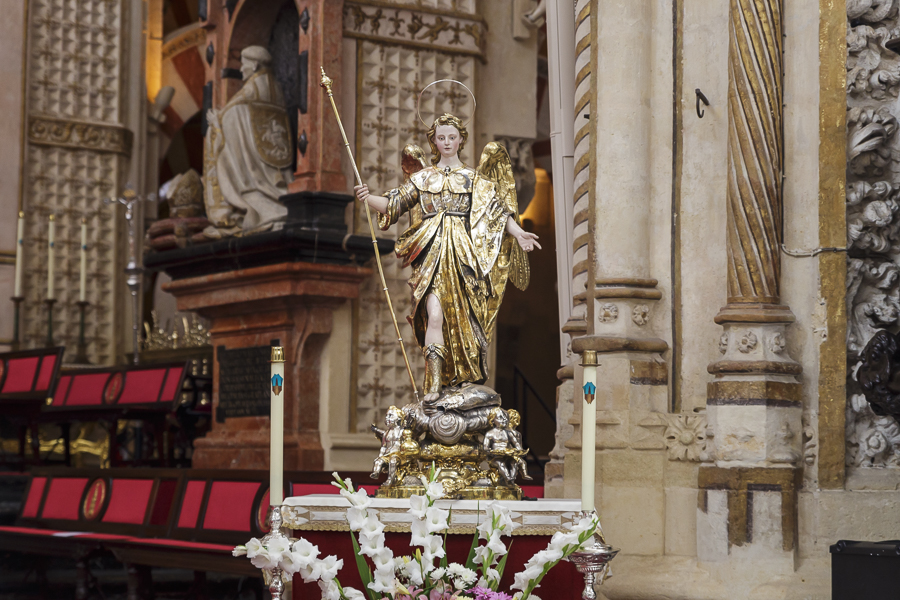
Córdoba will celebrate this Saturday, October 24, the feast of Saint Raphael, the archangel whom its inhabitants have venerated for centuries as the city’s guardian. It is one of the most deeply rooted religious devotions in the Andalusian capital, present in its churches, squares, streets, and monuments, and closely linked to the city’s history.
Unlike other places, where the celebration of the archangels Michael, Gabriel, and Raphael is held on September 29, Córdoba preserves October 24 as its own date dedicated to its guardian, in accordance with a tradition dating back several centuries.
A devotion linked to the epidemics that Córdoba suffered
The origin of Córdoba’s special veneration for Saint Raphael is related to the epidemics that affected the city and to a series of apparitions transmitted by local religious tradition.
One of the best-known episodes took place in 1578, when, according to tradition, the archangel appeared to the priest Andrés de Roelas and told him that God had designated him as protector of Córdoba.
The account preserves a phrase especially well known among the faithful: “I swear to you, by Jesus Christ Crucified, that I am Raphael, the angel whom God has placed as guardian of this city.”
This tradition became linked to the protection of Córdoba against the plague and gave rise to various expressions of popular piety.
The Diocese of Córdoba has recalled this year the story of the apparition and its connection with the Basilica of the Oath of Saint Raphael, built on the site associated with that event.
Since then, the figure of the archangel has occupied a singular place in the city’s religious identity, whose inhabitants have maintained the custom of invoking him as protector and guardian.
The triumphs of Saint Raphael, a hallmark of Córdoba
One of the most characteristic expressions of this devotion are the so-called triumphs of Saint Raphael, monuments erected in different parts of Córdoba in honor of the archangel.
These constructions, generally crowned by his image, began to spread during the Early Modern period and became symbols of gratitude and trust in his protection.
Among the best known is the Triumph of Saint Raphael located next to the Mosque-Cathedral, whose construction took place during the 18th century and which constitutes one of the most recognizable images of Córdoba’s religious heritage.
The historical research preserved by the Municipal Library of Córdoba documents the importance of these monuments and their relationship with the religious practices of generations of Cordobans.
The presence of the archangel also extends to the artistic heritage of the Cathedral, where paintings and sculptures related to his figure and the history of the local devotion are preserved.
The archangel who accompanied Tobias
The veneration of Saint Raphael is biblically grounded in the Book of Tobit, which presents the archangel as sent by God to accompany, protect, and heal.
In the story, Raphael guides the young Tobias during his journey, intervenes in the healing of his father’s blindness, and participates in the deliverance of Sarah from the affliction she suffered.
Upon finally revealing his identity, the archangel presents himself as one of the seven angels who stand before the glory of the Lord.
His name, of Hebrew origin, means “God heals,” and the Christian tradition has especially invoked him as protector of travelers and the sick.
These roles explain much of the devotion that the faithful have professed to him throughout history, especially in times of illness and calamity.
A celebration that preserves its traditional date
The Cordoban feast of October 24 maintains a liturgical particularity. In the Roman calendar prior to the reforms following the Second Vatican Council, Saint Raphael had his own celebration on this date.
Currently, the general Roman calendar unites the feast of the three archangels on September 29, although Córdoba preserves its local celebration in honor of the city’s guardian.
The feast continues to be part of Cordoban religious life and is traditionally celebrated with acts of worship in his honor, especially at the Basilica of the Oath, one of the main sites associated with this devotion.
The permanence of these celebrations, together with the triumphs, the religious images, and popular traditions, reflects the close relationship between the history of Córdoba and the veneration of Saint Raphael, a devotion passed down through generations that continues to occupy a prominent place in the city’s religious life.