


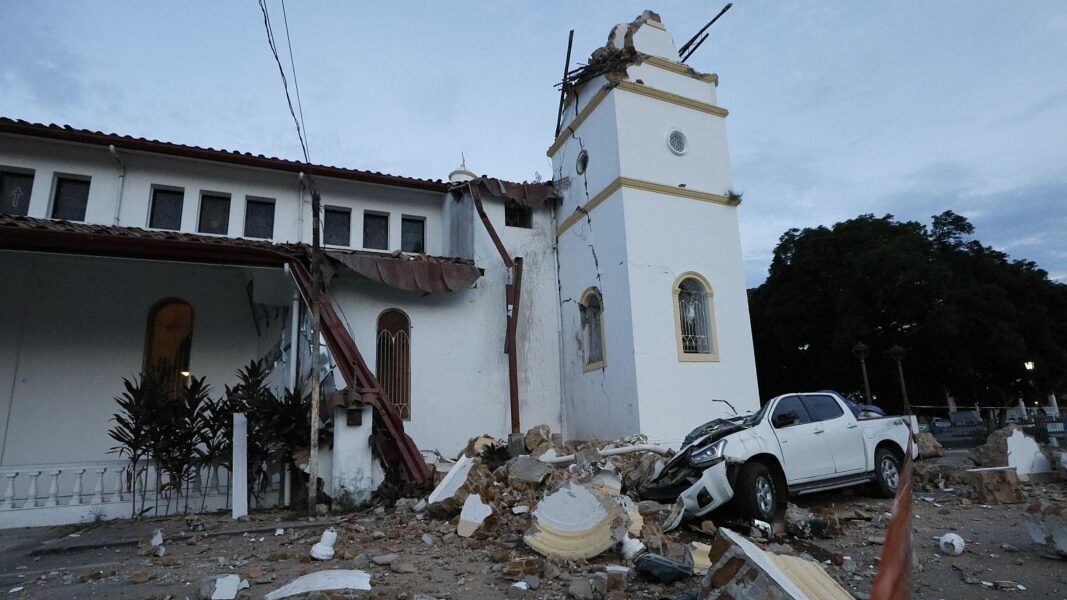
The 7.5-magnitude earthquake that struck Panama on October 9 has left 149 temples and religious spaces affected across various dioceses in the country, according to the preliminary report released on October 19 by the Panamanian Episcopal Conference (CEP). Among the most damaged buildings are two churches in the diocese of Santiago de Veraguas, classified as having “total damage,” and several cathedrals showing structural defects.
The quake occurred at 12:56 local time, with its epicenter northwest of Tonosí, in the province of Los Santos. Assessments carried out in the following days have significantly expanded the initial tally, which just one day after the earthquake counted only 13 affected religious buildings.
Two churches with total damage and severe defects in several cathedrals
According to the episcopal report covered by EWTN News, the most severe damage was recorded at the parish of San Isidro Labrador in Soná and at the minor basilica of Jesús Nazareno in Atalaya, both belonging to the diocese of Santiago de Veraguas. Both buildings are listed under the “total damage” category.
The cathedral of San Juan Bautista in Penonomé has also suffered significant damage. The upper section of its oldest tower partially collapsed, while the second tower shows tilting and severe damage to the dome and cross.
In the capital, the cathedral basilica of Santa María la Antigua shows considerable cracks and fissures, as well as damage to the sacristy dome. The report also warns of the apparent tilt of the bell located in the south tower, a situation that requires a specific technical evaluation.
Another affected church is San Atanasio in the province of Los Santos, which has lost the top level of its tower and shows cracks in its walls. In the diocese of David, the parish of Nuestra Señora de los Remedios reports sinkholes, fissures, and walls leaning outward.
Chitré concentrates the largest number of affected religious buildings
The diocese of Chitré accounts for 118 of the 149 damaged religious spaces, mainly rural chapels. It is followed by Penonomé with 13; the archdiocese of Panama and the diocese of Santiago de Veraguas with eight each; and David with two.
The damage has also forced changes in the pastoral activities of some communities. The church of the Santísimo Rosario in Chitré remains closed, and Eucharistic celebrations are being held outdoors while it is determined whether the building meets the necessary conditions to welcome the faithful again.
The Episcopal Conference has warned that its report is preliminary, as numerous buildings require specialized technical inspections to determine the actual extent of the damage and the necessary interventions.
The earthquake has also had serious consequences for the population. According to the report issued on October 19 by the National Civil Protection System (SINAPROC), one person has died, 27 have been injured, more than 9,000 homes have been damaged, and 3,827 people are staying in shelters.
Leo XIV expresses his closeness to the victims
The release of the report coincided with the ad limina apostolorum visit of the Panamanian bishops to Rome. On Friday, October 23, Leo XIV received the prelates and conveyed his solidarity with the communities affected by the earthquake.
According to Archbishop of Panama and president of the Episcopal Conference, José Domingo Ulloa, explained to Vatican News, the Pontiff asked the bishops to convey his prayers and closeness to those affected, especially those living in the hardest-hit regions.
The Pope also thanked the Panamanian people for their solidarity and the work carried out by social pastoral care and Caritas in accompanying families who have lost their homes or are in situations of particular vulnerability.
Ulloa described the meeting with Leo XIV as a “wonderful experience” and explained that the Holy Father encouraged the bishops to be bridge-builders through dialogue, to accompany the most in need, and to strengthen trust in God.
While assessments of the affected buildings continue, the Panamanian dioceses face the challenge of restoring numerous churches—some of great historical and religious value—and ensuring safe spaces for the celebration of Holy Mass and other parish activities.