


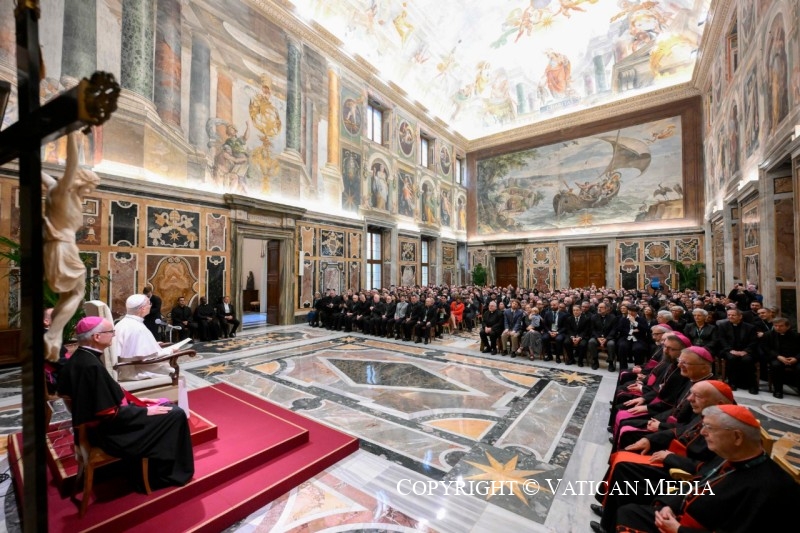
Pope Leo XIV recalled this Friday that Canon Law must be at the service of the supernatural good of the faithful and of the communion of the Church, and he insisted that ecclesial justice cannot be separated from truth and mercy. The Pontiff spoke these words during an audience in the Vatican Apostolic Palace with the participants in the International Congress organized on the occasion of the 150th anniversary of the Faculty of Canon Law of the Pontifical Gregorian University.
In his address, Leo XIV stressed that the study of Canon Law must not be limited to knowledge of the norms that regulate ecclesial life, but must form persons capable of understanding justice in the light of the legal tradition and the theological principles of the Church.
The Pope recalled the words of Saint John Paul II in the apostolic constitution Sacrae disciplinae leges, with which he promulgated the 1983 Code of Canon Law, to remind that the legal order of the Church has an essential function in safeguarding ecclesial communion. Likewise, he underlined that the teaching of this discipline must remain faithful to the Magisterium and at the service of the mission of the successor of Peter.
Audience with the participants in the International Congress on the occasion of the 150th anniversary of the Faculty of Canon Law of the Pontifical Gregorian University
In the name of the Father, and of the Son, and of the Holy Spirit.
Peace be with you.
Eminences, Excellencies, brothers and sisters:
I am very pleased to extend my greeting to all of you, Magnificent Rector, Father Dean, professors and lecturers, students and friends, who are taking part in the International Congress on the occasion of the 150th anniversary of the Faculty of Canon Law of the Pontifical Gregorian University.
On 16 August 1876, at the behest of Blessed Pius IX, the Congregation of Studies ordered the creation of your Faculty. It was the culmination of a long tradition of study and teaching of Canon Law that had accompanied the history of the Roman College and of the Society of Jesus. The date on which we celebrate the 150th anniversary represents, in fact, a fundamental stage in a history that began centuries ago, thanks to which the teaching of Canon Law had already developed its own scientific tradition, through the contribution of numerous figures of teachers who have brought prestige to the Faculty and have contributed significantly to the development of canonical science. They constitute a kind of unbroken thread that unites the generations and that still today transmits a valuable scientific and ecclesial heritage.
This Faculty, like the University of which it is a part, is an apostolic work of the Society of Jesus. It therefore shares in the spirituality that has its source in the Spiritual Exercises of Saint Ignatius of Loyola and which, among its characteristic features, includes what is summarized in the expression: Non multa, sed multum. That is to say, what matters is not to know many things, but to penetrate deeply into reality, to understand it and to interiorize it. Thus Saint Ignatius writes: “It is not much knowledge that fills and satisfies the soul, but the feeling and tasting of things inwardly” (cf. Spiritual Exercises, Annotations, 2, 4).
It is not surprising, therefore, that this spiritual approach finds correspondence in the way your Faculty conceives the teaching of the Law of the Church. The purpose, in fact, is, in addition to knowing the norms suitable for regulating ecclesial life, to form persons who have the ecclesial sense of what is iustum, acquired through careful study of the sources, of the canonical tradition and of the theological principles that illuminate the norm. This is possible when the study of Canon Law is carried out in the light of the mystery of the Church, as the Second Vatican Council set forth in the dogmatic constitution Lumen gentium.
If it is true, as Saint John Paul II wrote in the apostolic constitution Sacrae disciplinae leges (25 January 1983), with which he promulgated the Code of Canon Law for the Latin Church, that “it is impossible to translate perfectly into ‘canonical’ language the image of the Church,” nevertheless, Canon Law must reflect it. It performs an essential service in safeguarding ecclesial communion and, therefore, is “extremely necessary for the Church” and has as its purpose “to create such an order in the ecclesial society that, assigning primacy to love, grace and charism, may make […] its organic development easier.” Indeed, the good of the person and that of the ecclesial community cannot exist independently of each other.
For this reason, in the Programme of Studies of your Faculty it is stated: “The Law of the Church must always tend to the supernatural good of each of the faithful and to the building up of ecclesial communion.” I exhort you to act faithfully in accordance with this purpose, that is, for the supernatural good of persons, which is realized by seeking true justice, never separated in the Church from truth and mercy. Saint Augustine expresses it with a formula dear to the Christian tradition: “Ordinata dilectio est iustitia” (“Justice is ordered love”).
I would also like to emphasize a characteristic of your identity that is also found in the Statutes: the Faculty “recognizes its special role in the service of the Petrine mission. Therefore, in its teaching it is faithful to the Magisterium of the Church and gives priority to the service that its professors render to the Apostolic See.” I therefore invite you to offer your students a living experience of the universal Church, which finds in the Bishop of Rome the perpetual and visible principle and foundation of unity (cf. Lumen gentium, 23).
The students — clerics, consecrated persons and laity — who come from so many parts of the world to pursue their studies in Rome must be able to experience, also through university life, that the Church is a universal communion; and, once they return to their particular Churches, to carry with them this experience as a richness to be shared, placing it at the service of their communities.
Dear friends, after 150 years, your Faculty can look to the future trusting in God and also in the great heritage received. Thus, following in the footsteps of those who have preceded you, you will be able to continue to bear those fruits of doctrine, of science and of holiness of life that the Lord and the Church expect of you.
May the intercession of the Blessed Virgin Mary, Speculum iustitiae (Mirror of Justice), and my apostolic blessing accompany you on this journey.