


By Michael Pakaluk
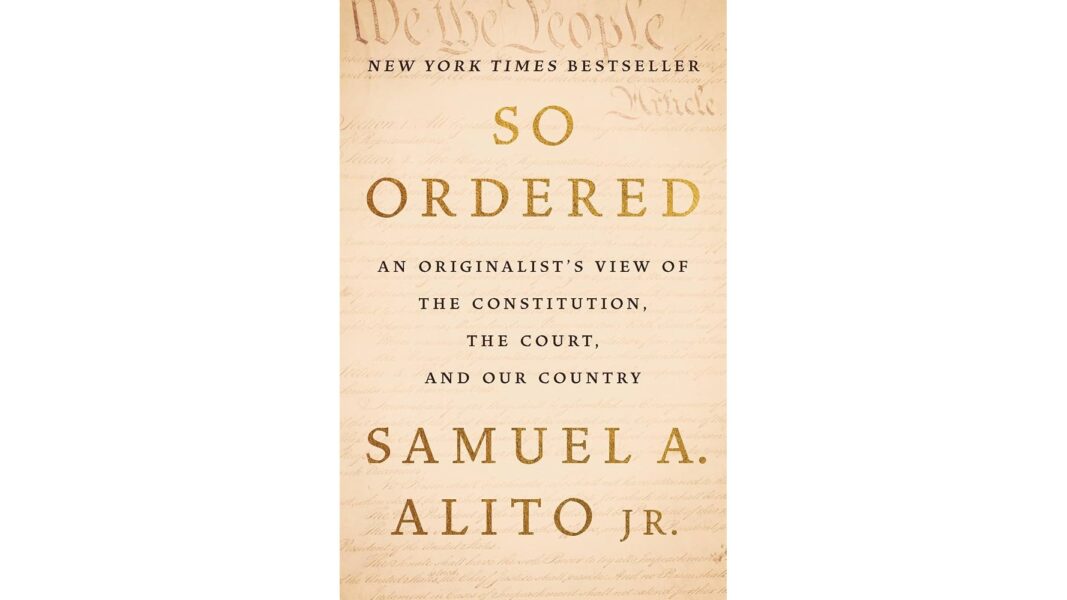
I read So Ordered: An Originalist’s View of the Constitution, the Court, and Our Country, by Supreme Court Justice Samuel Alito, backwards, chapter by chapter, and I would recommend that you do the same. The end of the book tells us about Samuel Alito, the magnanimous man and the patriot, while the beginning, undoubtedly more respectable from an academic point of view, dives headlong into the state of the debate on textualism and originalism, which are not to everyone’s taste.
The final chapter, “The True Counterculture,” is a speech delivered on the occasion of the fiftieth anniversary of the founding of Thomas Aquinas College, in Santa Paula, California. In this essay, as in almost all the others, Justice Alito’s exquisite historical sense is evident. I understand that a true originalist must be a true historian, since what the originalist proposes is to let Chesterton’s “democracy of the dead” exercise the authority it deserves.
Justice Alito refers to the 30,000 hippies who gathered in San Francisco for the 1967 Human Be-In, to the first Earth Day in 1970, and to student protests against Nixon’s bombing of Cambodia. None of these celebrated counter-movements from the era when the college was founded, he notes, has proved to be a lasting counterculture; instead, the college’s devotion to truth and to civilized disagreement remains countercultural, distinct, and vital.
What follows includes a chapter on the need for faith in a secular and materialistic age; another, “Four Men of the American Experience,” which interweaves the story of Theodore Roosevelt with that of the justice’s grandparents and the family of Clarence Thomas, in an attempt to define the properly American character; and a remarkable chapter on the “Achievements of Italian Americans.”
After recounting the terrible prejudices suffered by Italian immigrants, he asks whether we know, for example, that at least twenty-seven Italian Americans have received the Congressional Medal of Honor. Many have been great artists, such as Constantino Brumidi, the “Michelangelo of the United States Capitol,” the opera composer Gian Carlo Menotti, and the singer Frank Sinatra.
“In the realm of religion,” he says, “think of Mother Cabrini, the first American saint, who overcame enormous obstacles to aid suffering Italian immigrants. Think of Rita Antoinette Rizzo, better known as Mother Angelica, who founded EWTN.” And that is not all. “Is it possible to think of the history of baseball without Joe DiMaggio or Yogi Berra?” Indeed.
While reading the essays on the threats to the Constitution and the primacy of the right to religious freedom, I began to say to myself: “How have we come to deserve a high public official with such an extraordinary character? How is it even possible that this man has come to occupy a seat on the highest court? If we fail in this project, will we have anyone else to blame but ourselves?”
Throughout the book, the relentless workload of a Supreme Court justice today is conveyed. Writing about Learned Hand, Justice Alito longs for the times when a judge enjoyed the tranquility necessary to practice judging as a craft: “If Learned Hand’s drafting of opinions resembles the making of a custom garment, judges who sign fifty opinions a day are more like factory managers.”
Throughout this book, a striking humility about the role of the judge is also evident. Again and again, Justice Alito insists that he is not a philosopher. Addressing abstract questions in the way that might make a law professor famous has little to do with the practice of judging. Judges, he observes, are not trained to decide deep questions; most of their work is highly circumscribed and technical.
Certainly, one should not seek praise or fame through the work of judging; well done, it should attract little of either. A state supreme court justice and a low-ranking administrative judge differ in the scope and impact of their decisions, but the nature of the task is the same.
I confess that I am puzzled by the absence in the volume of any essay on the wound that Roe v. Wade inflicted on our country, or on the significance of the overturning of Roe in Dobbs, all the more so since he speaks many times of Obergefell. I suspect the matter is too painful for him, given how much he has been persecuted for the sake of justice. Yet what lessons can we draw from Roe, that sad abandonment of sound practical reason, about originalism and judicial review?
In “The Globalization of Judicial Review,” Alito comments: “If natural rights were a fiction and judges decided cases according to their personal opinions, how could judicial review of laws enacted by the people’s representatives be justified in a democracy?”
Originalism, as he understands it, is designed to reduce the grounds for invalidation to those John Marshall would have recognized: a clear conflict between a law and the Constitution. Alito thinks that is enough. But originalism, as a theory of what the Constitution did not intend or was not meant to do, is purely negative.

Why not understand, then, that originalism requires incorporating the Founders’ vision of providence and the divine endowment of rights as set forth in the Declaration? On questions of fundamental principle, what they thought, and not what we think, should be decisive, unless we amend the Constitution accordingly. These background beliefs provide the context for attributing the correct public meaning to the language of the Bill of Rights and the Fourteenth Amendment.
If we adopt this approach with respect to the unborn child, we arrive at a position like the one John Finnis defended so sharply in his First Things essay “Abortion Is Unconstitutional,” or the one Hadley Arkes has defended tirelessly.
Justice Alito shows himself open to that approach in what may be, for many readers of this column, the most fascinating essay in the book, “Originalism, Constitutionalism, and the Catholic Tradition.” “[It] is an important argument that deserves serious consideration… But, right or wrong, it is an originalist argument… What is advocated… is a corrected understanding of the doctrine [of originalism].” And there the status quaestionis may rest: so ordered.
About the Author
Michael Pakaluk, a specialist in Aristotle and an ordinary academician of the Pontifical Academy of St. Thomas Aquinas, is Professor of Political Economy at the Busch School of Business of The Catholic University of America, a distinguished senior fellow of the Gibbons Institute, and editor of the American Catholic Quarterly Review. He lives in Hyattsville, Maryland, with his wife, Catherine, also a professor at the Busch School, and their children. His most recent book, on natural law and civic friendship, Walk in the Good Way, will be published soon by The Catholic University of America Press. You can follow him on Substack at Michael Pakaluk.