


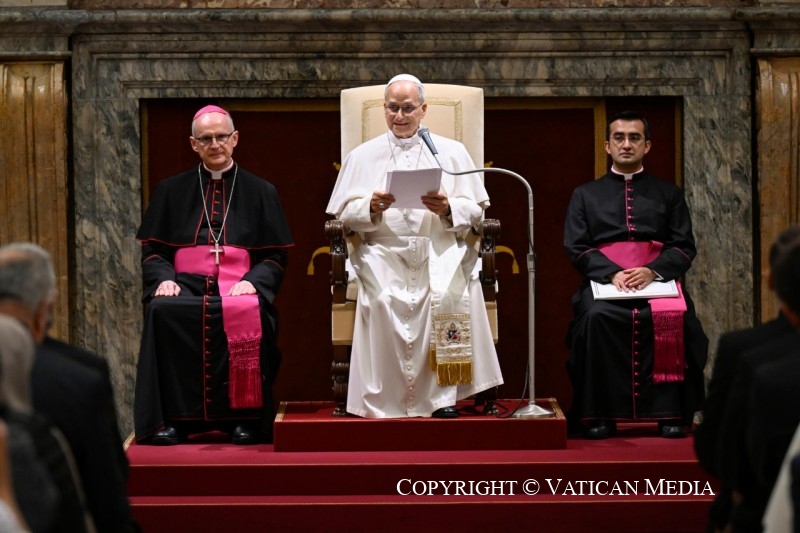
Pope Leo XIV has highlighted the importance of historical rigor in the processes of canonization, recalling that the holiness of those proposed for the altars must be supported by testimonies that are “authentic, credible, and above all suspicion.” The Pontiff has insisted on the need to carefully examine the documentation of each cause and to place the life of the candidates in their historical context, without subjecting the understanding of holiness to the changing criteria of each era.
This is what he stated this Wednesday, October 21, during an audience in the Vatican Apostolic Palace with the participants in the congress “Holiness in History”, organized by the Dicastery for the Causes of Saints. In his address, Leo XIV recalled the decision of Pius XI to introduce the historical-critical method in the examination of causes and underlined that canonization transcends historical circumstances, for through it the Successor of Peter presents to the whole Church models of Christian life valid for every age.
ADDRESS OF THE HOLY FATHER LEO XIV TO THE PARTICIPANTS IN THE CONGRESS “HOLINESS IN HISTORY” ORGANIZED BY THE DICASTERY FOR THE CAUSES OF SAINTS
In the name of the Father, and of the Son, and of the Holy Spirit.
Peace be with you.
It is beautiful to see so much enthusiasm for the saints of today, and thank you!
Eminences, Excellencies, dear brothers and sisters:
I am pleased to meet you on the concluding day of your Congress “Holiness in History,” organized by the Dicastery for the Causes of Saints. I greet and thank your superiors, members, consultants, officials, relators of the Congress, and all those who, in various ways, work on the causes of the saints.
The theme chosen for these days of study seeks to deepen the relationship between holiness and history, offering the opportunity to dwell on various aspects. The first concerns canonized holiness, which must be proven through testimonies that are authentic, credible, and above all suspicion. To this end, the work of the Historical Commission at the diocesan level and that of the relators and consultants of the Dicastery for the so-called “ancient causes” play an essential role.
It was precisely a historian of recognized prestige such as Pope Pius XI who established the Historical Section in the then Sacred Congregation of Rites, opening the causes of the saints to the specific use of the historical-critical method. Nor can the examination of “recent causes” dispense with a serious and rigorous verification of all the material collected. The causes of the saints employ the instruments proper to the study of history, although their purpose is not to produce historiography, but to bring to light the exemplarity, spirituality, and reputation of holiness of the candidates for the altars.
A second aspect is how historical and cultural evolution influences, at its various stages, the very concept of holiness. With the passage of time, the profile of the saints may also undergo certain developments: not to follow the stereotypes of the moment, but to interpret concrete experience through the categories of the lived Gospel. That is why it is very important to situate the testimony of a saint in the context in which he or she lived. The people of God seek models for living the present, intercessors who help the members of the Church to face current challenges and to recognize their opportunities. However, it must not be forgotten that the solemn act of canonization transcends historical circumstances. Indeed, through it, the Successor of Peter not only approves, but points out to the whole Church credible witnesses of the Gospel, capable of speaking to all ages.
Finally, it is necessary to consider how the presence and witness of the saints have transformed history. Enlightened by grace, they knew how to listen to the calls of their time, combining faith and history and giving their lives to build the new reality of the Kingdom of God. The history of the world without saints would be immensely poorer, that is, less human.
Dear friends, the witness of the saints, deeply rooted in the concrete reality of their time, reminds us of the innovative and transformative power of the Paschal Mystery. They show us a history shaped by faith. I thank you because, through your work, you help to highlight this wonderful reality. I entrust you to the protection of the Virgin Mary, Queen of Saints, and from my heart I impart the Apostolic Blessing. Thank you.