


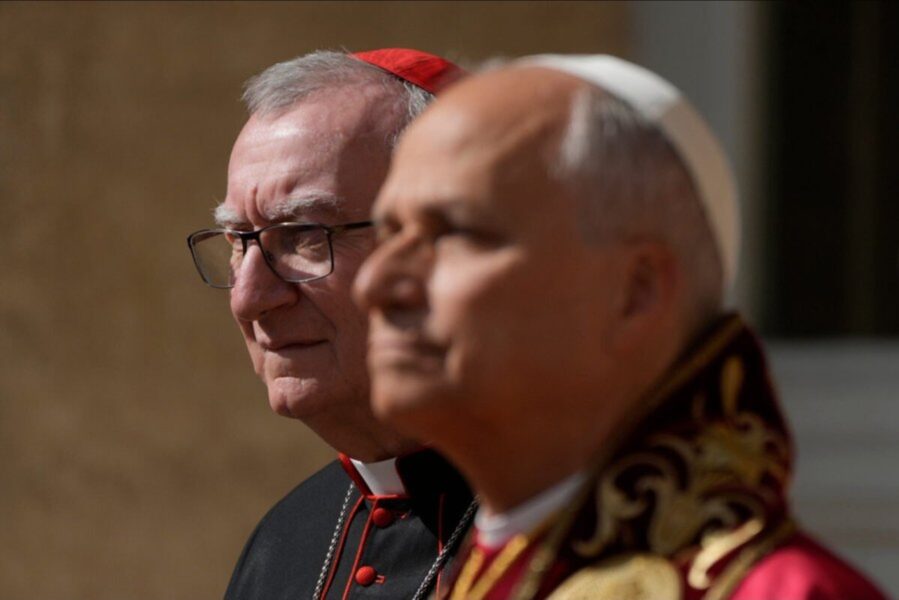
Cardinal Pietro Parolin admitted on Thursday that he remains “concerned” about the health of Leo XIV and uttered a phrase that in Rome has not gone unnoticed: depending on how his recovery progresses, the Pope “will adjust his pontificate, if it needs to be adjusted.”
The Secretary of State visited the Pontiff at the Gemelli Polyclinic, where he has been hospitalized since Tuesday after undergoing surgery for a pulmonary nodule. “Yes, I found him well,” he told reporters on his way out, adding that what the Pope told him “corresponds exactly to what the official statements have said.” Hours later, on the sidelines of an event at the Iraqi embassy in Rome, his tone was considerably more somber: “I am still concerned, because I deeply regret what has happened. I trust the information we have been given, the bulletins, and that is why I also hope this situation can be resolved as soon as possible.”
“No forecasts of any kind can be made”
Asked about the immediate future of the pontificate, the cardinal replied: “It has only been two days since the Pope was hospitalized; no forecasts of any kind can be made. We have to see when he returns and what the doctors say. And, depending on all these factors, the Pope will also adjust his pontificate, if it needs to be adjusted.”
It is hard to understand why the Holy See’s most seasoned diplomat, a master of the art of saying nothing, chose precisely that verb. In the same sentence in which he asks that no forecasts be made, he raises the possibility of a curtailed pontificate, and he does so with a vagueness that invites any number of interpretations, from a lighter schedule to scenarios no one in the Vatican would want to see in print. If the intention was to reassure, the result has been the opposite: the phrase has circled the globe within hours and has fueled precisely the speculation that Parolin himself claimed he wanted to avoid.
Nor did he commit himself regarding the Angelus on Sunday. If the Pope improves before the weekend, he believes he could lead it from the Gemelli, though he quickly corrected himself: “It will depend a bit on how the convalescence evolves. These are all my own assumptions.” Regarding the trip to Uruguay, Argentina and Peru, scheduled for November 6–17, he recalled that the initial decision was to keep it, but left the door open: “It is a long and demanding journey; it will depend on the doctors.”
What the bulletins do not say
Thursday’s medical bulletin is reassuring in the short term: normal tests, good recovery of the operated lung, physiotherapy with full motor activity, and a postoperative course that “is progressing normally.” The Pope has concelebrated Mass, has resumed part of his work, and, barring complications, will return to the Apostolic Palace between Tuesday and Wednesday of next week.
However, three days after the operation, no communiqué has specified the stage of the adenocarcinoma or whether the lymph nodes removed during surgery were free of disease. These are precisely the two pieces of information that determine the prognosis and the need for subsequent treatments. That silence, combined with the concern the Secretary of State did not bother to conceal, forces consideration of somewhat worse scenarios than those initially conveyed, when everything seemed to amount to a nodule detected in time and removed without further ado.
None of this justifies alarmism. Even in those less favorable scenarios, a successfully operated pulmonary adenocarcinoma in a seventy-one-year-old patient, with good recovery and independent living from day one, is a medically manageable situation. But the Holy See would do well to release that information as soon as possible, because each day of silence weighs more than any ill-chosen verb.