


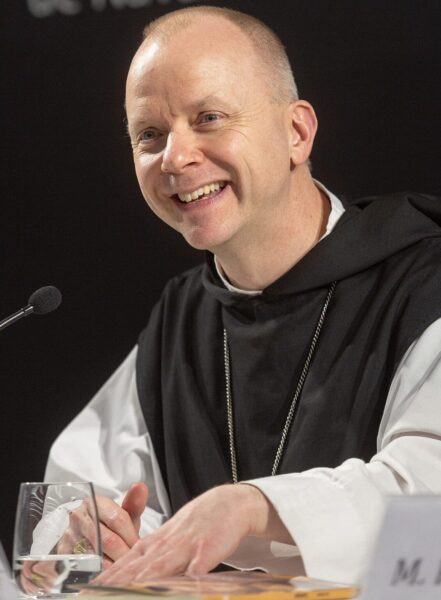
The Bishop Prelate of Trondheim, Erik Varden, asserts that Norway is experiencing a Catholic «springtime» and that the Church, long marginalized, must now assume «its role at the heart of society.» He makes this claim in an interview with Aleteia, as the number of registered Catholics in the country has more than tripled since 2009.
Varden is a Cistercian monk of the Strict Observance and has led the Prelature of Trondheim since 2019. He speaks of «many graces and many challenges» and warns that this springtime «also brings many responsibilities.» «We truly see grace at work. Many people are seeking truth, communion, and true life with diligence, seriousness, and sincerity,» he states.
In his view, Catholicism remained for a long time a very marginal part of society and only modestly returned to Norway in the nineteenth century, but today it is «no longer so marginal.» «It must now assume its role at the heart of society to help shape it, guide it, and sustain it,» he maintains.
A growth that triples the figures
The data supports this diagnosis. Religion Watch, a publication of the Institute for Studies of Religion at Baylor University, summarized in January a report by Pierre Jova in the French weekly La Vie. According to the article, registered Catholics rose from around 46,000 in 2009 to 168,000 in 2025, about 3% of the population. The real figure could be between 250,000 and 300,000, since many immigrants do not register. This would make Catholicism the second-largest religion in the country, behind the Lutheran Church (62%) and ahead of Islam (3.5%).
Immigration is the main driver of this growth, but not the only one. The report notes that some practicing Lutherans have been drawn to the doctrinal stability, liturgy, and historical tradition of Catholicism. Among recent converts are men aged 15 to 35, many with no prior religious formation, who discovered the faith through North American voices on YouTube such as Jordan Peterson or Bishop Robert Barron.
The backdrop is one of the most secularized societies in Europe: according to a 2020 survey cited in the article, 48% of Norwegians do not believe in God. Varden told La Vie that in Norway «there is hardly anything left to secularize.» He described it as an enormous cultural and religious loss, but also an opportunity to proclaim the Gospel «for the first time,» because the population has forgotten what it entails.
Catholics from 130 countries
The bishop recalls that the Norwegian Catholic community is made up mostly of immigrants. «In Trondheim we have Catholics from 130 different countries,» he explains. This diversity, he adds, helps avoid treating national identity as something absolute or imagining a «specifically Norwegian» form of Catholicism that should serve as the norm. Instead, he invites people to live it «in the original, etymological sense of the word: as a universal communion.»
From awakening through music to the Roman Curia
In the interview, Varden also reviews his personal journey. He was born in 1974 into a nominally Christian family and drifted away from the faith in adolescence, until at the age of 14 or 15 he experienced an inner awakening. A «strange illumination» through music gave him certainty of a presence «with a name,» and that search led him to the Bible, to Christ, and to the Church. He became Catholic in 1993 and entered the English Trappist abbey of Mount Saint Bernard in 2002, which he later led as abbot.
In February, the Norwegian bishop preached the Lenten spiritual exercises to Leo XIV and the Roman Curia in the Pauline Chapel, under the theme «Illuminated by a hidden glory.» These meditations have been published in French as Illuminés d’une gloire cachée (Artège). At the same time, Introduction à la vie cachée (Fayard) has been released, a conversation with Nicolas Diat based on Benedict XVI’s address at the Collège des Bernardins in 2008. Varden argues in the interview that public action requires «a foundation of reflection and interior rootedness,» so that words express something true and are not mere verbiage.