


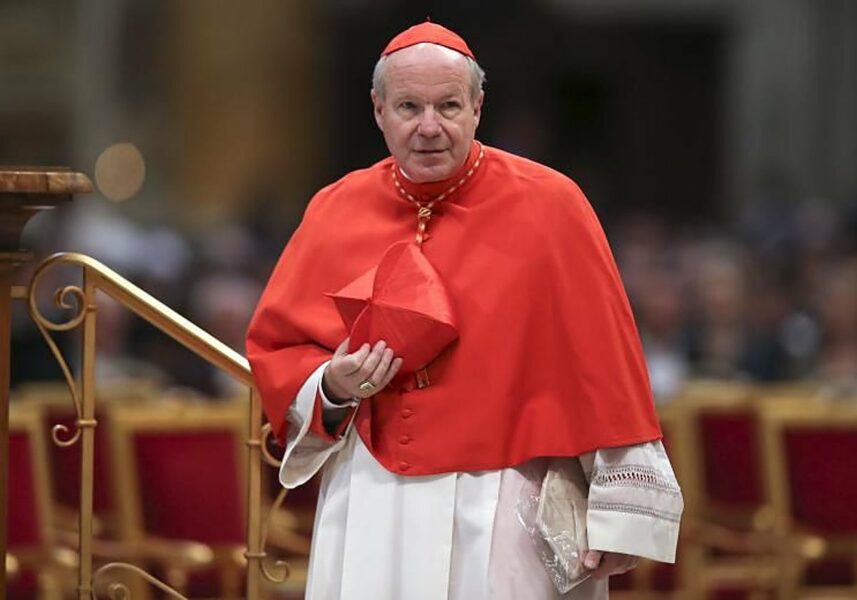
Cardinal Christoph Schönborn has issued a new warning about the direction of the German Synodal Way. The archbishop emeritus of Vienna believes the reform process has become trapped in a series of «dead ends» due to insufficient attention to the guidance Pope Francis gave to the German Church in 2019. The cardinal particularly questions the reliance on structural reforms as a solution to the ecclesial crisis and recalls that the true renewal of the Church does not come from reorganizing its institutions, but from lived faith and the sacraments.
In an interview granted to the German Catholic weekly Die Tagespost, published on October 8, Schönborn specifically referred to the situation of the Synodal Way, whose promoters have for years been advocating changes on issues such as sexual morality, the priesthood, and the Church’s governance structures.
«If Pope Francis’s letter to the Church in Germany had become the guiding principle of the Synodal Way, we would not be in the dead ends in which it currently finds itself,» the cardinal stated. Nevertheless, he added that «it is still not too late» to correct course.
The warnings from Francis that Germany set aside
Schönborn’s words refer to the letter Francis addressed to German Catholics on June 29, 2019, when the Synodal Way was beginning to take shape.
In that document, the Pontiff acknowledged the gravity of the crisis facing the Church in Germany, but warned of the danger of seeking answers solely through organizational changes or adaptations to the demands of contemporary society.
Francis insisted that evangelization must be at the center of the process and recalled that no institutional reform could replace the action of the Holy Spirit or the need for conversion.
Seven years later, the German Synodal Way continues to be marked by tensions with Rome. Its proposals regarding the blessing of same-sex couples, priestly celibacy, sexual morality, and lay participation in ecclesial governance have provoked repeated warnings from the Holy See.
This is compounded by the project to establish a permanent Synodal Conference, conceived as a body for joint participation of bishops and laity, whose configuration has raised objections due to its possible implications for episcopal authority.
«Believing that structural reforms produce renewal is an illusion»
Schönborn, who played a decisive role in the elaboration of the Catechism of the Catholic Church, questioned the idea that transforming structures can by itself solve the Church’s problems.
«Believing that renewal can be achieved solely through structural reforms is an illusion,» he stated.
The cardinal recalled that the history of the Church is marked by periods of crisis, but also by movements of renewal that did not primarily arise from administrative reforms.
«It has been the great saints, as well as the unknown ones, who have brought renewal in every century,» he noted. And he added that there has never been a century in which there was not both decadence and renewal.
His conclusion was clear: «True strength comes from lived faith, from the sacraments.»
The cardinal’s reflection points to one of the central issues in the German ecclesial debate: whether the crisis of faith and the decline in religious practice can be addressed through new structures of participation and disciplinary modifications, or whether priority should be given to evangelization, conversion, and sacramental life.
Schönborn does not deny the need for reforms, but rejects that these can replace what constitutes the foundation of the Church. His warning takes on special importance at a time when the German episcopate continues to seek a formula to give institutional continuity to the Synodal Way.
The cardinal, who left the governance of the Archdiocese of Vienna in 2025 after three decades, does not consider the future of the German process closed. However, his statements leave a warning that is difficult to ignore: without an authentic renewal of faith, no structural reform will be enough to pull the Church out of its crisis.