


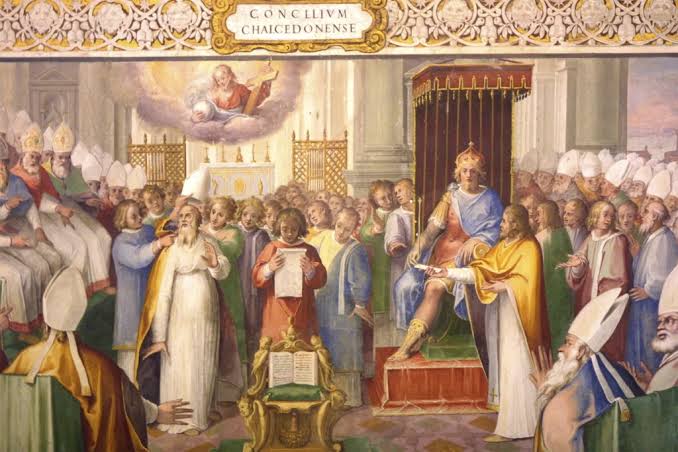
On October 8, 451, hundreds of bishops gathered in the basilica of Saint Euphemia in Chalcedon, opposite Constantinople. In the midst of the assembly the book of the Gospels was solemnly placed. Thus began the fourth ecumenical Council of the Church and one of the great doctrinal battles of Christian Antiquity: it was necessary to confess with precision who Jesus Christ is.
Exactly 1,575 years have passed since that day, yet the question that occupied the conciliar Fathers does not belong solely to the theological controversies of the fifth century. The Catholic understanding of the Incarnation, the Passion, and ultimately the Redemption depends on its answer. The Christ who was born of the Virgin, suffered under Pontius Pilate, died on the Cross, and rose again is true God and true man; one single Person, that of the eternal Son of God, in two natures, divine and human.
Chalcedon formulated this faith with a precision that would span the centuries. Decisive for reaching that definition was the intervention of a Pope who was not even physically present at the council: Saint Leo the Great. When his teaching on the Incarnation was read before the bishops, the assembly responded with an acclamation that has remained inscribed in the history of the Church: “Peter has spoken through the mouth of Leo.” Benedict XVI expressly recalled this episode when presenting Saint Leo as theologian, pastor, and defender of the Roman primacy.
The problem was not a matter of words
To understand why the Church needed to convene a council, one must return to the christological disputes that had marked the preceding decades. Nicaea in 325 had confessed the true divinity of the Son against Arianism, and Ephesus in 431 had defended the unity of Christ’s Person, legitimately recognizing the Virgin Mary as Theotokos, Mother of God.
Yet the defense of one truth could lead to the opposite error if pushed to an extreme. This happened with Eutyches, an influential archimandrite of Constantinople who, in his opposition to Nestorianism, ended up obscuring the true humanity of Christ. His way of explaining the union between divinity and humanity led him to maintain a single nature after the Incarnation. The Lord’s humanity thus ceased to be preserved intact in the union with the Word.
The question might have seemed reserved for theologians, but it touched the very heart of the faith. If Christ does not possess a true humanity like ours, then his birth, his suffering, and his death are not fully real either. The doctrine concerning Christ is inseparably linked to the doctrine concerning our salvation.
Pius XII explained this with particular clarity in 1951, when he commemorated the fifteenth centenary of Chalcedon through the encyclical Sempiternus Rex Christus. Recalling Eutyches’ error, he pointed out that its consequences ultimately rendered the mystery of the Incarnation empty, for the very reality of the human nature the Son of God had assumed in order to save us was compromised.
Saint Leo enters the controversy
Eutyches was condemned in Constantinople by a synod presided over by Saint Flavian, bishop of the city. The controversy, however, was far from over. Emperor Theodosius II convened a new meeting in Ephesus in 449 under the presidency of Dioscorus of Alexandria, protector of Eutyches and adversary of Flavian.
Saint Leo sent his legates and forwarded an extensive doctrinal letter intended for Flavian. This is the text history would come to know as the Tome to Flavian, one of the great christological expositions of the ancient Church.
The letter was meant to help resolve the controversy, but at that meeting in Ephesus its reading was not permitted. The assembly was marked by pressure and violence; Flavian was deposed and died shortly afterward. Leo himself rejected what had taken place and branded that meeting with a name that would accompany it forever: the “Robber Council of Ephesus.”
The death of Theodosius II and the accession of Marcian and Pulcheria changed the situation. Finally a new council was convoked, first to meet in Nicaea and ultimately transferred to Chalcedon. There, on October 8, 451, the assembly began.
The Gospels in the midst of the council
The scene with which Chalcedon opened well expresses what was at stake. The Fathers gathered in the basilica of Saint Euphemia, and in their midst the book of the Gospels was placed. It was not a matter of inventing a new doctrine about Jesus Christ, but of safeguarding and expressing without ambiguity the faith received from the Apostles.
Saint Leo’s legates occupied a principal place in the assembly. The Pope remained in Rome, but his teaching would reach Chalcedon through the document that had not been allowed to be read freely two years earlier in Ephesus.
When the Tome to Flavian was read and examined, the Fathers recognized in it the same faith transmitted by the Apostles and professed by the great Fathers of the Church. Then came the celebrated acclamation:
“This is the faith of the Fathers, this is the faith of the Apostles. All of us believe thus; the orthodox believe thus.”
And next: “Peter has spoken through the mouth of Leo.” The conciliar acts preserve the acclamation within a longer series in which the bishops also affirm Leo’s agreement with Saint Cyril of Alexandria and with the faith received.
Benedict XVI, recalling the episode in 2008, saw in those words the recognition of the responsibility Saint Leo exercised as successor of Peter. The Pope had intervened from Rome in a controversy that had arisen mainly in the East, and his teaching was received in Chalcedon as an expression of the apostolic faith.
True God and true man
The Tome to Flavian expressed the reality of the Incarnation with extraordinary clarity. Against those who might divide Christ and against those who ended up confusing his humanity and his divinity, Leo maintained both truths: Jesus Christ is one, and in him the divine nature and the human nature remain intact.
A formula of the Pope admirably summed up the mystery: “One and the same is truly the Son of God and truly the Son of man.”
The eternal Word did not cease to be God when he assumed our nature, nor was the humanity he received from the Virgin absorbed or annulled by his divinity. The same one who is eternally Son of the Father was truly born of Mary according to the flesh; the same Son of God suffered and died, not in his divinity, which is impassible and immortal, but in the human nature he had truly made his own.
For this reason Leo could teach that, in the unity of a single Person, each nature preserves what is proper to it. Pius XII would later summarize this doctrine by recalling the Leonine formula according to which “humility” was assumed by “majesty,” “weakness” by “strength,” and “mortality” by “eternity.”
It was not a matter of resolving a philosophical subtlety. The very reality of Christmas and of Calvary was being protected. The Child of Bethlehem is truly God; the man who hungers, weeps at the tomb of Lazarus, and bleeds on the Cross is truly man. And it is always the same Jesus Christ.
The four words of Chalcedon
The council ended by expressing this faith through a definition that would become one of the pillars of Catholic christology. Following the holy Fathers, it confessed “one and the same Son and Lord Jesus Christ,” perfect in divinity and perfect in humanity, true God and true man, consubstantial with the Father according to divinity and consubstantial with us according to humanity.
To protect the mystery from any distortion, Chalcedon added four expressions that have spanned the centuries. The two natures of Christ must be recognized “without confusion, without change, without division, without separation.”
Each word closed the path to an erroneous way of understanding the Lord. His humanity and his divinity are not mingled so as to produce a third reality; neither is transformed into the other; nor is Christ divided into two persons, nor can what God has united in the single Person of the Word be separated.
The difference between the natures remains, the Fathers taught, yet both concur in “one single person and subsistence.” The formulation of Chalcedon thus became a firm point of the Church’s faith concerning the hypostatic union: the divine and human natures are united in the single personal subject who is the Word of God.
A definition from 1,575 years ago that we continue to profess
Historical distance may make the controversies of Chalcedon seem like discussions belonging to another world. Nevertheless, the faith defended then is present every time a Catholic confesses the Creed, contemplates a crucifix, or kneels before the Blessed Sacrament.
If Jesus Christ were not truly God, he could not save us as the eternal Son sent by the Father. If he were not truly man, he would not have truly assumed our condition nor offered in our nature the sacrifice of the Cross. Catholic faith refuses to sacrifice either of these two truths.
For this reason Benedict XVI could present Chalcedon as the secure culmination of the christological development of Nicaea, Constantinople, and Ephesus. He also recalled that Saint Gregory the Great already compared those first four ecumenical councils to the four Gospels, because upon them, he said, the edifice of faith rises as upon a square stone.
1,575 years ago, the bishops gathered in Chalcedon had to find words sufficiently precise to safeguard a mystery that no human formula can exhaust. At the center of that task was the confession the Church had received from the beginning and that Saint Leo the Great knew how to express with extraordinary clarity: Jesus Christ is true God and true man, one and the same.
When the Fathers heard the Pope’s teaching, they recognized in it the faith they were to safeguard and transmit. Hence that acclamation that still today sums up one of the most memorable moments of Chalcedon:
“Peter has spoken through the mouth of Leo.”