


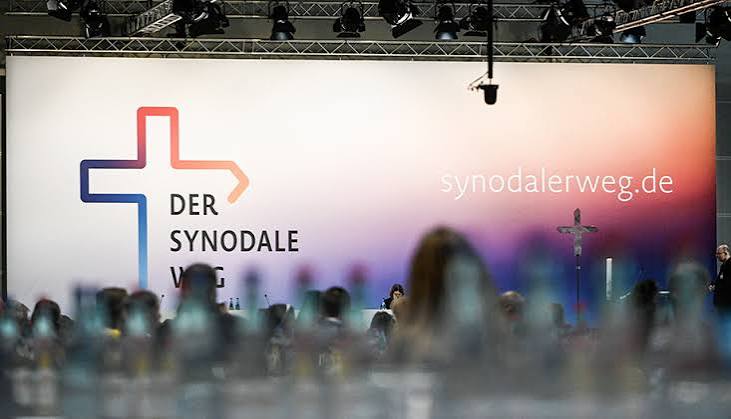
Two German auxiliary bishops have acknowledged that the direction the Church is taking in their country raises doubts among prelates from other parts of the world. During the recent course for new bishops held in Rome, Joshy Pottackal, auxiliary of Mainz, was even asked by other participants whether what is happening in Germany “is still Catholic.” Martin Marahrens, auxiliary of Hildesheim, heard another equally direct question: “What are you Germans really doing?”
Both prelates reject the idea that the German episcopate intends to break with Rome and attribute part of that perception to false information or to a simplified image of the debates taking place in the Church in their country. Their own testimonies, however, show the extent to which the controversies surrounding the Synodal Way have crossed German borders and raised questions among members of the episcopate in other countries.
The two bishops shared their experiences in interviews given to katholisch.de after taking part in Rome in the course for recently appointed prelates.
“Is all this still Catholic?”
Joshy Pottackal, auxiliary bishop of Mainz, acknowledged that the German Synodal Way is viewed “critically” from other countries, although he maintains that “many fake news” are also circulating about Germany.
During his stay in Rome, that perception came up directly in his conversations with other bishops.
“Since I come from Germany and at the same time have another background, many feel free to ask me whether, for example, we are not participating in international synodality and whether all this is still Catholic,” he explained.
Pottackal says he usually responds by asking where that information comes from and reaffirming that the German Church is part of the universal Church.
“I say that, of course, we are part of the Catholic Church,” he noted.
The auxiliary of Mainz also defended the idea that the vitality of the German Church cannot be measured solely by Mass attendance figures and tried to explain to his interlocutors some of the particularities of Catholicism in the country.
“What are you Germans really doing?”
Martin Marahrens, auxiliary bishop and diocesan administrator of Hildesheim, recounted a similar experience. The 49-year-old prelate explained that during the course he was able to speak with bishops from numerous countries and with officials of the Curia. In general terms, he described an atmosphere of communion and recalled that one of the North American participants summarized the impression of the meeting by saying that everyone was “on one bus,” heading in the same direction and “in line with Pope Leo XIV.”
But when Germany came up in the conversation, the questions changed in tone.
“It was a recurring topic. The question often came up: ‘What are you Germans really doing?’” he acknowledged.
Marahrens explained that he had to insist “again and again” that “no German bishop plans to proclaim a new Reformation or in any way separate from the Pope.”
According to the auxiliary of Hildesheim, that impression is far from marginal.
“This prejudice is really very widespread,” he stated.
Marahrens attributes that perception to the way some German debates are reduced to headlines or presented outside the country, creating the impression that “the Germans are going their own way.”
For that reason, during his conversations in Rome he repeated that “no German bishop wants to follow a separate path.” One of the North American prelates responded after hearing his explanations: “Oh, it’s very good to hear that.”
The background of the Synodal Way
Since its launch in 2019, the Synodal Way has promoted changes on issues such as sexual morality, blessings for same-sex couples, lay participation in Church governance, the priestly ministry, and the role of women.
One of the main points of conflict has been the intention to continue the process through a permanent structure of shared governance between bishops and laity.
Rome has warned on several occasions that neither the Synodal Way, nor the German Bishops’ Conference, nor a diocesan bishop can create bodies that limit or condition the governing authority that belongs to the bishops.
From that process emerged the project of a Synodal Conference, whose statutes still require the approval of the Holy See.
Read also: Germany postpones the first Synodal Conference due to lack of Vatican approval
Disagreements have also extended to other areas. When Rome closed the door to laity regularly preaching during Mass, those responsible for the German process called for keeping the discussion open.
The statements by Pottackal and Marahrens now offer a different perspective on that controversy. This time it is not a formal warning from Rome, but the questions that other bishops are asking the German prelates directly when they meet them.
One had to clarify that Germany is not preparing “a new Reformation” or seeking to separate from the Pope. The other was asked, bluntly, whether what is happening in his Church “is still Catholic.”
But reducing those doubts to fake news, simplified headlines, or prejudices does not seem sufficient either. Reservations about the direction of the German Church have not arisen solely from external perceptions, but from concrete decisions, proposals, and conflicts accumulated over the years: from attempts to institutionalize structures of shared governance between bishops and laity to repeated frictions with Rome on issues of discipline, morality, and ecclesial authority.
That is why the questions that Pottackal and Marahrens heard in Rome cannot be understood solely as the result of a distorted image of Germany. They are also the consequence of a process that has repeatedly forced the Holy See to intervene to recall the doctrinal and canonical limits within which a particular Church may act.