


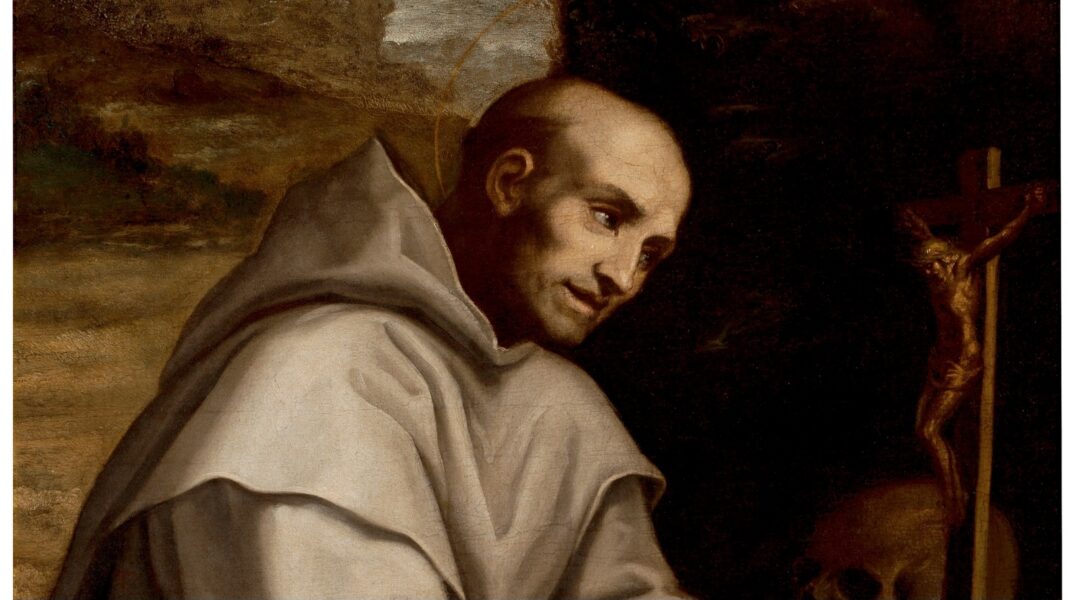
There are religious orders whose history can be told through great founders, reforms, universities, missions, and apostolic works. That of the Carthusians unfolds differently. For nearly a thousand years, generation after generation, their monks have sought to disappear from the world’s gaze in order to remain alone with God.
Their history begins with Saint Bruno of Cologne, whose memory the Church celebrates each October 6. In 1084, Bruno and six companions arrived at a remote, mountainous place in the French Alps, near Grenoble. There, in the Chartreuse massif, a form of monastic life was born that still retains something of that first withdrawal into the desert.
Centuries have passed. Kingdoms and dynasties have vanished; Europe has known wars, revolutions, and transformations that Saint Bruno could scarcely have imagined. The Charterhouse, however, continues.
An ancient expression linked to the Order seems to sum up that vocation better than any treatise:
«Stat crux dum volvitur orbis»
(The Cross remains while the world turns)
Saint Bruno and the desire for solitude
Bruno was born in Cologne around 1030 and received a solid intellectual formation. He studied in Reims and became master of one of the most prestigious schools of his time. Among his disciples was the future Pope Urban II.
His path toward the eremitic life was not, therefore, that of a man unable to find a place in the world. Bruno knew well the ecclesiastical life of his era and had reached a position from which he could expect greater honors. Precisely for that reason, his renunciation is all the more eloquent.
What he sought was something else.
After various vicissitudes, Bruno and his first companions reached Hugh, Bishop of Grenoble, who provided them with a secluded place in the mountains. There they built small individual dwellings around a church and began a life that combined two ancient traditions of Christian monasticism: the solitude of the hermit and the common life of the cenobite.
The Grande Chartreuse was born.
Bruno did not leave behind a monastic rule comparable to that of Saint Benedict. The way of life he had begun took shape gradually and would be set down in writing decades later by Guigo, the fifth prior of the Charterhouse. Those customs eventually became the foundation of one of the most distinctive contemplative traditions in the Latin Church.
A community of solitaries
The peculiarity of the Charterhouse lies precisely in that apparent contradiction: the Carthusians live together in order to live in solitude.
The monastery is organized so that a large part of the monk’s day is spent in his own cell. Yet calling that space a “cell” can be misleading. Traditionally, it is a small dwelling with the necessary places for prayer, study, and work, accompanied by a small garden.
There the monk spends long hours without human company.
He prays, works, studies, eats, and sleeps in silence. The community gathers for certain moments of the liturgy and for some occasions of fellowship provided by the Carthusian observance itself, but afterward each one returns again to his solitude.
It is not an improvised isolation nor an individualistic search for tranquility. The entire architecture of the Charterhouse is conceived to safeguard a life oriented toward contemplation.
Silence is not an end in itself. Silence is kept in order to listen.
The Carthusian night
One of the moments that best expresses this vocation occurs while much of the world sleeps.
In the middle of the night, the monks leave their cells and make their way to the church for a long celebration of the Divine Office. The darkness, the chant, the psalms, and the readings form part of a tradition rooted in the ancient monastic vigils.
Afterward they return to their cells.
The day continues to be marked by the liturgical hours, personal prayer, the reading of Sacred Scripture and the Fathers, manual work, and the celebration of Mass.
There is no haste to fill every moment with activity. Nor is the day measured by the usual standards of productivity. Time belongs to God, and the monastery bells continually remind those within toward whom everything is ordered.
Austerity also reaches the table. The Carthusian tradition excludes meat and preserves fasts and abstinences that may seem extraordinary to contemporary eyes, yet they form part of an understanding of monastic life in which body and soul together participate in the search for God.
The desert within the Church
The desire to withdraw from the world did not begin with Saint Bruno.
From the earliest centuries of Christianity, men and women left cities and possessions to go into the desert. The names of Saint Anthony the Abbot, Saint Paul the Hermit, and the ancient Desert Fathers belong to that long spiritual lineage.
The Carthusian continues, in his own way, that intuition.
He does not flee because he considers creation evil or because the Church leaves him indifferent. He withdraws precisely within the Church and for the Church.
The contemplative life has always had this dimension that is difficult to measure. The monk may never preach before a crowd, administer a parish, or travel on a mission. His apostolate is carried out principally in prayer, in penance, and in a life offered to God.
From the outside it may seem that nothing is happening.
For the Christian, however, the fruitfulness of a life is not reduced to what can be counted.
An order without great reforms
For centuries an expression has been attributed to the Charterhouse: Cartusia numquam reformata quia numquam deformata, “the Charterhouse was never reformed because it was never deformed.”
Taken literally, the phrase simplifies a much more complex history. The Carthusians, too, have endured wars, suppressions, expulsions, the loss of monasteries, and the inevitable difficulties of every human institution. Yet the saying expresses something true about the extraordinary continuity of their way of life.
The Order did not need periodically to become something different in order to justify its existence.
Its reason for being remained where it had been from the beginning: the search for God in solitude.
That stability is especially striking when viewed from an age fascinated by novelty. The Carthusians have not survived because they learned to follow every cultural change, but because their vocation never depended on them.
When Bruno left his own Charterhouse
The founder’s life also contains a paradox.
Saint Bruno did not spend the rest of his days in the solitude he had sought in the Alps. His former disciple, now Pope Urban II, summoned him to Rome to keep him close as an advisor.
Bruno obeyed.
For one who had desired withdrawal, the papal court represented a sacrifice different from those he had chosen in Chartreuse. Eventually he obtained permission to return to the contemplative life, though not to his first foundation. He settled in Calabria, where another community was born and where he died in 1101.
His story thus reminds us that Carthusian solitude was never independence from the Church. Bruno even left the place he loved when obedience asked it of him.
Contemplation had not separated him from the Church; it had placed him more deeply at her service.
While the world turns
Few institutions allow one to contemplate so clearly the contrast between the passage of time and the permanence of a vocation.
From 1084 to the present day, the world surrounding the Carthusian monasteries has changed almost completely. Medieval roads became highways; the printing press, industry, electricity, the automobile, radio, television, and the internet appeared. News began to travel the planet in seconds, and silence became, even materially, an increasingly difficult good to find.
Inside a Charterhouse, however, a man continues to enter his cell to pray.
He continues to rise at night to sing the psalms.
He continues to work with his hands.
He continues to learn to be silent.
Not because time has stopped behind the monastery walls, but because what the Carthusian seeks does not belong to any age.
Perhaps that is why those words still seem written for them:
«Stat crux dum volvitur orbis»
(The Cross remains while the world turns)