


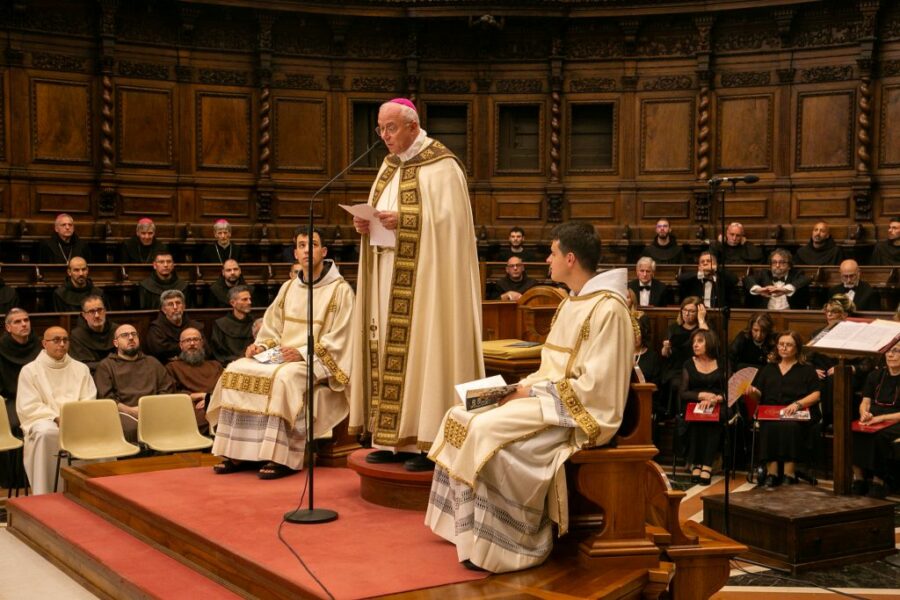
The Archbishop of Cagliari and Secretary General of the Italian Episcopal Conference, Giuseppe Baturi, presided on October 3 at the Basilica of Santa Maria degli Angeli in Assisi over the first Vespers of the solemn commemoration of the Transitus of Saint Francis, celebrated this year on the occasion of the VIII centenary of the saint’s death.
In his homily, Baturi reflected on the way Saint Francis faced his final moments and maintained that the witness of the saints can help us understand the Christian meaning of death and, with it, of life itself.
«Welcome, Sister Death»
The Secretary General of the CEI recalled that Saint Francis, upon realizing his last hour was approaching, did not flee from death but went out to meet it with joy, even calling it «sister».
«Welcome, Sister Death», Baturi recalled, quoting the account of Thomas of Celano.
The Archbishop linked this attitude to Francis’s identification with the crucified Christ. From the beginning of his vocation, he explained, the saint kept the Lord’s Passion ever present and understood his path as a progressive conformation to Christ.
In his final moments, Francis asked to be laid naked upon the earth, a gesture that Baturi connected with the poverty that had marked his entire life and with his desire to resemble the crucified Christ.
From this episode, the Archbishop also referred to the way contemporary society faces death.
«We live in a culture that eliminates death, hides it, or anticipates and “manages” it as a problem to be solved», he stated.
In contrast, he noted that Saint Francis offers another way of confronting death: looking at it without denying or fleeing from it, and doing so from the relationship with the crucified Christ.
Baturi added that, in the face of suffering, the Church is called to offer presence and accompaniment, remaining beside those who suffer «without looking away and without being in a hurry to close the matter».
«Life is a gift»
The Archbishop also highlighted that Saint Francis’s final moments were marked by praise.
As he recalled, the saint spent his last days singing and urging his brothers and all creation to praise God.
Baturi interpreted this attitude as an expression of gratitude for the life received and emphasized that this same outlook leads to a special care for the most fragile life.
«Whoever sings knows that life is a gift and that a gift is guarded from its beginning to its last breath», he affirmed.
The Secretary General of the CEI added that, in a society that tends to measure things by their usefulness, the experience of Saint Francis reminds us that «no life lacks value, not even the one that is fading away».
Francis died announcing paradise
Another aspect highlighted by Baturi was hope in eternal life.
The Archbishop recalled the expression attributed to Saint Francis: «I want to send you all to paradise», and explained that the saint faced his final moments with his hope placed in God.
«Announcing paradise today does not mean escaping from history, but inhabiting it with a hope that makes it more human», he noted.
According to Baturi, this hope is also translated into attention to the poor, the sick, and those in situations of greater fragility.
«No one should die alone»
Baturi also dwelt on the fact that Saint Francis died accompanied by his brothers.
The saint, according to the accounts cited during the homily, gathered the friars who were with him, blessed them, and exhorted them to persevere in the love of God and in fidelity to the vocation they had received.
The Archbishop summarized this scene in three concepts: proximity, guardianship, and care.
«No one should die alone and no one should be left alone bearing the weight of someone who is dying», he affirmed.
Baturi noted that this accompaniment concerns both parish communities and families, as well as those who work in hospices or care at home for elderly or sick relatives.
The Archbishop concluded his homily by recalling one of the last phrases attributed to Saint Francis: «I have done my part; may Christ teach you yours».
In Baturi’s view, these words summarize a legacy that remains valid eight centuries later: allowing faith in Christ to transform «living and dying, loving, working, and suffering».